COVID-19 really does erase memory
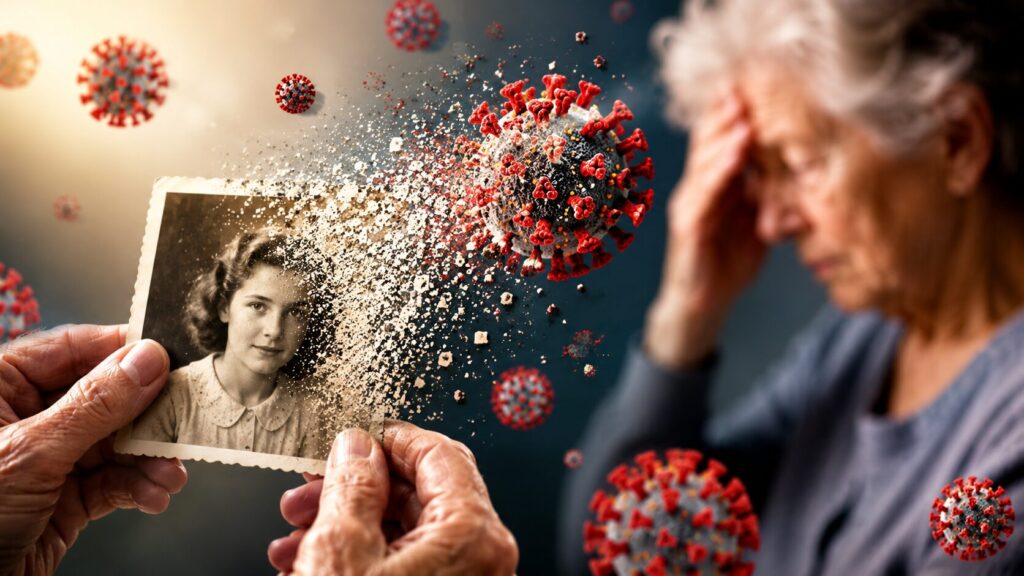
After recovering from COVID-19, a young woman discovered she could no longer recognize people by their faces — including her own father. Faces became “like water in her head” — details simply wouldn’t stick in her memory. This case was described in the scientific journal Cortex, and it shows just how precisely the virus can strike the brain.
How Memory Suffers After COVID-19
The subject of this case is a 28-year-old woman who worked as a freelance portrait artist. She used to be able to check a reference photo once every 15–30 minutes and keep the facial features in her mind. But after contracting the coronavirus infection, this became impossible: the image of a person simply wouldn’t stick in her memory.
The problems weren’t limited to faces alone. The woman found it difficult to navigate her usual supermarket and locate her car in a parking lot. In November 2020, she began experiencing balance problems and frequent migraines.
What she encountered is called prosopagnosia — a medical term for the inability to recognize faces, or, more simply, face blindness. The person sees a face, understands it is a face, but cannot connect it to a specific individual.
Problems With Remembering Faces Due to COVID-19
To understand how serious the impairment was, doctors conducted several face memory tests. The woman was asked either to memorize the faces of strangers or to recognize celebrities. She performed significantly worse than ten women of similar age in the control group.
The most interesting part — in other cognitive tests, she showed normal results, on par with the comparison group. This means it wasn’t memory in general that was affected, but specifically memory for faces.
They also separately tested so-called face perception — the ability to understand that what you’re looking at is actually a face. She had no problems with this. It turns out the brain recognized a face as an object but couldn’t memorize and identify its owner. The report’s authors concluded that the deficit was specifically related to face memory, not face perception.
Why Face Blindness Is a Rare Consequence of COVID-19
It is known that SARS-CoV-2 can cause a wide variety of neurological effects, and long COVID has long been linked to problems in the nervous system. But face blindness specifically is extremely rare.
The case authors surveyed more than 50 people with long COVID to check whether they had similar signs. Many did indeed show a general decline in visual recognition and spatial orientation. But a specific problem with faces was not found in the group.
With prosopagnosia, a person sees a face but cannot connect it to a specific acquaintance
This is an important caveat. A single described case does not prove that COVID causes face blindness on a mass scale. The authors only suggest that the infection may have triggered the impairment — either during the acute phase of the illness or afterward. The exact mechanism by which the virus led to a disruption in face processing remains unclear.
Which Infections Have Already Been Linked to Face Blindness
Prosopagnosia is not unique to the coronavirus. It has been linked to various infections before, although such cases are uncommon. Among the known “culprits”:
- bacterial meningitis — inflammation of the brain’s membranes;
- Whipple’s disease, caused by the bacterium Tropheryma whipplei;
- stroke in the right hemisphere of the brain — a long-known cause of loss of the ability to recognize faces.
Incidentally, there was a second described case of face blindness after COVID-19. However, in that case the patient also suffered a stroke in the right hemisphere, which is itself a classic cause of prosopagnosia. The 28-year-old woman had no stroke — and that is precisely why her story particularly puzzled doctors.
Can Acquired Face Blindness Be Cured
No specific course of treatment was described in the report, and overall there are few effective methods against face blindness so far. If there is a clear cause — for example, a tumor in the brain area responsible for face processing — then eliminating that cause may restore the ability to recognize people.
If the condition proves to be persistent, the person is helped to adapt. There are several approaches:
- perceptual training — exercises that improve the ability to notice and memorize facial features;
- relying on other cues — voice, manner of speech, gait;
- using social context — for example, expecting to see a specific person in a particular place.
For a portrait artist whose work depended on the ability to read and memorize faces, such an impairment is especially painful. But it was precisely this profession that helped her quickly notice the problem — an ordinary person might have attributed the difficulties to fatigue or stress.
This case is valuable not as a sensation, but as a reminder: the virus can strike not “the brain in general” but a very narrow function, leaving everything else virtually untouched. Understanding such pinpoint disruptions helps us figure out how exactly the brain stores and recognizes faces — and why this process is so easily disrupted. Observing such rare cases is important so that over time we can understand how often infections interfere with the nervous system’s functioning.