6 popular foods created by accident — and you didn’t know about it
Some of the most famous foods in the world didn’t come about as a result of brilliant planning, but thanks to chance, forgetfulness, or even revenge. A glass of lemonade forgotten in the cold, potatoes sliced too thin, a barrel of forgotten sauce — all of these turned into foods without which it’s hard to imagine modern cuisine. History has plenty of examples where accidental discoveries changed the familiar world. Here are six stories about how mistakes and improvisation gave us what everyone now loves and happily eats.
Chocolate Chip Cookies — A Chocolate Mishap
In the 1930s, American chef Ruth Graves Wakefield was making her signature cookies at the Toll House Inn in Massachusetts. At some point, she discovered she had run out of baking chocolate, which usually dissolves completely into the dough. Instead, Ruth broke a bar of Nestlé chocolate into pieces and added them to the dough, expecting them to melt and evenly color the cookies.
But the pieces didn’t melt. Instead of a uniform chocolate dough, the result was cookies with soft pockets of melted chocolate inside — the very chocolate chip cookie that is sold all over the world today. A simple substitution of one ingredient accidentally gave birth to one of the most popular desserts in history.
Popsicles — An Accidental Invention by an 11-Year-Old Boy
In 1905, 11-year-old Frank Epperson from San Francisco mixed water with soda powder, stirred it with a wooden stick — and, as often happens with children, got distracted and forgot the glass outside. The temperature dropped overnight, and by morning the drink had frozen solid, stick and all.

Popsicle on a stick — an invention we owe to a child’s forgetfulness
Frank tried the frozen mixture and realized he had stumbled onto something worthwhile. He named his invention “Epsicle” and started selling it to neighborhood kids. As an adult, Epperson patented the product, and the name eventually turned into Popsicle — that’s what his own children called it, saying “Pop’s sicle” — “Dad’s icicle.” Today, the popsicle is one of the most widely sold frozen desserts in the world (with the side effect of brain freeze), and it’s all thanks to one cup forgotten in the cold.
Potato Chips — An Irritated Chef’s Response
In 1853, at a restaurant in Saratoga Springs, New York, one of the diners was unhappy with the French fries he was served — they seemed too thick and soft. The dish was sent back to the kitchen, where chef George Crum resolved the matter radically: he sliced the potatoes as thin as possible, fried them in hot oil until crispy, and generously salted them.
The result — ultra-thin crispy slices that became known as “Saratoga Chips” — was an instant hit at the restaurant. From there, the story unfolded predictably: the dish spread beyond a single kitchen and eventually became one of the best-selling snacks on the planet. True, today scientists are increasingly studying how chips affect the brain, but it all started because a chef wanted to respond to a picky customer.
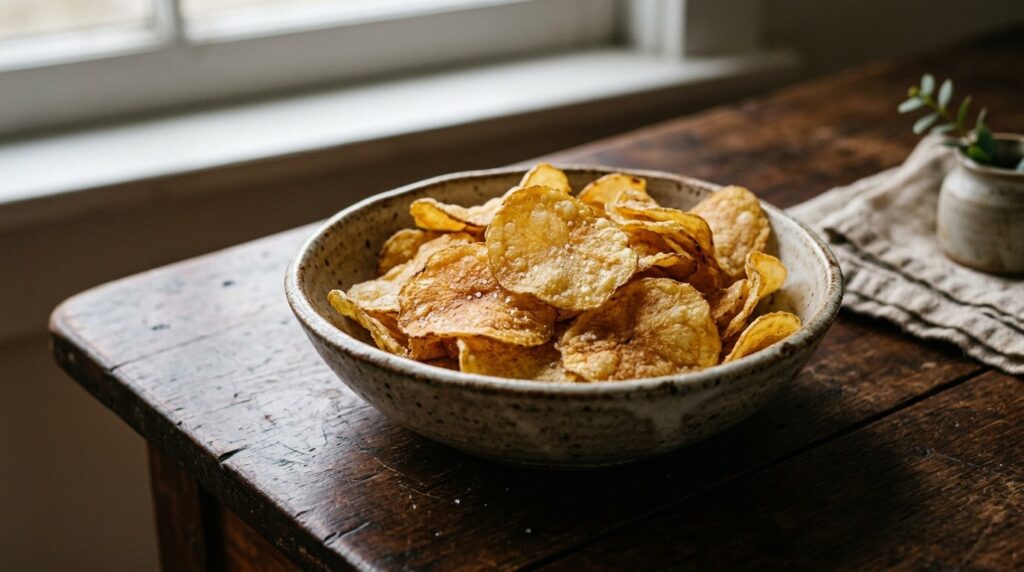
Potato chips emerged as a bold response to a picky restaurant patron
The Waffle Cone for Ice Cream — Improvisation at a Fair
Before the early 20th century, ice cream was served in cups and on plates. The edible cone, which today seems like an obvious solution, appeared, according to one of the most well-known versions, at the World’s Fair in St. Louis in 1904.
Syrian immigrant Ernest Hamwi was selling zalabiya — thin waffle-like pastries — at the fair. Next to him, another vendor was selling ice cream. Seeing waffles and ice cream side by side, Hamwi came up with the idea to roll his pastry into a cone and place a scoop of ice cream on top. The improvisation was an instant hit with visitors.
In 1910, Hamwi founded the Missouri Cone Company to produce cones on an industrial scale. Even if the idea of an edible cone existed before the fair, it was the St. Louis exhibition that made it mainstream and familiar — just as we know it today.

The waffle cone for ice cream became a hit at the 1904 World’s Fair
Worcestershire Sauce — A Forgotten Barrel That Aged for Two Years
Worcestershire sauce, whose name few people can pronounce correctly on the first try, also owes its existence to a happy accident. According to one version, Lord Sandys, having returned to England after serving in Bengal, wanted to recreate a beloved Indian sauce. He turned to chemists John Lea and William Perrins from Worcestershire.
They prepared a large batch, but the result was terrible — the mixture gave off a pungent fishy smell and was completely unfit to eat. Disappointed, the chemists hid the barrel in the cellar and forgot about it. Two years later, in 1837, they accidentally discovered the forgotten sauce. During that time it had fermented, mellowed, and developed an entirely new, complex flavor. Lea and Perrins began selling it, and the sauce quickly became a worldwide bestseller — it’s still used to this day in Bloody Mary cocktails, Caesar salad dressing, and dozens of other dishes around the world.
Nashville Hot Chicken — A Dish Born from Revenge
If chocolate chip cookies came about due to a lack of ingredients, Nashville Hot Chicken owes its existence to jealousy. According to legend, a Nashville resident named Thornton Prince had a girlfriend who decided to teach him a lesson for his late-night escapades. Her plan for revenge was simple and culinary: she prepared fried chicken, generously coating it with hot pepper, hoping the dish would be inedible.
The plan backfired spectacularly. Prince loved the taste so much that he kept the recipe, started serving it to friends, and eventually opened his own restaurant. Today, Prince’s Hot Chicken Shack is still in operation, and hot chicken has become Nashville’s culinary calling card alongside country music.
All these stories share one common thought: sometimes the best culinary inventions are born not from recipes and calculations, but from mistakes that turned out to be tastier than the original plan. A forgotten glass, a spiteful joke, a barrel of failed sauce — each of these accidents turned into a product known to millions of people. Which of these foods surprises you the most: chips born from spite or a sauce from a forgotten barrel?