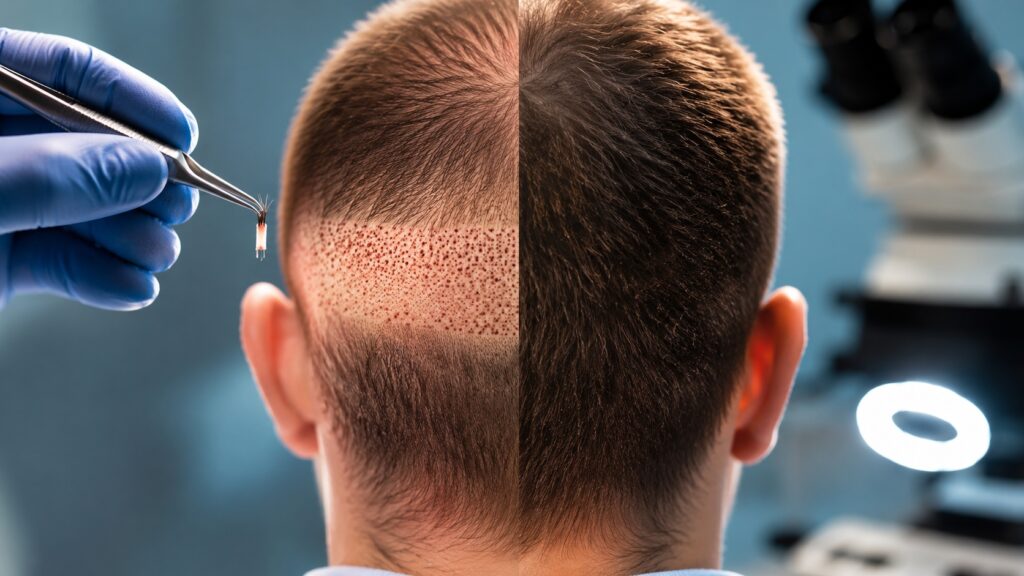
Surgeons pay special attention to choosing the donor hair site
Hair transplant surgery is actually very simple in essence. The surgeon carefully takes hair follicles from areas where hair grows thickly and transplants them to areas where hair is lacking. The follicles don’t come from nowhere — the doctor extracts them from a donor zone. Which body areas are best suited for this, how many hairs can be taken at once, and why is it impossible to transplant someone else’s hair?
What Is the Donor Zone in Hair Transplantation
The donor zone is the area of the body from which the surgeon extracts hair follicles for transplantation into the balding area. The hair there must be healthy, sufficiently dense, and, most importantly, resistant to hair loss.
Each extracted fragment of skin with follicles is called a graft. A graft in hair transplantation is a microscopic piece of tissue approximately 0.5–1 mm in diameter, containing one to four hairs. These grafts are transplanted one by one into the balding area, forming a new hairline.
It’s important to understand that hair taken from the donor zone will no longer grow back in its original location. That’s why the doctor calculates in advance how many grafts can be extracted without visible thinning.
Why Hair for Transplants Is Often Taken from the Back of the Head
The main source of hair for transplantation is the occipital area. This is because in most people experiencing male-pattern hair loss, balding starts at the forehead and crown, while the back of the head remains untouched throughout their entire life.
The reason lies in biochemistry. Balding is caused by the hormone dihydrotestosterone (DHT), a derivative of testosterone. It penetrates hair follicles, causing them to shrink and eventually stop functioning. But follicles on the back of the head are genetically insensitive to DHT, which is why even men with pronounced balding retain hair on the back and sides of their head.
This resistance is preserved even after transplantation because the follicle “remembers” its origin. If moved to the crown, it will continue to grow as if it were still on the back of the head. This is exactly what makes occipital hair the ideal donor material.
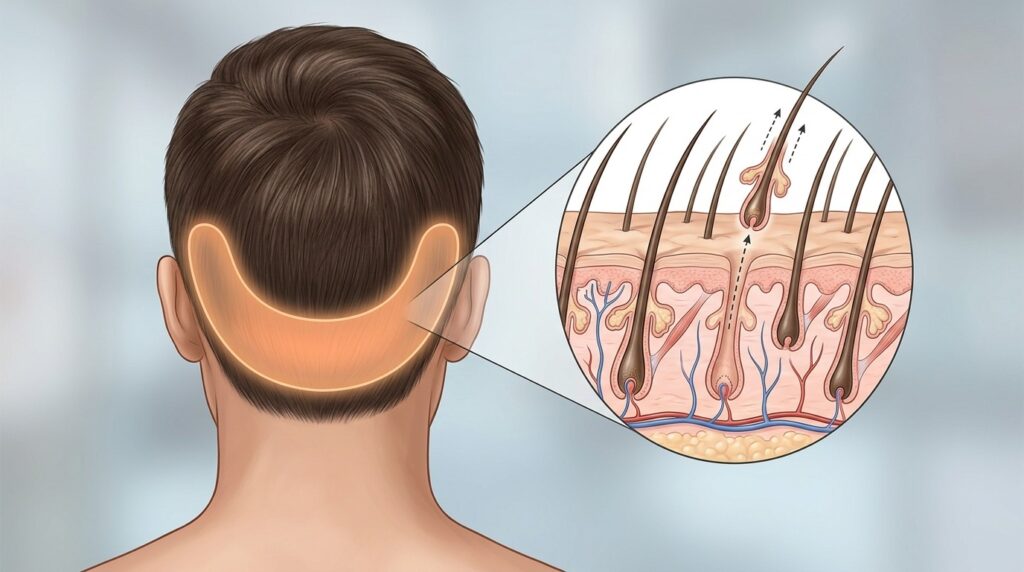
The occipital area is the main donor zone in hair transplantation
The sides of the head, such as the temples, are also used as donor areas but less frequently. The hair there is similar in structure and color to the rest, but doctors try not to take too much from there to avoid affecting the overall appearance of the hairstyle.
Can You Transplant Hair from the Beard, Chest, and Back
Sometimes the back and sides of the head aren’t enough. This happens with advanced balding, when the donor zone has already been depleted by previous surgeries, or when the patient needs a very large number of grafts. In these cases, the doctor may consider hair from other parts of the body.
The beard is the most popular alternative source of donor hair. Hair on the chin and neck is quite dense and, like occipital hair, is minimally susceptible to hormone-related hair loss. It is often used to add density in the transplant area. However, beard hair may differ in appearance from scalp hair, so the surgeon combines it with occipital hair to ensure the result looks natural.
Hair from the chest and back for transplantation is used in extreme cases and on small areas. It has a different growth cycle and different thickness, so its capabilities are limited. This is more of a supplementary resource than a primary one.
How Many Grafts Can Be Taken in One Procedure
The number of grafts depends on the individual characteristics of the patient: hair density in the donor zone, the size of the occipital area, and the condition of the skin. Typically, from the occipital area in one procedure, 3,000 to 5,000 grafts can be safely extracted.
Over a lifetime, the safe limit is approximately 5,000–7,000 grafts without noticeable thinning of the donor zone. With proper planning, this is enough for one or two full transplant procedures. If the limit is exceeded, the back of the head will start looking bad, with bald patches and even scars appearing.
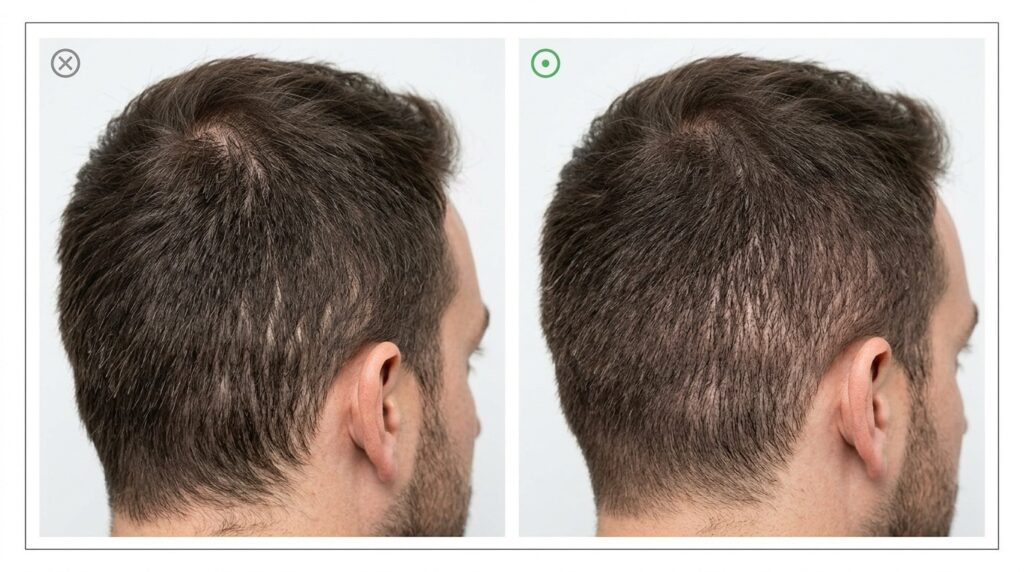
Proper graft extraction preserves the natural density of the donor zone
This is exactly why a good surgeon never promises “maximum grafts in one session.” They plan a strategy considering possible repeat surgeries in the future, especially if the patient is young and balding may progress.
How the Donor Zone Heals After Hair Extraction
The speed of recovery depends on the hair transplant method. Today, the most common method is FUE (Follicular Unit Extraction). This is a scarless technology where each graft is extracted individually using a micro-instrument 0.6–0.9 mm in diameter. After this extraction, tiny dot-like wounds remain on the skin, which heal within a few weeks.
The alternative is the FUT method (strip method), where a thin strip of skin is cut from the back of the head and the wound is then sutured with a cosmetic stitch. The scar after FUT is usually hidden under the hair, but it may be visible with a short haircut.
The FUE method is more delicate in this regard because the marks are virtually invisible even with short hair.
In the first days after the procedure, the donor area looks irritated, and this is normal. Complete healing takes from several weeks to a couple of months. In some cases, shock hair loss is observed — a temporary phenomenon after which the hair begins to grow again.
Why Someone Else’s Hair Is Not Suitable for Transplantation
One of the most common questions: can you transplant another person’s hair? The answer is no.
The immune system perceives foreign follicles as a foreign body and rejects them. This is the same principle by which rejection works in organ transplantation.
And can artificial hair be transplanted? Also no. It doesn’t grow, often causes inflammation, and over time requires replacement. No reliable hair transplant method involves the use of artificial materials — only the patient’s own living follicles.
In conclusion, hair transplantation always involves working with the resources the patient already has. The back of the head remains the main source of hair follicles, while the beard and other body areas serve as backup options. The condition of the donor zone determines how dense and natural the result will be. That’s why a thorough assessment of this resource before surgery is no less important a step than the transplant itself.