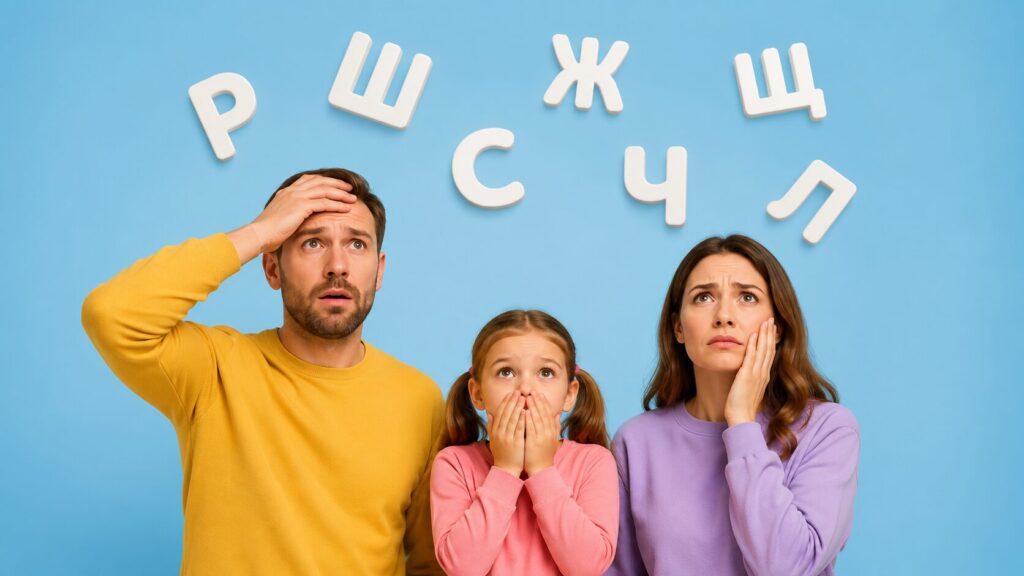
Child can’t pronounce certain sounds? Here’s what you should do.
“Wabbit” instead of “rabbit,” “thun” instead of “sun” — many preschoolers talk this way. Strictly speaking, a child mispronounces not letters but sounds: letters are what we see and write. And not every mistake indicates a problem — the speech apparatus matures gradually, and complex sounds appear later than simple ones. So a four-year-old without a clear “r” usually doesn’t need to be urgently seated in front of a mirror with a speech therapist. Real conversations, reading, and screen-free games will do more good than endless “say it correctly.” But there are age-related milestones beyond which waiting is no longer advisable.
Which Sounds a Child Should Be Able to Pronounce by Age
Up to three years old, speech can be quite “babyish”: children skip parts of words, replace complex sounds with simpler ones, and speak in a way that parents understand best. By three to four years old, speech should already be understandable to people outside the family. Sibilant sounds like “s,” “z,” and “ts” may still sound unclear, but the child usually speaks in phrases and doesn’t turn every long word into a puzzle.
At four to five years old, sounds like “sh,” “zh,” “ch,” and “shch” gradually become established. The last to come are usually “l” and “r”: in the Russian language, normal sound pronunciation usually develops by approximately five to five and a half years, sometimes closer to six. So the absence of a single “r” at age four is not a catastrophe. Unclear speech by itself says nothing about intelligence either: children’s abilities cannot be honestly assessed based on a single trait, as research on school IQ tests shows.
It’s important to evaluate not just one sound but the entire speech as a whole. If a child easily builds sentences, understands speech directed at them, and is easily understood by strangers, there’s usually no need to worry about one delayed sound. But if they mix up many sounds, rearrange syllables, and their speech is hard to understand, it’s better not to wait for the “magic age of five.”
When It’s Time to Take Your Child to a Speech Therapist
You should schedule a consultation if:
- by age three, the child hardly speaks in phrases;
- at three to four years old, only close family members can understand them;
- after age five, numerous sound substitutions and distortions persist;
- by five and a half years old, “l” and “r” haven’t appeared;
- a sound is produced unusually — for example, “r” comes out guttural, or the tongue ends up between the teeth when saying “s”;
- the child has difficulty understanding simple requests, avoids conversations, or gets angry when not understood;
- they have lost previously acquired speech skills.
Loss of already mastered words and skills is a reason to seek medical attention without delay, regardless of the child’s age.
It makes sense to start with a speech therapist. The specialist will check not only pronunciation but also the mobility of the tongue and lips, the ability to distinguish sounds by ear, vocabulary, and sentence construction. Russian clinical guidelines consider such a comprehensive examination as the primary way to understand where exactly the problem lies.

A speech therapist will help correct problems with incorrect sound pronunciation.
If the child frequently asks “what?”, doesn’t react to a quiet voice, turns up the TV volume, or has had many ear infections, it’s worth getting their hearing checked separately. Sometimes parents mistake hearing problems for stubbornness or inattention. Meanwhile, it’s difficult for a child to learn to speak clearly if they don’t always hear sounds well themselves.
A pediatrician can help determine whether other specialists are needed. A neurologist is not required for every child with an incorrect “r” — only when indicated: for example, in cases of skill regression, seizures, noticeable movement disorders, or general developmental delays. In most cases, the path is simple: first a speech therapist, then only those examinations for which there are real reasons.
What to Do at Home While Your Child Learns to Speak Clearly
Don’t turn conversation into an exam. If the child says “wabbit,” calmly respond: “Yes, that’s a big rabbit,” slightly emphasizing the correct word but without demanding they repeat it five times. Constant corrections, mimicking, and ridicule don’t speed up speech development but quickly kill the desire to talk.
Every day, read aloud, discuss pictures, recall what happened on a walk, make up rhymes, and look for objects that start with a particular sound. A useful family habit can be reading before bed: the child hears correct speech, learns new words, and engages in calm dialogue.

Low-key activities in the form of games and conversation will help correct sound pronunciation.
It’s better to practice briefly but regularly and through play. You can clap out syllables, guess the first sound in a word, find rhymes, and slowly practice fun tongue twisters without rushing for speed. Sometimes a child can already produce a sound in isolation — for example, a long “r-r-r” — but loses it in words. This is a normal stage: the new sound still needs to be reinforced in words, sentences, and everyday speech.
Don’t try to “set” a difficult sound on your own based on a random video. First, a speech therapist needs to figure out exactly why the sound isn’t working and which tongue or lip movements need to be practiced. The same incorrect sound in different children can arise for different reasons, so there is no universal exercise that works for all children.
And one more rule: don’t compare your child with their sibling, the neighbor’s kid, or the most talkative toddler in the group. The benchmark should be age-appropriate norms and overall progress. If your child is four years old, their speech is understandable, and only the “r” is missing, it’s usually fine to observe. If speech is hard to understand, there are many errors, or your anxiety just won’t go away, one consultation with a speech therapist is more useful than several months of doubt.