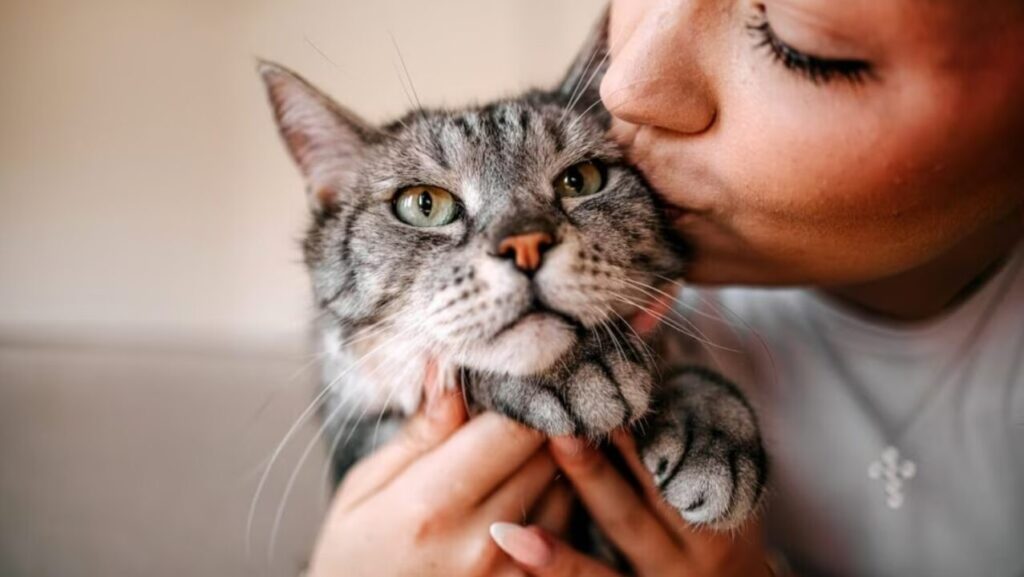
Do cats understand our kisses and hugs?
Cats do not understand kisses and hugs the way humans do, because neither gesture exists in their own communication repertoire. A kiss is something a cat can interpret in its own terms and, over time, get used to. A tight hug is different: most cats read it as being grabbed and held. That does not mean affection has to stop. Many cats eventually accept both from people they trust. The real questions are how a cat decodes our gestures, where its tolerance ends, and how to express love in a language it actually understands.
What you need to know
- Cats rub cheeks and foreheads to exchange scent, so a kiss on the top of the head resembles a ritual they already know.
- Cats have no behavior that resembles a human hug; being held tightly triggers prey instincts and reads as capture rather than affection.
- Flattened ears and wide eyes are early warning signs that appear before hissing, biting, or scratching.
- Slow blinking, brushing, and stroking the chin, cheeks, and lower back are ways to show affection a cat can recognize.
A kiss looks like a scent exchange to a cat
Cats habitually rub their cheeks and foreheads against other cats, people, and objects. This leaves their scent behind and effectively marks something as theirs. When you lean down and kiss a cat on the top of its head, the gesture looks very much like that same ritual from the cat’s point of view. A cat that knows you well will most likely tolerate it calmly and may even rub back.
There is a second explanation. Cats that are close to each other groom one another, cleaning fur in places the other cannot reach. This is a sign of trust that occurs only between members of the same social group. A cat may file a human kiss into the same category, and the stronger your bond, the more willingly it will accept one.
There is a flip side. An unfamiliar cat, or a cat that is stressed or unwell, perceives an approaching face as an intrusion into its personal space. In those moments it is better not to insist: the cat will remember the pushiness, not the affection.
A hug feels closer to capture than to a caress
Hugs are more complicated than kisses. Cats simply have no behavior that resembles a human embrace. Cats that are close to one another sleep side by side or even on top of each other, but they never squeeze each other with their paws. The nearest thing to a hug in a cat’s repertoire is when it rubs against your legs and wraps its tail around them.
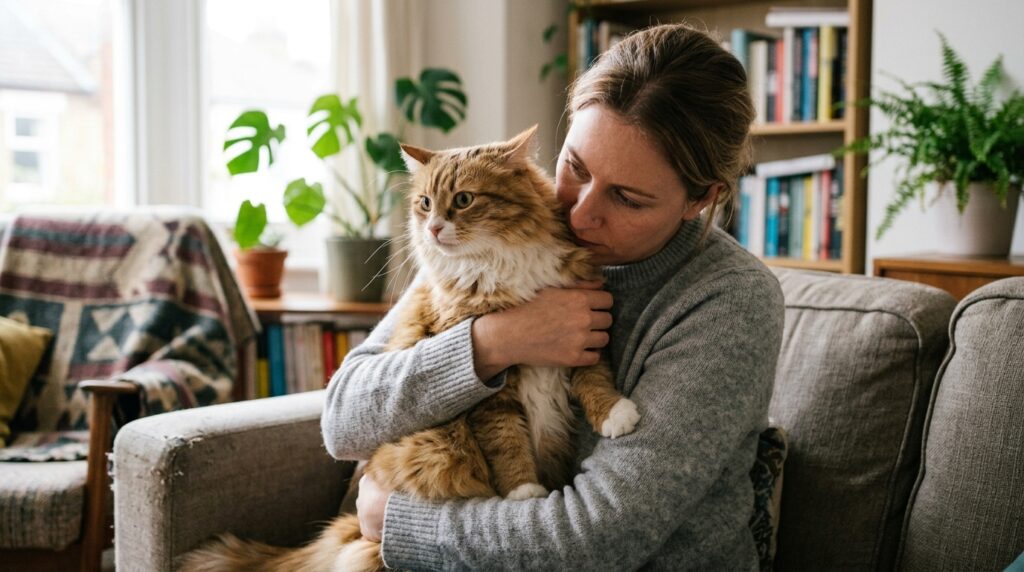
The more firmly a cat is held, the faster affection turns into a loss of control for the animal
The reason lies in feline instincts. In the wild, a cat is both predator and prey: it hunts small animals, but larger animals hunt it. So a situation in which something big grabs it and holds on tightly registers as capture, not a caress. Hence the tense body, the attempts to break free, and the fear.
The overwhelming majority of cats dislike hugs, and it is only worth trying with a pet you are very close to. Even then, hold the cat loosely, do not squeeze, and watch its reaction: at the first sign of displeasure, let go immediately.
Five signals that your cat has had enough
A cat rarely suffers in silence; it warns in advance that it is uncomfortable. The problem is that people often miss these warnings and are then surprised by scratches. Here is what to watch for when you lean in for a kiss or pick your cat up:
- the cat turns its head away and angles its body away from you;
- it hisses or growls;
- it swats with a paw;
- its eyes open wide;
- it flattens its ears against its head.
Any of these signs means one thing: now is not the time. Release the cat and let it walk away. Flattened ears and wide eyes are especially important because they appear before hissing and biting. If you learn to notice them, it will almost never come to claws, and your cat’s trust will only grow.
The feline love language: blinking, brushing, and the right places to stroke
Cats express attachment in their own way: head-butting, rubbing, licking, kneading with their paws, and simply staying close to the people they love. The most reliable strategy is to work out what your particular cat prefers and respond in kind, rather than imposing human rituals.
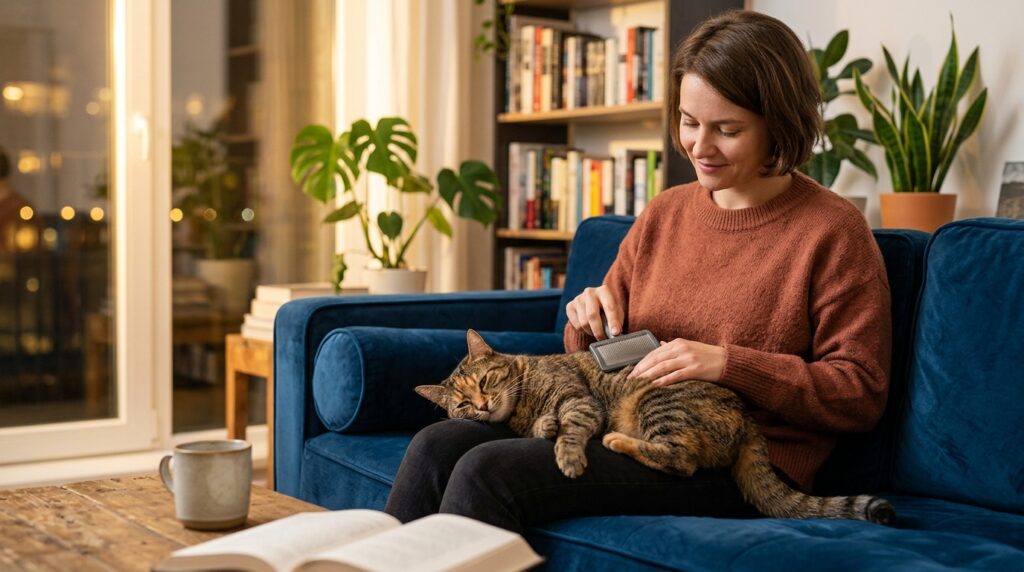
Brushing and calm touch are usually clearer to a cat than a human hug
Several ways to show love that a cat will definitely understand:
- if your cat likes to head-butt or rub its cheek against you, simply extend a hand and let it leave its scent there;
- if it rubs against your legs, licks your skin, settles on your chest or lap, and kneads with its paws, do not shoo it away; give it time;
- when you catch your cat’s gaze, blink slowly several times: this is how cats tell each other that all is calm and they are among friends;
- brush your cat when it is relaxed, because to a cat, brushing is the same grooming that cats offer only to those close to them.
Stroking works too, if you choose the right spots: most cats enjoy the chin, cheeks, and lower back. Add a calm, quiet voice, regular play, and treats for good behavior, and the bond will strengthen without a single hug.
A daily routine and a high shelf count as care too
For a cat, love is not only about touch but also about predictability. A stable routine, in which food, play, and attention from the owner happen at roughly the same time each day, noticeably calms a pet. A cat that knows what comes next worries less and is more willing to engage.
The home environment matters as well. Complete, balanced nutrition, high shelves and places to climb, hiding spots where nobody will disturb it, scratching posts, and a window with a view of birds outside are all things a cat perceives as care far more clearly than a kiss on the nose.
Cats do not hug or kiss the way we do, and they are unlikely ever to fully understand these gestures. But they are very good at befriending people, and that friendship is built on time, respect for boundaries, and attention to small details. There is a simple way to check: kiss your cat on the top of its head and see whether it rubs back or silently turns away. The answer will tell you where your relationship stands.