
8 strange Google interview puzzles that were already banned: can you answer them?
Imagine you came to a Google interview in the early 2000s. Back then it was the best workplace on the planet, getting in was extremely difficult, and the interviewer would suddenly ask with a smile: “You’ve been shrunk to the size of a nickel and thrown into an empty blender. The blades will turn on in 60 seconds. What do you do?” It was believed that such puzzles revealed raw intelligence, creativity, and the ability to stay cool under pressure. Candidates were asked how many golf balls would fit in a bus and why manhole covers are round. Google used these strange brain teasers in hiring for many years — until in 2013 it turned out they predicted almost nothing. Let’s break down the most famous puzzles — and understand why they were eventually abandoned.
Why Google Asked Brain Teasers at Interviews
The idea was simple and, at first glance, logical: give a person a non-standard problem with no pre-learned answer and watch how they think. Not what they know, but how they reason when familiar patterns don’t work.
Such questions fall into several types. Some require pure creativity, others demand careful calculation and logic, and still others test whether a person panics when a problem sounds absurd. They were all conceived as a test of “out-of-the-box thinking,” and that’s exactly why Google became famous for them worldwide.
The problem is that the beautiful idea didn’t work in practice. But before we get to the post-mortem, let’s honestly test ourselves on a few classic puzzles.
How to Escape a Blender When You’re the Size of a Coin
This is perhaps the strangest puzzle on the list — and yet the answer is deceptively simple. The clue is hidden in physics, not in cleverness about blades and buttons.
When you shrink by roughly 90 times, your mass drops much faster than your muscular strength. The strength-to-weight ratio increases dramatically — that’s exactly why a flea or a mouse can jump to heights many times their own body length. So the correct answer is: simply jump out of the blender. For a tiny creature, this is entirely feasible. It’s a vivid example of so-called scaling laws — why small animals are relatively stronger than large ones.
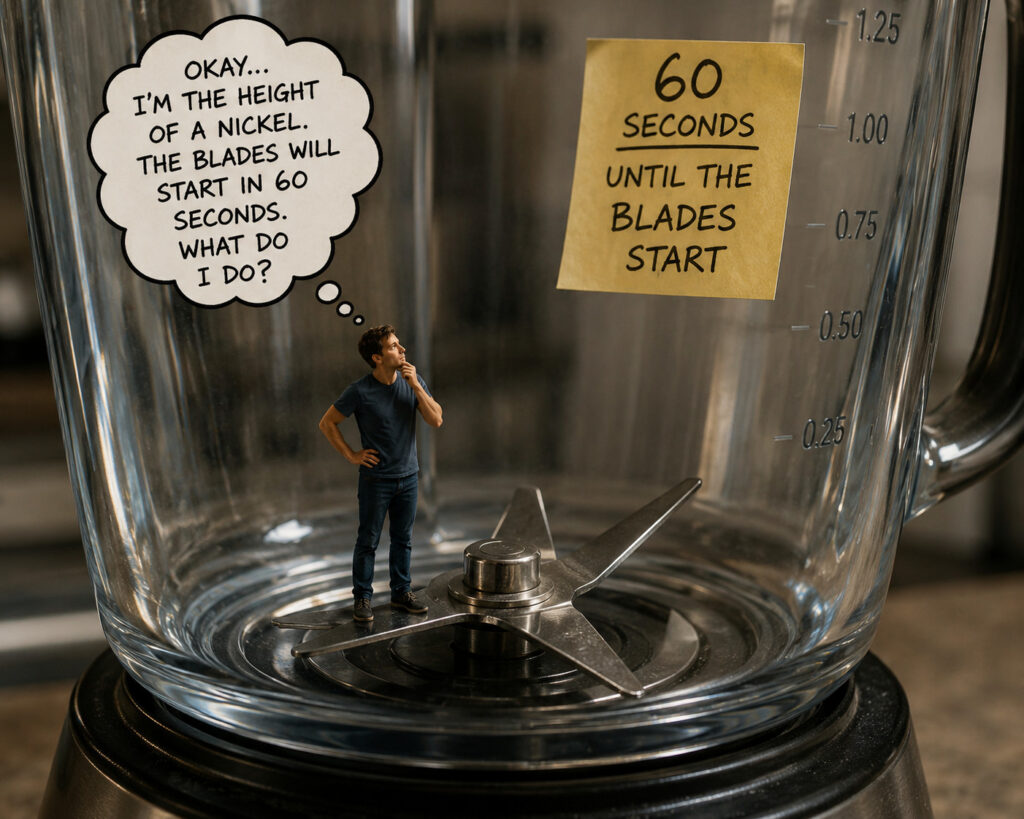
You’ve been shrunk to the size of a nickel and thrown into an empty blender. The blades turn on in 60 seconds. What do you do?
How Can Four People Cross a Bridge in 17 Minutes
A classic optimization problem. Four people need to cross a bridge, but they walk at different speeds: the first takes 1 minute, the second — 2, the third — 5, and the fourth — 10. Only two people can cross at a time, and they need a single flashlight that someone must bring back.
The trap is making the fastest person a “shuttle” running back and forth. That approach yields 19 minutes — and loses. The winning strategy is to send the two slowest people together so their times overlap. The order is:
- First and second cross: 2 minutes
- First returns with the flashlight: 1 minute
- The two slowest — third and fourth — cross: 10 minutes
- Second returns: 2 minutes
- First and second cross again: 2 minutes
Total: exactly 17 minutes. The key insight: the two slowest people must cross simultaneously; otherwise you lose a lot of time twice.
How Many Golf Balls Fit in a School Bus
This is an entire genre of estimation questions. It also includes “how much would you charge to wash all the windows in Seattle” and “how many gas stations are in Manhattan.” There’s no strictly correct answer here — there’s a range of reasonable estimates, and the whole point is how you reason.
The logic goes roughly like this. Take a bus interior about 35 feet long, 7.5 feet wide, and 6.5 feet tall — that’s approximately 2.95 million cubic inches. A golf ball has a volume of about 2.5 cubic inches. Then two important adjustments: seats, handrails, and the driver’s area eat up space, leaving roughly 75% of the volume usable, and spheres leave gaps between them. The random packing density of spheres is about 64%.
So: 2,948,400 cubic inches × 0.75 × 0.64 ÷ 2.5 ≈ 566,000 golf balls. A reasonable answer could lie somewhere between 350,000 and 600,000. What matters is not the number but the thought process — the ability to break the problem into understandable assumptions.
How Many Times a Day Do Clock Hands Overlap
The problem seems simple, but it’s easy to get wrong because of noon and midnight. The easiest approach is to turn it into geometry.
The clock face is a circle. The minute hand covers 360 degrees per hour, while the hour hand covers only 30 degrees per hour (360 divided by 12). So the minute hand catches up to the hour hand at a rate of 330 degrees per hour. An overlap occurs every 12/11 of an hour, meaning slightly less than once per hour — and over 24 hours, the hands overlap 22 times, not 24 as one might expect.
A Coin Landed Heads 560 Times Out of 1,000: Is This Probability Possible?
Randomness is trickier than it seems. Nobody expects exactly 500 heads out of 1,000 flips — but how large can the deviation be and still be considered normal?
This is where the concept of standard deviation helps — it’s the typical “spread” around the average value. For repeated yes-or-no events like this one, it’s calculated as the square root of the product of the number of flips, the probability of heads, and the probability of tails: √(1000 × 0.5 × 0.5) ≈ 15.8. The normal spread is about 16 heads in either direction. Essentially, any value in the range from 500 plus or minus 16 would be considered normal. But 560 is a deviation more than three times the expected spread — more than three standard deviations. Such a result no longer looks like a fair coin.
100 Unfaithful Husbands: What Happens After the Queen’s Announcement
In a village there are 100 unfaithful husbands. What will happen if the queen announces that at least one of them has been unfaithful? This is one of the toughest puzzles on the list — and also a beautiful illustration of what logicians call common knowledge. In the village live 100 married couples. Some husbands secretly cheat. Every wife knows about all unfaithful husbands except her own. If a wife realizes her husband has cheated, she throws him out at midnight. All wives are very smart. All husbands keep their secret.
One day the queen announces to the entire village: there is at least one unfaithful husband in town. How many husbands will be thrown out, and when?

The queen’s announcement triggers a chain of logical reasoning in all wives simultaneously
In the village, every wife can find out whether another woman’s husband has been unfaithful. But no wife knows whether her own husband has been unfaithful. So in a village with 100 unfaithful husbands, each wife sees 99 unfaithful husbands. But each wife thinks: “Maybe my husband is innocent, and only these 99 men are guilty.”
The queen’s statement may seem useless since everyone already knows there are cheaters in the village. But there’s a subtlety: the announcement transforms private knowledge into common knowledge — now everyone knows that everyone knows.
Imagine there were only one unfaithful husband. His wife would see no other cheaters. After the queen says at least one husband has been unfaithful, she would realize it must be her husband. And she would throw him out on the very first day.
If there are two cheaters, each of their wives sees one and thinks: “Maybe only one is cheating.” If that were the case, the other wife would have acted on the first day. But when the first day passes and no one is thrown out, both wives realize there must be more than one cheater. And each understands that her husband is also guilty. On the second day, both husbands are thrown out.
This logic continues further. With 100 unfaithful husbands, each wife sees 99 guilty men. She waits 99 days to see how the wives of those 99 men will act. When nothing happens, she realizes there must be a hundredth cheater — her own husband. Thus, for 99 days nothing happens. Then, on the 100th day, all 100 husbands are thrown out simultaneously.
A 100-Story Building and 2 Eggs
Another tricky puzzle. You have exactly 2 identical eggs, and you need to determine the maximum safe floor from which you can drop them from a 100-story building. If you drop an egg from the height of one floor, it survives. There is a highest floor from which you can drop an egg without it breaking. If you drop an egg from higher than that floor, it will break. You need to find that floor while making as few drops as possible.
Checking one floor at a time takes up to 100 drops — far too many. Starting from the 50th floor is also bad: if the egg breaks, you’d have to check floors one through forty-nine one by one.