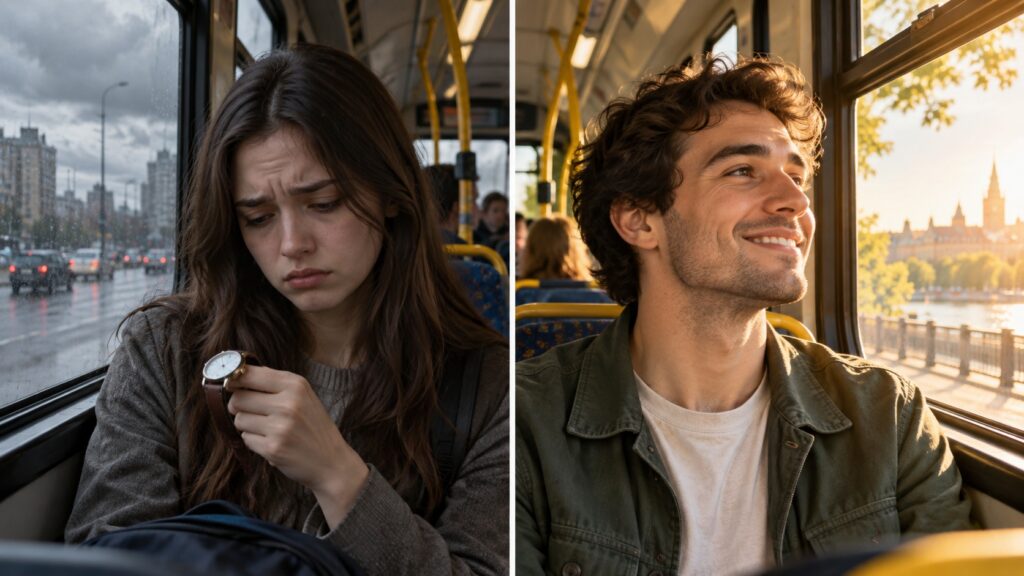
Travel time there and back feels different, and research has measured the gap
You drive the same route out and back. The distance is identical and so is the clock time, yet the return leg almost always feels shorter than the long, tiring trip out. This is not imagination: psychologists have measured the gap, and in the studies cited below the return journey is judged roughly 17–22% shorter than the outbound one. The leading explanation is not familiar scenery but expectations: on the way out we optimistically guess how long the trip will take, repeatedly check whether we are nearly there, and feel let down when reality runs longer. On the way back, expectations are already calibrated, and memory quietly rewrites the trip as quicker.
What you need to know
- Studies cited in this article put the perceived difference between outbound and return trips at 17–22%.
- In a 2011 Dutch experiment, the return trip felt shorter even for participants who came back by a different, unfamiliar route of equal length, so recognizing the landscape is not the main cause.
- Watching seven-minute cycling videos, participants estimated the outbound half at 9.12 minutes on average and the return at 7.35 minutes; a fake “this trip is very long” review shown beforehand almost eliminated the effect.
- A Kyoto University study found no distortion while the journey was in progress: the return only felt faster when participants judged the whole trip afterward.
How expectations shape travel time
The core mechanism lies in how the mind handles predictions. Heading somewhere unfamiliar for the first time, a traveler subconsciously estimates the duration. Suppose the navigation app promises forty minutes. Half the time passes, then a bit more, and the brain starts repeatedly asking whether the end is near. Every such thought fixes attention on the passage of time. If the trip turns out even slightly longer than expected, mild disappointment sets in.
On the way back the picture changes completely. The brain now has accurate data: the trip will take exactly this long. Expectations become realistic, there are no unpleasant surprises, and the same forty minutes fit the internal schedule perfectly. The result is a journey that feels easy and subjectively fast.
Familiar scenery helps only partly
The most common everyday explanation is that on the return trip we simply recognize the surroundings. During the first trip the brain works hard: hunting for the right turns, checking signs, memorizing landmark buildings. This flood of new visual information does stretch subjective time.
But experiments by Dutch psychologists in 2011 indicated that familiarity is not the main factor. The researchers split participants into two groups. The first returned along exactly the same route; the second went back by an entirely different, unfamiliar road of equal length.
If the secret lay solely in recognizing buildings and intersections, the effect should have vanished for the second group. Instead, the return trip felt shorter to all participants without exception. Recognizing familiar streets helps, but the powerful illusion of accelerated time appears even without it.
A fake review cancelled the effect
The gap in perception is not a matter of a minute or two. In a laboratory setting, participants watched video recordings of bicycle trips lasting exactly seven minutes. Viewers estimated the outbound half at 9.12 minutes on average and the return at just 7.35 minutes, a substantial distortion.
To test the expectations theory directly, the psychologists ran a further experiment. Before the video, some participants were shown a fabricated review from a supposed previous participant stating that the trip had been incredibly long and exhausting. In other words, their expectations were artificially lowered so that they braced for the worst.
The result was striking. The forewarned viewers stopped being disappointed by the drawn-out outbound trip, and the return trip effect practically disappeared: both halves of the route were perceived roughly equally. This suggests that we create the illusion of an endless road ourselves when we hope to arrive faster than is physically possible.
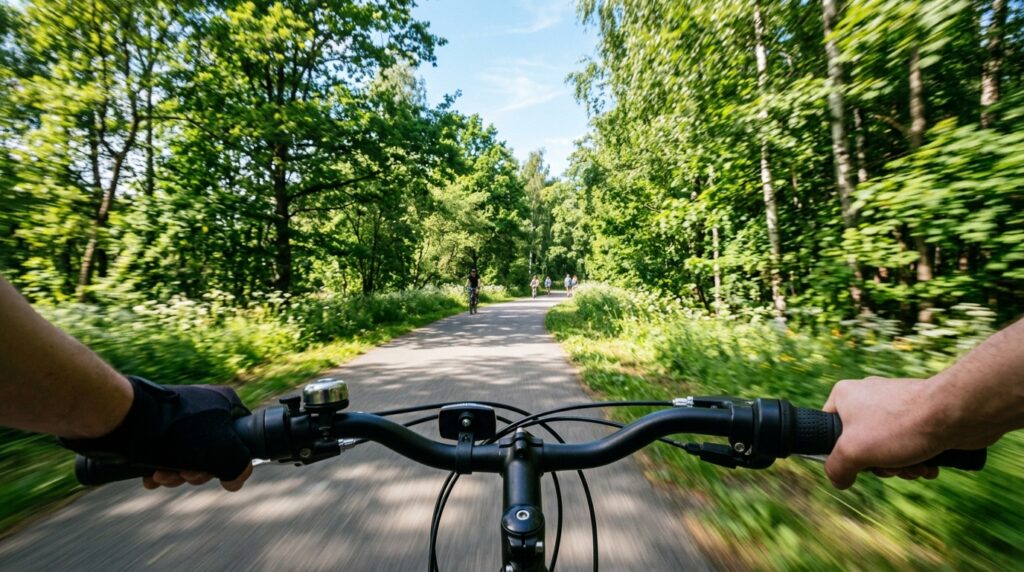
Sometimes we create the illusion of an endless road ourselves
The brain rewrites the estimate after the fact
Later, researchers at Kyoto University made the task harder. They asked participants to mark every three minutes in real time while watching recordings of long walks. The aim was to find out whether a person’s internal clock actually speeds up during the return leg itself.
It turned out that in the moment, people felt no distortion at all. The intervals were marked out roughly equally on both legs of the journey. But once the viewing ended and participants were asked to judge the duration of the whole trip, they again confidently reported that the return had been faster.
In other words, the brain does not make time run faster in reality; it rewrites the memory of it once the event is over. A shift in attention adds to this. On the way to a destination we are often tied to a hard deadline: a flight, an important meeting, the start of a film. That brings stress and more frequent glances at the clock. The trip home is simply the end of the story: no deadlines remain, we can relax, put on music, and stop monitoring the minutes.
Why the daily commute is immune
The mechanism described above works well for holiday travel, occasional trips into nature, or visits to unfamiliar neighborhoods. But it breaks down entirely for routine daily journeys.
If you have been traveling to the same office for years, your internal clock is perfectly tuned. You know exactly where the bus will sit in traffic, how many minutes the descent into the metro takes, and when you will reach the door. There are no inflated expectations, so there is no disappointment when they collapse. The brain adapts to routine and stops spending resources on needless worry.
Ultimately, the return trip effect is less a trick of space than a complex product of memory and attention. The mind constructs its sense of elapsed time from how eagerly we awaited arrival, how often we glanced at the clock, and how closely harsh reality matched our optimistic forecasts.