An ant or beetle that tumbles off a high-rise balcony usually walks away unharmed, while the same fall would almost certainly kill a person. The main reason is not a tough shell but sheer size: a tiny body has very little mass relative to its surface area, so air resistance slows it dramatically, its terminal speed is low, and the energy it must absorb on landing is minuscule. The exoskeleton helps, but it is a secondary factor.
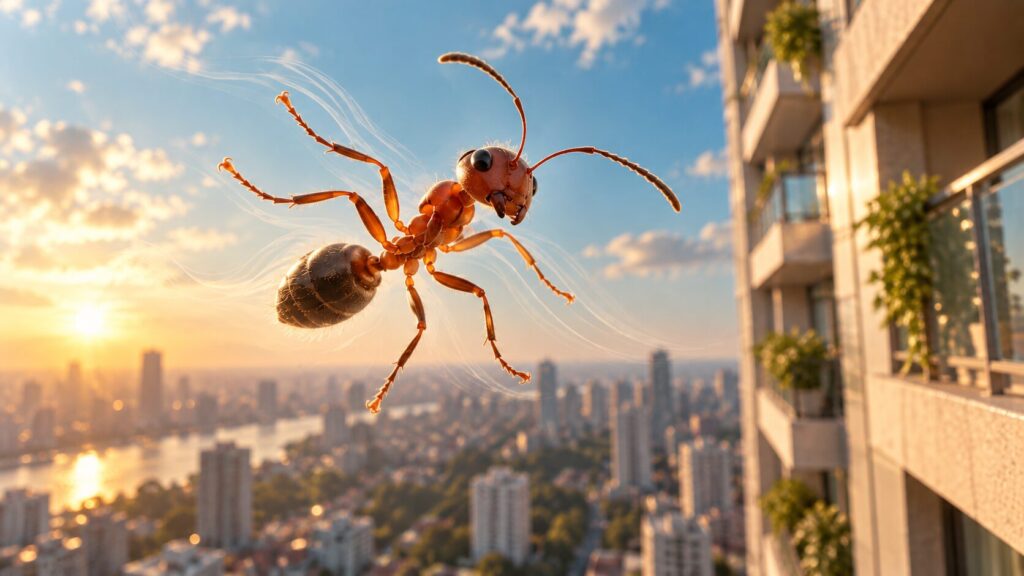
Air resistance strongly slows an insect’s small body
What you need to know
- Shrinking an animal tenfold cuts its mass roughly a thousandfold but its surface area only a hundredfold, so air drag matters far more relative to weight.
- Once an insect reaches terminal speed, extra floors barely increase the force of impact, so a fall from the 10th and 50th floors can end about the same.
- The chitin-based cuticle helps absorb a landing but does not make insects invulnerable; large beetles and butterfly wings can still be damaged.
- Spiders are arachnids, not insects, and Cornell University warns that heavy tarantulas can be seriously injured by even relatively short falls.
A small body works almost like a parachute
Gravity pulls on an ant exactly as it pulls on a human. But a second force is at work: air resistance. The faster a body falls, the harder the air pushes back, until at some point drag balances gravity and the speed stops increasing. This is known as terminal velocity. As NASA explains, it depends on factors including the object’s mass, area, and shape.
This is where insects gain an enormous advantage. Their mass is tiny, yet the area of their body, legs, and wings is relatively large in proportion to it.
The smaller the body, the more strongly air slows it relative to its own weight.
Scale an animal down by a factor of ten and its mass drops by roughly a thousand times, while its surface area drops by only a hundred. As a result, an ant meets far more air resistance relative to its weight than a person does. The OpenStax university physics textbook examines this scaling effect in detail.
After a few floors, height stops mattering much
It seems logical that the higher an insect falls from, the harder it should hit the ground. But that only holds up to a point. While the insect is still accelerating, its speed does increase. Then air resistance balances gravity, and from there it descends at roughly constant speed.
Once terminal speed is reached, additional floors add almost nothing to the impact.

After reaching terminal speed, an insect almost stops accelerating.
This is why a hypothetical ant falling from the 10th floor and from the 50th may end up in roughly the same condition. That does not mean height is irrelevant; it simply means that beyond a certain point, speed barely grows.
For the same reason, the question “what is the maximum height an ant can fall from” is not quite the right one. For a very small animal, what matters is not the height as such but its terminal speed and exactly what it lands on.
On impact, there is little energy to do damage
There is another factor. The danger of a fall depends not only on speed but on the energy the body must dissipate when it stops. A human is heavy, so the body carries enormous energy when it hits the ground. An ant weighs a few milligrams. Even at the highest speed the air allows, it carries very little energy.
A small insect’s impact carries too little energy to seriously damage its body in most cases.
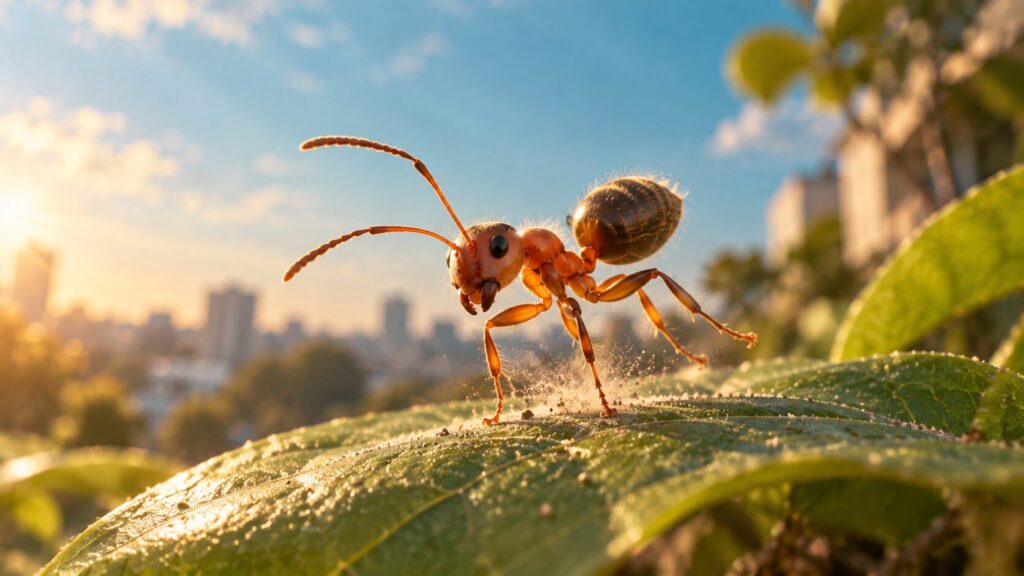
Because of its low mass, the impact with the surface is comparatively weak.
The same logic explains why size reshapes the rules of animal life in general. Giant insects once existed on Earth, but they cannot simply be scaled up to the size of a dog: as size grows, mass, respiration, structural strength, and aerodynamics all change sharply.
The exoskeleton helps, but it is not super-armor
Insects have no bones like ours. Their bodies are covered by a cuticle, a lightweight exoskeleton based on chitin and proteins that both supports the body and shields it from damage. Recent research shows the cuticle can combine rigid and more elastic regions, and a recent review describes it as one of the defining structural features of insects.
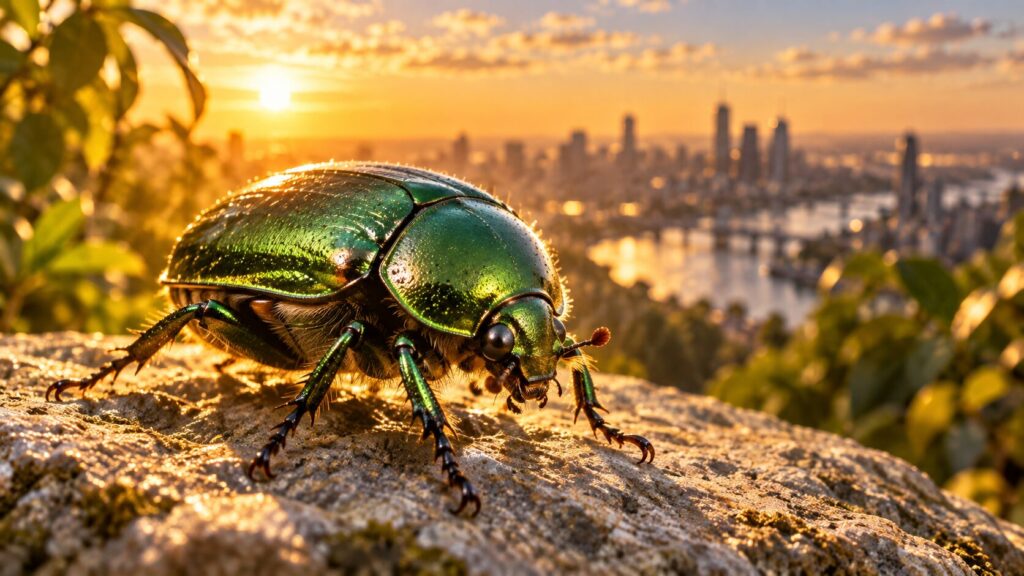
A sturdy exoskeleton gives the insect extra protection on landing.
On landing, the legs, joints, and body casing also help spread the small load. But the chitin covering helps an insect survive an impact; it does not cancel the consequences. A large beetle can be injured by a fall, a butterfly’s wing is easily damaged, and a collision with a wall or ledge during flight is sometimes more dangerous than the landing itself.
An ant will survive; a large spider may not
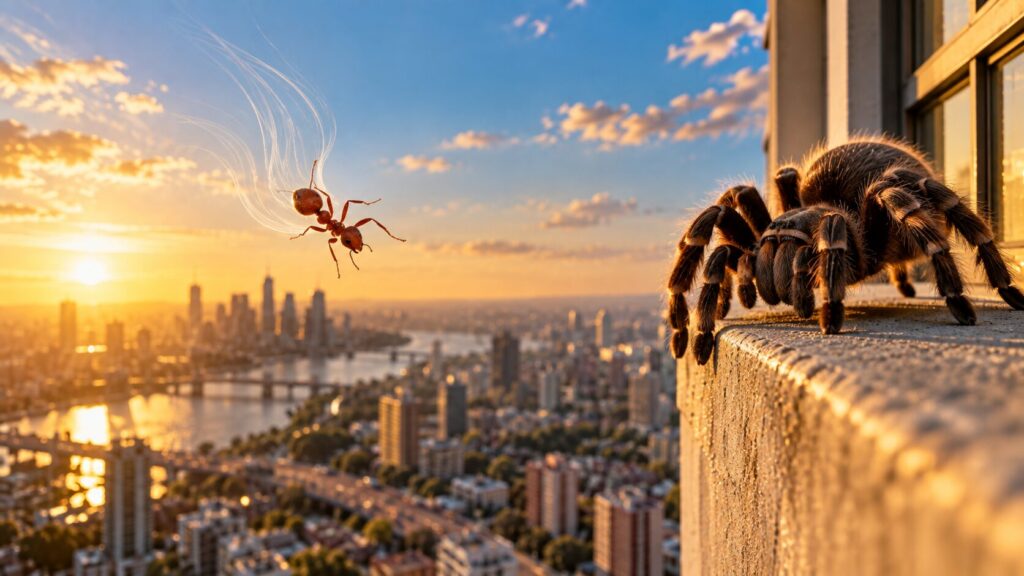
The larger and heavier the arthropod, the more dangerous a fall is for it.
Answers to the most common questions about such falls:
- An ant falling from a roof or a high-rise window usually has a good chance of staying intact. Its low mass and air resistance work in its favor.
- A small cockroach can also survive a very serious fall, but the larger and heavier the insect, the smaller this advantage becomes.
- Flies and other winged insects often turn a fall into flight by stabilizing themselves with their wings.
- A spider is not an insect but an arachnid. Small spiders benefit from the same favorable physics of scale, but large spiders can be quite fragile. Cornell University warns, for example, that heavy tarantulas can be seriously injured even by a relatively short fall.
- In a vacuum, an insect would fare worse. There is no air to slow the fall. Low mass would still be an advantage, but the built-in “air parachute” would be gone.
So a small ant that vanishes over the edge of a balcony has not necessarily taken its final flight. Most likely, a few seconds later it is crawling on as if nothing unusual had happened.