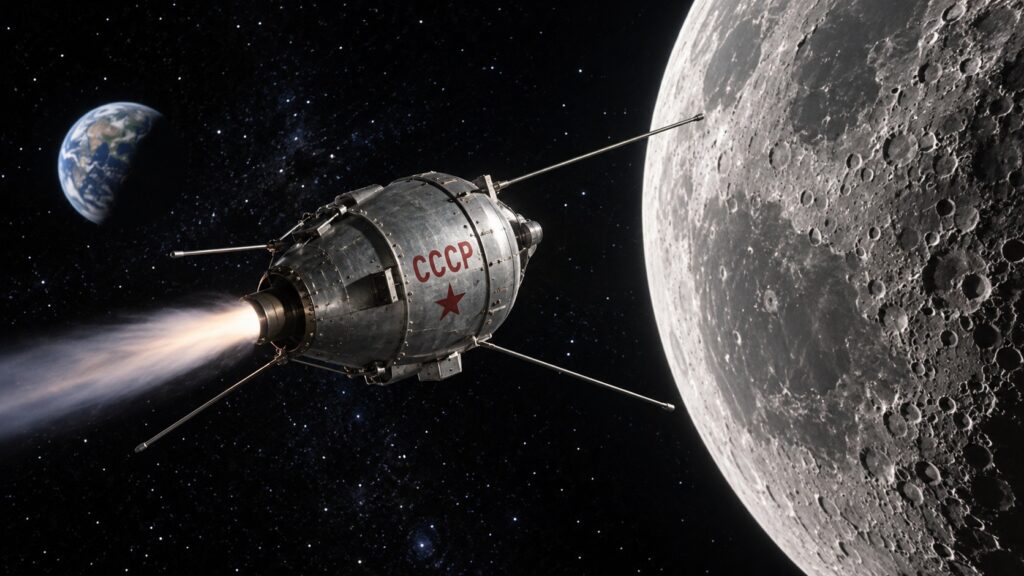
The first flight to the Moon was made possible by a long series of failures and mistakes
On 13 September 1959, the Soviet probe Luna 2 became the first human-made object to reach the Moon. It did not land softly: the spacecraft slammed into the surface at high speed. But that impact proved for the first time that a vehicle launched from Earth could actually reach another celestial body. Here is how the USSR and the United States raced toward the same goal in 1958–1959, why the earliest launches failed, and what those early flights taught scientists about the Moon and near-Earth space.
What you need to know
- Luna 1, launched 2 January 1959, missed the Moon by roughly 6,400 km because its upper-stage engine burned longer than planned, and became the first human-made object in orbit around the Sun.
- Luna 2 struck the Moon on 13 September 1959 between Mare Imbrium and Mare Serenitatis, about 250 km from where Apollo 15 would land 12 years later, and found no lunar radiation belts or notable magnetic field.
- Luna 3 photographed about 70% of the Moon’s far side in a 40-minute session on 7 October 1959, taking 29 images developed on board and transmitted by radio.
- The US Pioneer probes failed to reach the Moon at first but confirmed the Van Allen radiation belts and discovered a second, outer belt; Pioneer 4 flew past the Moon at 59,000 km in March 1959.
A calculation error and the first “artificial planet”
The first three Soviet attempts to reach the Moon in 1958 ended in failures of the R-7 rocket. Success came only on 2 January 1959, with the launch of the first “Cosmic Rocket,” later renamed Luna 1. The spherical spacecraft, weighing a little over 360 kilograms, carried instruments for measuring radiation and magnetic fields.
A new upper stage allowed the rocket to reach escape velocity, the speed required to break free of Earth’s gravity. But the engine fired for longer than planned. Because of that error, the probe flew past its target at a distance of about 6,400 kilometers. Contact was maintained for roughly 62 hours, until the batteries ran down. By then the probe was almost 600,000 kilometers from Earth and had entered a heliocentric orbit, becoming what was described as the first artificial planet.
Note: “artificial planet” is not an astronomical term here but a metaphor — Luna 1 was simply the first human-made object to orbit the Sun.
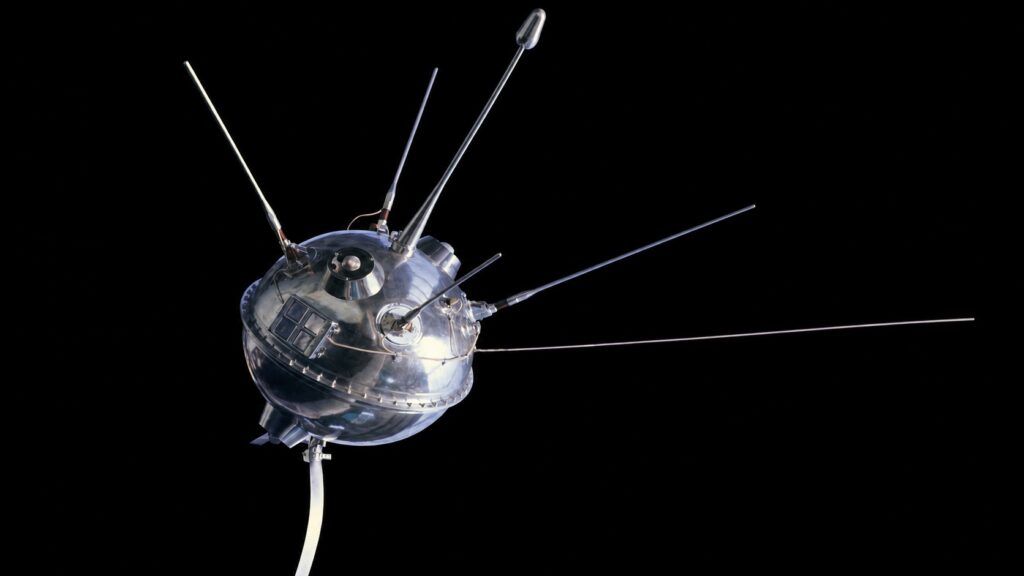
The Luna 1 interplanetary probe
Luna 2’s historic impact
After the miss, engineers prepared the next spacecraft. Luna 2, nearly identical to its predecessor, launched on 12 September 1959. This time the calculations were correct and the probe entered an accurate intercept trajectory. Along the way, the upper stage released a cloud of sodium vapor so that astronomers on Earth could photograph it and confirm the course.
The next day, 13 September 1959, the probe hit the lunar surface between Mare Imbrium (the Sea of Rains) and Mare Serenitatis (the Sea of Serenity). The site lies only about 250 kilometers from the area where the Apollo 15 astronauts would land 12 years later. Before impact, the instruments relayed an important finding: the Moon had no radiation belts and no appreciable magnetic field. On impact the spacecraft broke apart, scattering metal spheres bearing Soviet emblems.
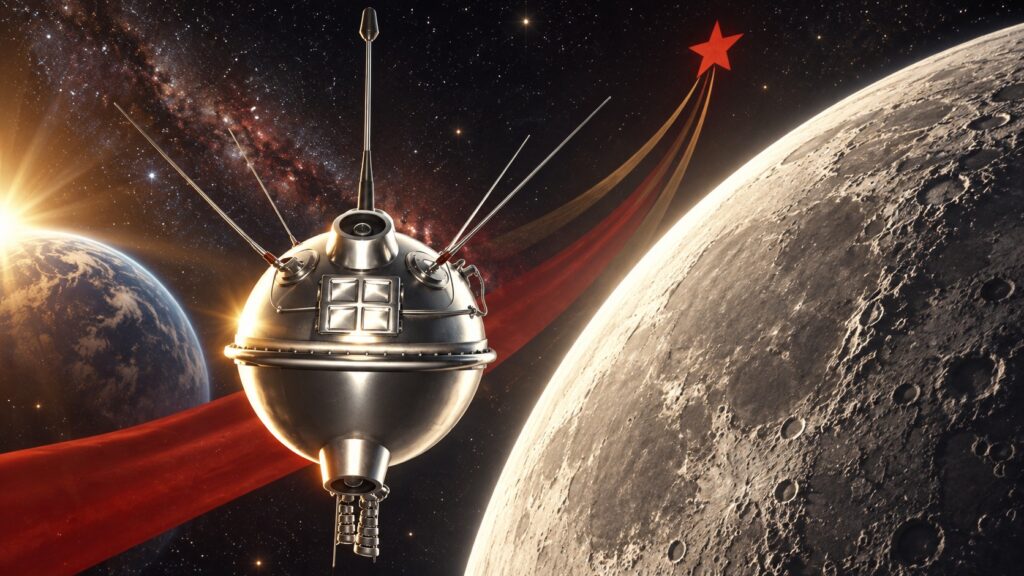
The Soviet Luna 2 probe
How Luna 3 photographed the far side
Where the first missions simply had to reach the Moon, Luna 3, launched on 4 October 1959, was given a far harder task: fly around the Moon and photograph the side that is never visible from Earth. On 6 October the probe passed over the lunar south polar region at an altitude of about 7,900 kilometers, and the next day, having receded to roughly 65,000 kilometers, it began imaging the far side.
The session lasted about 40 minutes, during which the spacecraft took 29 photographs covering roughly 70% of the far side. The film was developed on board the automated probe, then scanned and transmitted to Earth by radio. The images revealed for the first time how strongly the far side differs from the near side: there were far fewer of the dark basaltic plains known as lunar maria.
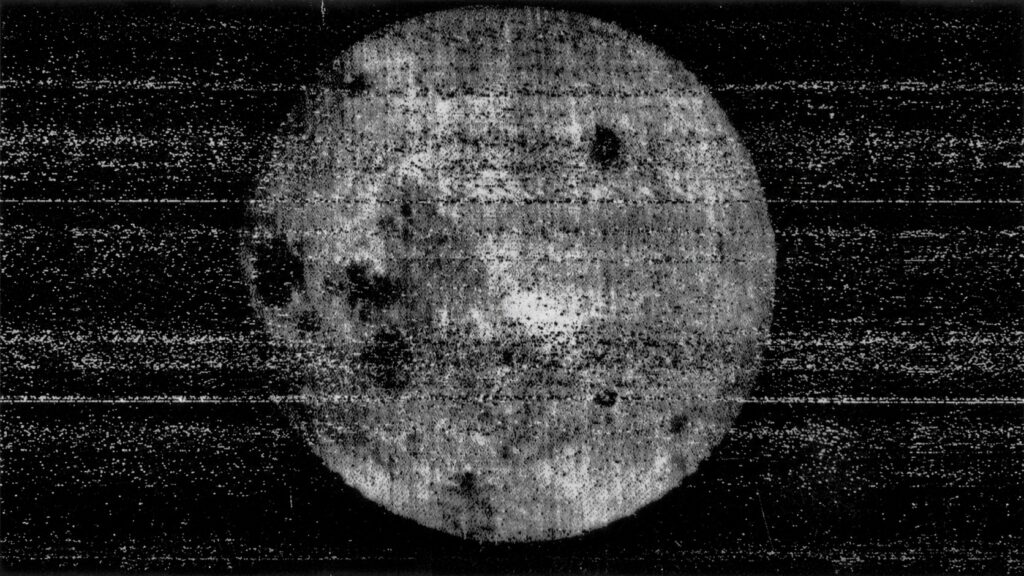
The first photograph of the far side of the Moon
Decades after the end of the Cold War, a curious detail emerged. According to NASA’s history account, Soviet engineers used American photographic film for the mission — film recovered from a Project Genetrix reconnaissance balloon that had come down on Soviet territory. Specialists found that this film tolerated temperature swings and radiation well, which made it well suited to photography in space.
The struggles of the American Pioneer program
The United States pursued its own lunar program, which included three orbiter spacecraft and two flyby probes. The early attempts ran into numerous technical problems. The 38-kilogram Pioneer 1 failed to reach the required speed because of issues with the rocket stages. It climbed to a then-record 113,000 kilometers before falling back and burning up in Earth’s atmosphere 43 hours after launch.
Despite failing to reach the Moon, these missions produced important scientific results. Instruments aboard the fading Pioneer 1 confirmed the existence of the Van Allen radiation belts around Earth. Pioneer 3, launched later and also falling short of its target, discovered a second, outer radiation belt.
Success came in March 1959, when Pioneer 4 passed within 59,000 kilometers of the lunar surface. It became the first American spacecraft to enter orbit around the Sun, and it transmitted radiation data from more than 650,000 kilometers away — nearly twice the Earth–Moon distance.
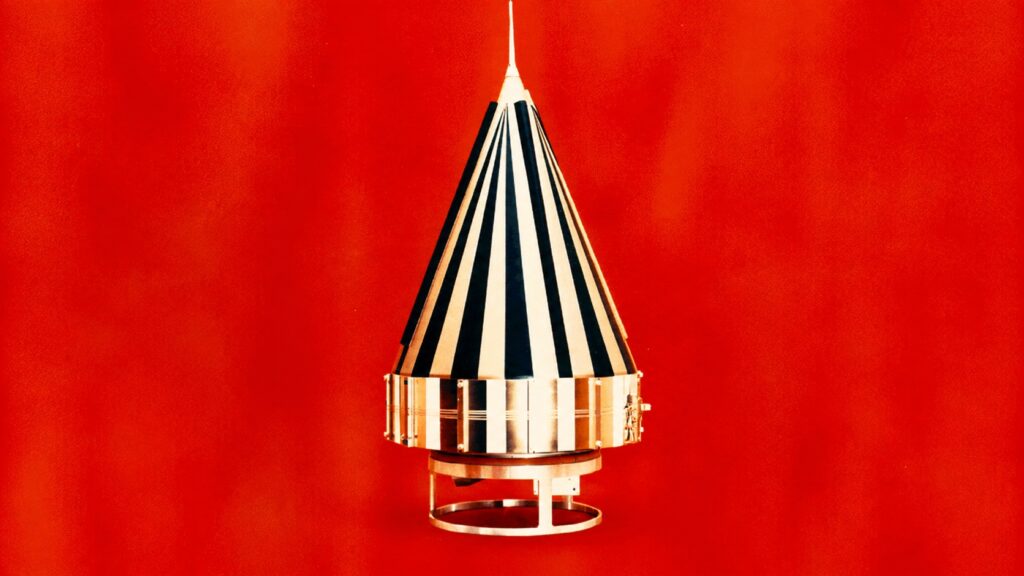
The Pioneer 4 spacecraft
From crash landings to soft landings
The Pioneer program also let the United States test a 26-meter tracking antenna in California. It became the first element of the deep-space communications network that would later control lunar landers and track the historic crewed flights to the Moon.
After these early missions, both superpowers paused. As NASA’s historical archives note, scientists needed time to develop the next generation of technology. The USSR set about building systems for soft landings, while the US began mapping the lunar surface to find safe sites for a human landing. The era of deliberate hard impacts was over, clearing the way for the genuine exploration of other worlds.