Attempting to make gasoline at home can end in tragedy
Gasoline doesn’t flow from the ground in a ready-to-use form. Underground, there is only crude oil — a dark, viscous liquid that by itself is not suitable for an engine. To produce gasoline, oil is processed at complex refineries using strict technologies. Some people wonder how to make gasoline at home, but they clearly overestimate their abilities.
Where Oil Comes From and Why It’s Not Gasoline
Gasoline in the usual sense is almost always derived from oil. First, it is extracted from deposits, transported to a refinery, separated and chemically processed, and then the components are blended to the required grade — AI-92, AI-95, AI-98, and others. Oil itself, according to the modern geological understanding, forms in sedimentary basins from ancient organic matter — primarily plankton that spent millions of years under pressure and heat.
When understanding how gasoline is made, it’s important to realize that oil is not a ready-made fuel but a mixture of a vast number of hydrocarbons. It contains light, medium, heavy, sulfurous, and resinous components. Before gasoline can be obtained from this, the oil must be prepared, separated into parts, and transformed at the molecular level.
What Gasoline Is Made Of and What the Letters AI Mean
Gasoline is not a single substance like water. It is a mixture of light hydrocarbons and a small amount of permitted additives. And what matters isn’t just whether it “burns or doesn’t burn.” The octane number, fractional composition, vapor pressure, sulfur content, benzene, aromatic compounds, and much more are all significant.
The labeling is defined by GOST 32513-2023. The letters AI stand for automotive gasoline with an octane number determined by the research method; the numbers 80, 92, 95, 98 indicate the minimum value of that number; and designations like K5 indicate the environmental class. So AI-95-K5 is automotive gasoline with an octane number of at least 95 and environmental class K5.
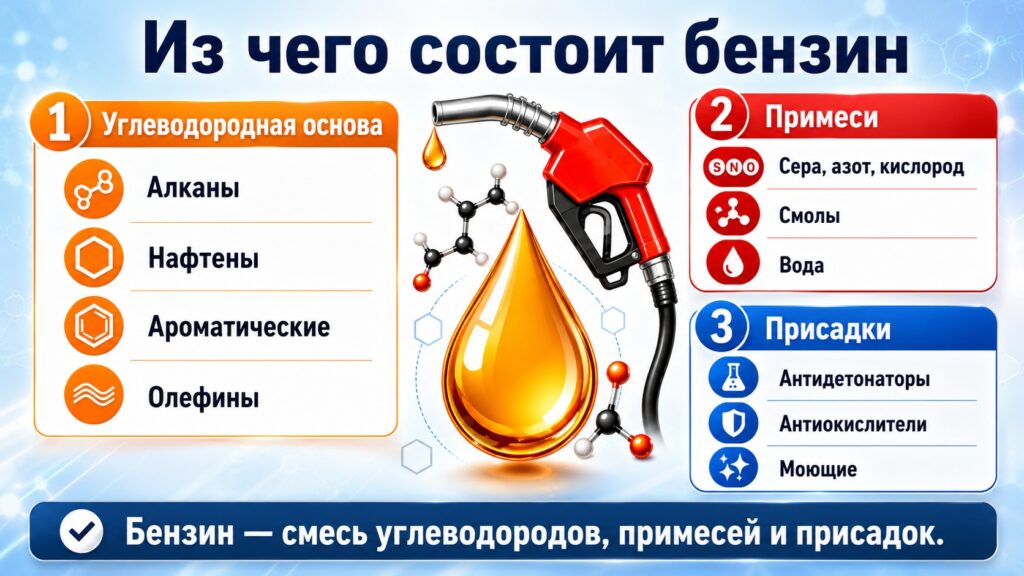
A reference guide on what gasoline is made of
It’s worth dispelling a common misconception here. The octane number of gasoline is not a measure of power but rather the fuel’s resistance to detonation — the undesirable spontaneous explosion of the mixture in the cylinder. That’s why pouring AI-98 into an engine designed for 92 isn’t always beneficial, while putting 92 where 95 or 98 is required is dangerous: it risks detonation, overheating, and engine damage.
How Oil Is Turned Into Gasoline at a Refinery
Before oil becomes fuel for our cars, it goes through several stages, each serving its own purpose.
First, the oil is prepared: it’s dehydrated, desalted, and impurities are removed. Salt and water cause equipment corrosion, and excess gases interfere with processing. Then the oil is heated and fed into a rectification column — a tall tower where separation into fractions occurs.
Different parts of oil boil at different temperatures, so they exit the column at different “floors.” At the top are the lightest fractions, below that kerosene and diesel, and at the very bottom — heavy fuel oil. Gasoline fractions boil off at approximately 35–205 degrees Celsius. But even this is not yet full-fledged AI-95: such straight-run gasoline often has a low octane number and is unsuitable for modern engines without further processing.
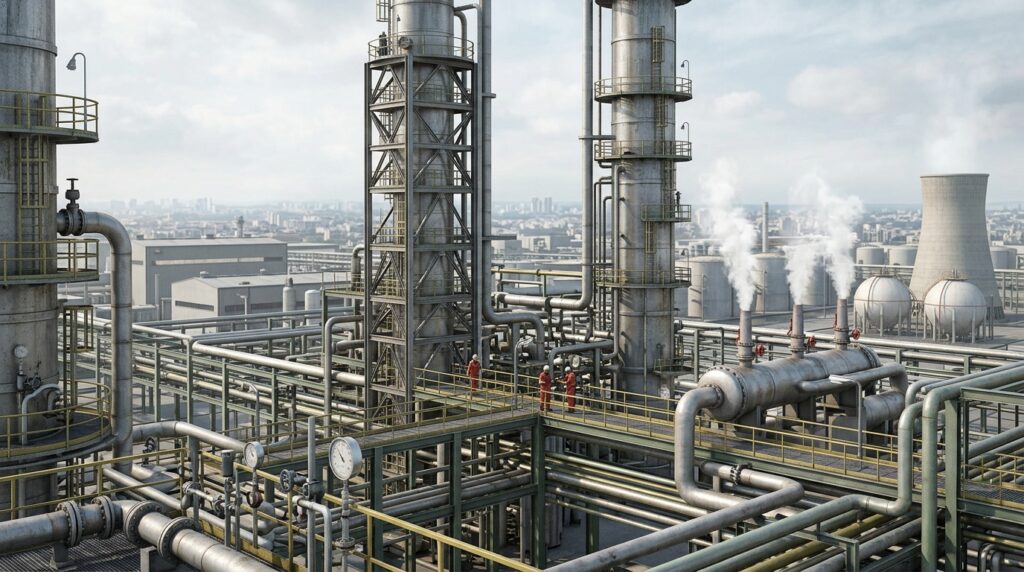
A rectification column separates oil into fractions by boiling point
Secondary Oil Refining Processes: Why Simple Distillation Isn’t Enough for Gasoline
To produce large quantities of quality gasoline, a refinery doesn’t just “pour out” fractions — it chemically transforms the molecules themselves. Several processes are used for this, each with its own role:
- Catalytic cracking breaks down heavy hydrocarbons into lighter ones and produces a high-octane component with an octane number of approximately 91–93;
- Catalytic reforming restructures low-octane fractions into detonation-resistant ones, but the feedstock must first be purified because sulfur and nitrogen “poison” the catalyst;
- Isomerization converts straight-chain molecules into branched ones, thereby raising the octane number of light fractions;
- Alkylation produces alkylate — a stable component free of sulfur and aromatics, which is considered nearly ideal for quality gasoline;
- Hydrotreating removes sulfur and nitrogen compounds, which is important both for the environment and for the car’s catalytic converter.
After all of this comes the final stage — blending, which is the mixing of components into commercial gasoline. Finished AI-95 is not a stream from a single pipe but a mixture of reformate, isomerate, alkylate, cracking products, and additives. Here the octane number, volatility, vapor pressure, and sulfur, benzene, and aromatic content are adjusted to meet standards. For the K5 class, for example, sulfur must not exceed 10 mg/kg, and benzene must not exceed 1% by volume.
How Gasoline Gets to the Gas Station
After production, gasoline undergoes laboratory testing, is stored at the refinery and fuel depots, and then is shipped by rail tank cars, tank trucks, and sometimes by pipeline. For example, Rosneft describes fuel sales through a network of fuel depots and dispatch points at refineries and separately notes that fuel must comply with the technical regulations of the Customs Union.
If you lay out the entire journey, it looks like this: oil field, oil extraction, transportation, refinery, processing, component blending, laboratory testing, fuel depot, gas station, and finally your car’s tank. Behind the simple number on the pump stands an entire chain of complex chemistry and logistics.
Can You Make Gasoline at Home
Now for the main question that many came here for. Making gasoline at home is impossible, and you shouldn’t even try.
Theoretically, one could imagine a household distillation of some petroleum mixture. But the output would be a dangerous, unstable, and poorly controlled mixture of light hydrocarbons — not AI-92 or AI-95 at all. Without industrial rectification, hydrotreating, reforming, cracking, and laboratory analysis, you simply won’t know the octane number, vapor pressure, or sulfur content. Such a “product” could cause poor engine starts, detonation, clog the fuel system, destroy the catalytic converter, and be outright poisonous.
But the main reason is not even quality — it’s safety. Gasoline is a highly flammable liquid, and its vapors form explosive mixtures with air. According to fire safety sources, the flash point of gasoline is below zero, and the explosive concentration of vapors in air is only about 1–6%. In other words, a small vapor leak in an enclosed space is enough for disaster. In real containers, concentration constantly changes due to evaporation, mixing, and even static electricity, which is why any “home distillation” of hydrocarbons is especially dangerous.
There’s also the legal side. Fuel distribution is regulated, and the technical regulation TR CU 013/2011 requires that fuel compliance be confirmed through declaration before it enters circulation. So homemade fuel production is both dangerous and illegal.
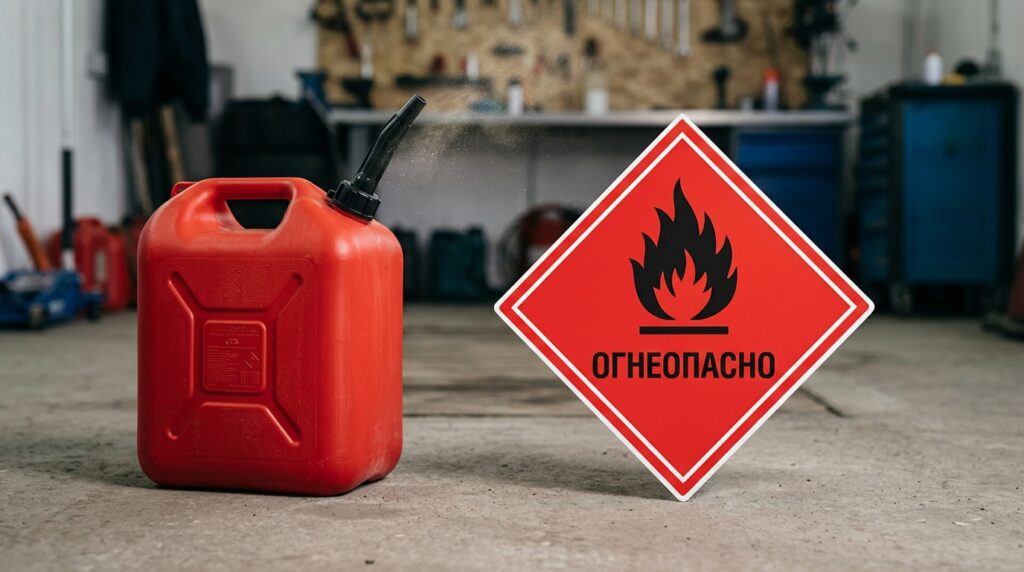
Gasoline vapors are explosive even at low concentrations in air
Can You Make Gasoline from Coal or Gas
Gasoline can be produced from sources other than oil — but this is also industrial chemistry, not a home hobby. From coal, natural gas, or biomass, synthesis gas is produced, and then through the Fischer-Tropsch synthesis process, it is converted into liquid hydrocarbons. This technology requires industrial-scale equipment, high temperatures, pressures, and specialized catalysts — far beyond anything achievable in a home setting.