Beef tea was used as a medicine, but this idea was eventually abandoned
In the 19th century, doctors prescribed patients suffering from exhaustion an unusual remedy — concentrated beef tea. Today we know this product in a completely different form, but back then it was considered a cutting-edge scientific breakthrough. From chemists’ attempts to feed the poor, an entire industry was born, and meat extract became one of the most controversial phenomena in Victorian medicine.
An Old Way to Save on Meat
In the mid-nineteenth century, German scientist Justus von Liebig, one of the founders of organic chemistry, set out to improve the nutrition of urban dwellers. At the time, meat was an expensive product, unaffordable for many families. The scientist decided to apply a scientific approach to nutrition and create the first concentrated meat extract. This remarkable story was told by the authors of Popular Science.
Liebig’s idea, proposed in 1847, involved boiling beef down to a thick paste. The assumption was that people could dilute this concentrate with water and obtain a nutritious broth. However, a serious problem arose: producing one kilogram of extract required thirty kilograms of fresh beef. Because of this, the innovative product turned out to be much more expensive than the regular meat it was designed to economize on.
The situation changed only years later, when engineer Georg Christian Giebert proposed moving production to South America. There, beef cost next to nothing, as it was a byproduct of the leather industry. In 1865, the partners founded the company LEMCO, and meat concentrate became a mass-market product, spawning numerous commercial imitations around the world.
The Beef Tea Recipe
Although Liebig and his competitors successfully sold ready-made extract, people at home began mass-producing so-called beef tea. Despite the name, the drink had nothing in common with steeping leaves, but it couldn’t be called an ordinary broth either.
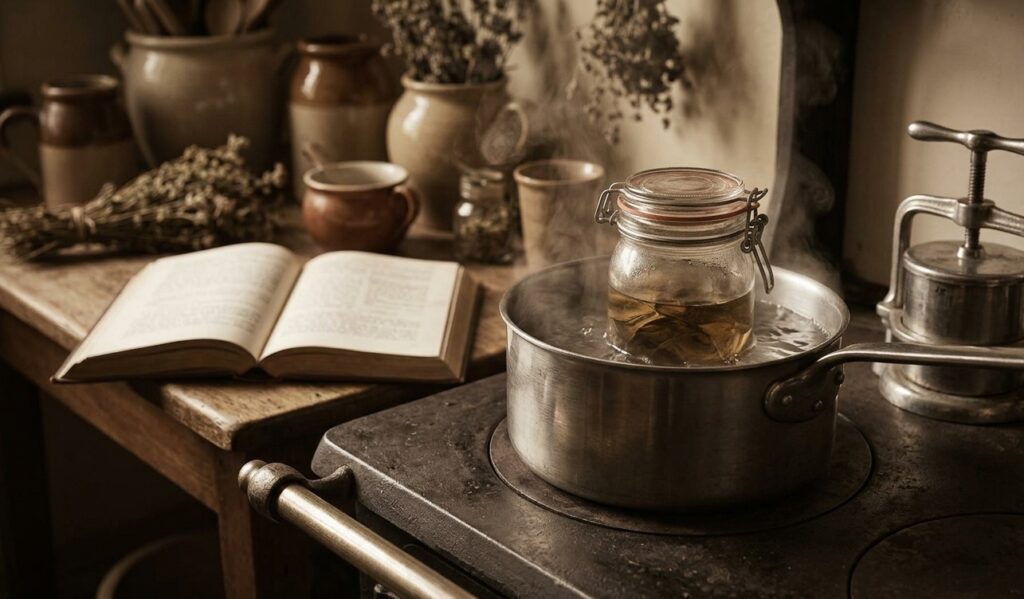
A classic broth is cooked in an open pot, where meat simmers in water for a long time. The beef tea recipe, however, was an early analog of sous-vide technology. The preparation process went as follows:
- Raw meat was finely chopped and placed in a sturdy glass jar;
- The container was tightly sealed, creating a vacuum environment and preventing steam from escaping;
- The jar was placed in a pot of boiling water and heated under pressure for a long time.
As a result, the meat released its juices, which couldn’t evaporate. The resulting liquid had a much more intense flavor than the water from ordinary broth. Modern research confirms that cooking in a sealed container under pressure does indeed preserve more nutrients compared to regular boiling in an open pot.
Beef Tea in 19th Century Medicine
Beef tea wasn’t consumed for pleasure. Society perceived it as a powerful remedy for patients with sensitive digestion or those recovering from severe blood loss. Medical reference books of the era even recommended enemas with beef tea for treating delirium tremens in cases of severe alcohol dependence.
For those who required maximum concentration of benefits, there was yet another method. In kitchens and hospitals, people used a metal meat juice press. A piece of beef was lightly heated, and then all its juices were literally squeezed out using a heavy cast-iron mechanism. Sometimes this liquid was mixed with jar-made beef tea to enhance the effect.
In 2019, culinary video blogger EmmyMade recreated this recipe using an original 19th-century press. It turned out that the drink was tasty but had a pronounced metallic aftertaste. This is unsurprising, since the extract was rich in heme iron, found in blood, which made it an effective remedy for anemia in an era before the invention of modern vitamins.
The Transformation of Medicinal Extracts into a Culinary Seasoning
At the turn of the 19th and 20th centuries, medicine began to change rapidly. The emergence of national drug quality standards displaced folk medicine, which was especially popular at the time. Doctors stopped prescribing meat juice to patients, realizing that it could not replace proper therapy with real medications.
However, the extract manufacturers didn’t go bankrupt. They noticed in time that people continued buying their product simply because it made food tastier. The thick, slightly salty paste, rich in natural monosodium glutamate, turned out to be an ideal flavor enhancer.
Today, we are unlikely to slow-cook beef in a glass jar to treat a cold. However, this story perfectly illustrates how the search for an innovative medical remedy can accidentally give the world a technology without which it’s hard to imagine the shelves of modern supermarkets.