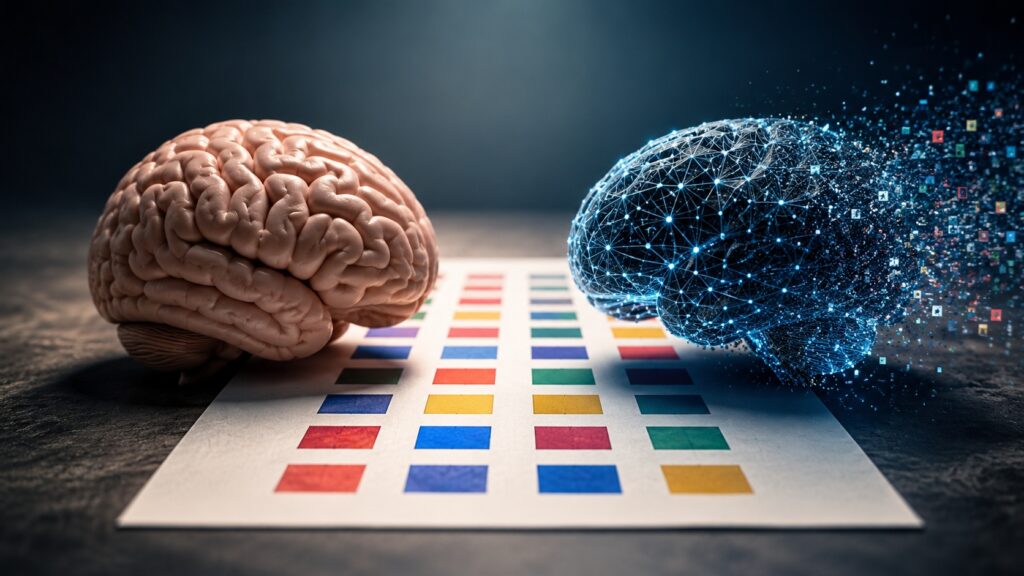
Neural networks lose attention faster than humans
The most popular neural networks failed a simple attention test that humans pass almost without thinking. Researchers took a classic psychological experiment and discovered that the longer the test runs, the more AI accuracy falls apart. Some systems dropped from 90% correct answers to near-total failure. It sounds paradoxical because neural networks write essays, solve complex problems, and even compose music for us, yet they stumble where humans have no trouble at all.
What Is the Stroop Test and Why Do Psychologists Use It
The Stroop test is one of the most well-known psychological experiments, invented nearly a hundred years ago. Psychologists use it to assess attention, concentration, and self-control.
The concept is simple. You are shown the names of colors, but they are printed in different ink colors. Sometimes the word and the color match — for example, the word “red” written in red. Other times they conflict — for example, the word “red” printed in blue ink. The participant’s task is to name the ink color, not read the word itself.
It seems easy enough. But this is exactly where the catch lies, because reading words is automatic for humans. The brain has to suppress the habitual urge to read the word and instead focus on the ink color. It is precisely this struggle that makes the test valuable for science.
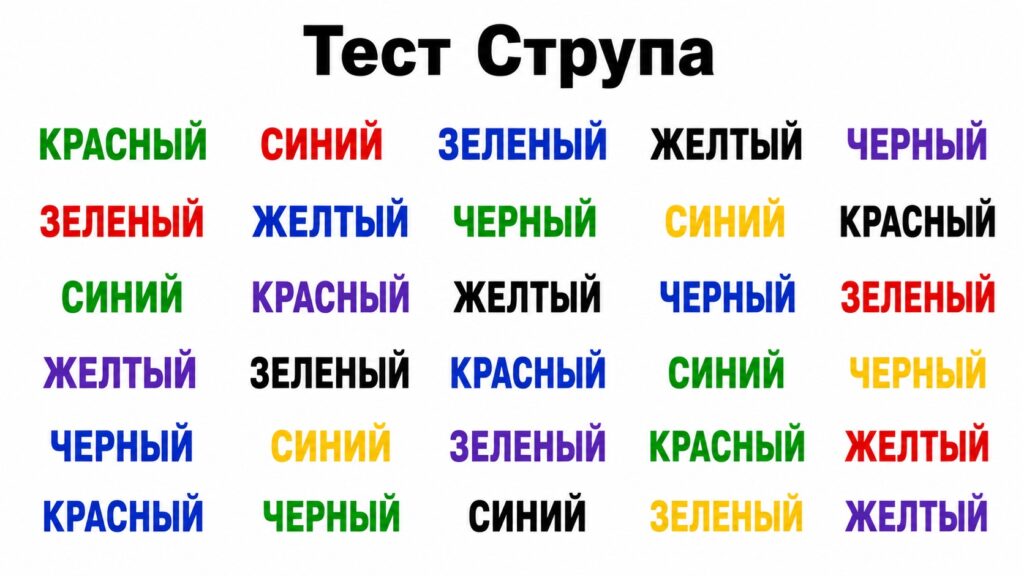
Try taking the Stroop test yourself
How Scientists Tested Artificial Intelligence’s Attention
A team led by Suketu Patel set out to determine whether modern large language models handle this challenge the same way humans do. These are the very systems behind ChatGPT, Claude, and Gemini. They are trained on massive volumes of text and pick up language patterns, which is why their responses often seem almost human.
On short lists, everything looked great. When models were given five color names, they answered well, even when the word and ink color didn’t match. Problems began when the list grew longer.
Here is what the study showed using GPT-4o as an example:
- on five words — 91% correct answers
- on ten words, accuracy dropped to 57%
- on forty words, only 15% remained
A similar pattern repeated with other top systems. Claude 3.5 Sonnet held steady up to twenty words but then sharply fell to 24% accuracy on forty-word lists. The same trends were observed by the researchers in GPT-5, Claude Opus 4.1, and Gemini 2.5.
Why AI Loses Focus on Long Tasks
The most interesting part came when matching and conflicting pairs were mixed within a single list. Under these conditions, the accuracy of neural network responses on conflicting words dropped to nearly zero.
According to the researchers, the models could not maintain the instruction to name the ink color. Instead, they increasingly defaulted to simply reading the words themselves. In other words, the systems proved unable to consistently suppress the response most strongly ingrained through training — that is, reading the word.
This is where a fascinating parallel with humans emerges. People are also much better at reading words than naming ink colors, and this bias never goes away. Yet despite having the same tendency, humans maintain high accuracy even on long lists of conflicting words and colors. Neural networks showed no such resilience.

The longer and more confusing the task, the more the neural network’s accuracy falls apart
How Human Attention Differs from AI Attention
The main conclusion of the study lies in the difference of mechanisms. Although modern artificial intelligence demonstrates impressive language abilities, its attention works differently from the processes in a living brain.
Humans can hold onto a specific goal and filter out everything irrelevant, even when there is a lot of information and the temptation to get distracted is high. The results show that current models struggle with such cognitive control when the task becomes increasingly voluminous and demanding.
The researchers believe that this collapse in accuracy points to fundamental limitations of language models. AI sometimes convincingly imitates human behavior, but its ability to maintain focus works nothing like it does in people. This is worth remembering when we entrust neural networks with long and monotonous tasks where it is easy to lose the thread.
What the Stroop Test Failure Means for AI Applications
It is important not to overstate the conclusions and to remember that the Stroop test is a narrow check, not a verdict on all of AI. But it clearly reveals a weak spot in neural networks that is easy to miss in short conversations. As long as a model answers a couple of lines, it looks flawless, but load it with a long sequence containing distracting elements, and it starts to falter.
So the longer and more monotonous the task for a neural network, the more carefully you should double-check the result. Behind smooth and confident answers, there is not always a stable maintenance of the goal. And for developers, this is a hint about where to move next — that is, teaching models not to lose focus during long reasoning tasks.