Beating baldness is possible. The key is knowing how
Humanity has known about baldness for thousands of years and keeps discovering new causes of hair loss. However, truly effective remedies for combating this phenomenon are few and far between. That’s why news from clinical trials sounds almost like a sensation: the experimental pill VDPHL01 helped nearly 8 out of 10 men who were experiencing hair thinning. And this isn’t just another shampoo with bold promises — it’s a drug that has undergone rigorous testing. Let’s break down what exactly happened and how reliable it is.
What Results Did the VDPHL01 Pill Show in Trials
The trial followed strict protocols: participants were divided into groups, some received the actual drug, while others received a placebo. Neither the doctors nor the patients knew who received what. This is exactly how they verify whether a medication truly works rather than being just a placebo effect.
The study involved 519 men with mild to moderate baldness. Improvement in hair coverage was noted by 79.3% of participants taking one dose per day, and 86% of those taking two doses — compared to 35.6% in the placebo group.
Looking at the raw density numbers, the picture is even more striking. By the sixth month, the average number of hairs in the target zone increased by 30.3 hairs per cm² with once-daily dosing and by 33.0 hairs per cm² with twice-daily dosing — compared to 7.3 hairs per cm² in the placebo group. In other words, hair growth was roughly four times greater than in those who took the dummy pill.
A Medication with Proven Hair Restoration Effectiveness
The figure of “nearly 80% success” means little on its own without comparison. The key is the gap with placebo. The placebo effect is quite powerful: a person believes they are being treated, and they genuinely feel like they have more hair. That’s why 35.6% “improvements” in the control group represent a normal baseline.
Against this backdrop, the drug’s results look convincing. A statistically significant difference from placebo in hair count and physician assessments appeared as early as the second month. This is important: the effect came early and held steadily, rather than appearing randomly at the end of the trial.
Both investors and dermatologists are watching the results. After the data was published, Veradermics shares rose 47% — from $67.84 to $100.10 in a single day. Jefferies analysts had estimated the drug’s potential market at over $2 billion even before the report.
How Oral Minoxidil for Hair Growth Works
The most interesting part: the molecule at the core of the drug is not new at all. It’s minoxidil — a long-known hair growth agent. Minoxidil has been used topically for baldness since the late 1980s, when the FDA approved a 2% solution, and around 2006 — a 5% foam.
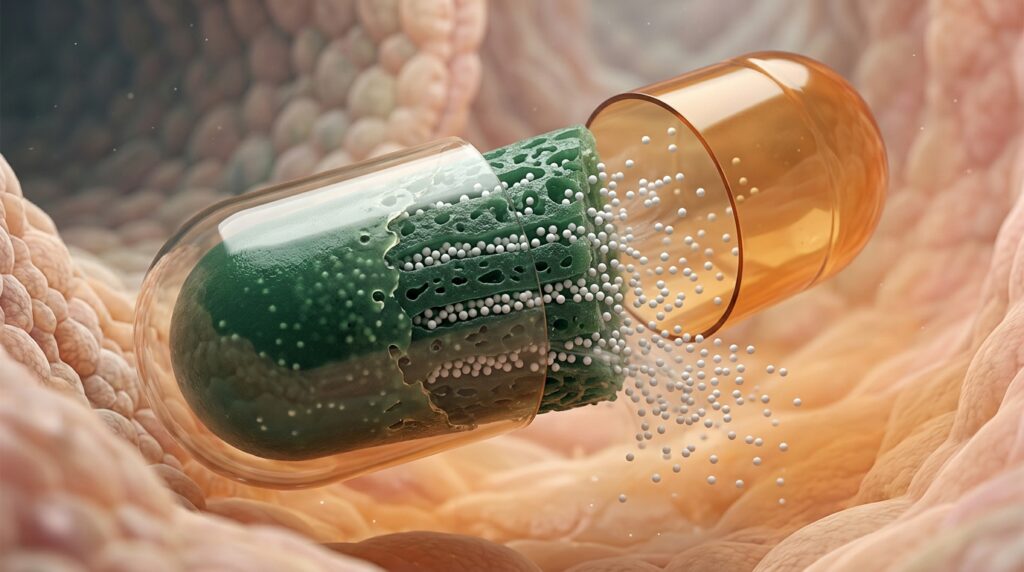
The gel matrix gradually releases minoxidil, avoiding sharp spikes in blood levels
Minoxidil in pill form is also prescribed by doctors, but “off-label.” And this approach has a problem. Oral minoxidil has been used for hair loss unofficially for years, but it carries risks for the heart — fluid retention, rapid heartbeat, and pericardial effusion — especially at doses sufficient for noticeable hair growth.
This is precisely the problem the new drug attempts to solve. The extended-release formula uses a gel matrix that gradually and steadily delivers minoxidil to hair follicles. This release profile is designed to promote hair growth without blood concentration spikes that could trigger heart problems. Simply put, instead of a sharp “hit” of the dose, the drug releases the medication slowly and evenly — like an IV drip versus a shot.
And judging by the data, it worked. The study recorded no treatment-related serious side effects and noted no specially monitored adverse cardiac events. Moreover, the rate of treatment discontinuation due to side effects was comparable between the drug group and the placebo group.
What This Could Mean for Millions of People with Baldness
If the drug is approved, the entire approach to treatment will change. The company believes that the results position VDPHL01 to become the first FDA-approved baldness pill of its kind in nearly 30 years and potentially the best option for the 50 million men with this condition in the United States.
Convenience also plays a role. Currently, many hair loss treatments are foams and solutions that need to be rubbed into the scalp. A once-daily pill would be noticeably simpler for many people.
It’s important to understand what stage everything is at. The positive data comes from Part A of the “302” study, which included 519 adult men with mild to moderate androgenetic alopecia. One successful phase does not yet equal approval.
What’s Next for the Drug Trials
The research program doesn’t end here, and the drug’s fate depends on the next steps.
- The second pivotal trial in men — study “304” — has already completed enrollment. This is a randomized, multicenter, placebo-controlled, double-blind study evaluating the efficacy and safety of VDPHL01 in 536 men with mild to moderate baldness.
- Top-line results from the second male Phase III trial are expected in the second half of 2026.
- Separately, work is underway on female baldness — the company has enrolled women in a dedicated Phase II/III trial.
Only after data accumulates from all these trials will the regulator be able to make an approval decision. So a “baldness pill at the pharmacy” is still a prospect, not today’s reality.
The key change: for the first time, a familiar medication has been reformulated to work in a convenient pill while being safer for the heart — and this has been confirmed in a rigorous trial. The definitive answer will come from the results of the second Phase III, expected in the second half of 2026. If they confirm the success, millions of people may indeed gain the first truly new solution to the baldness problem in decades.