Why the July sky will be the most spectacular of the year: the Perseid meteor shower
In July 2026, night sky enthusiasts won’t be bored. Over the course of the month, there will be planetary conjunctions, meteor showers, lunar-planetary meetups, and a rare chance to see the bright heart of the Milky Way. According to National Geographic, eight major celestial events await us this month, and most of them can be seen with the naked eye — all you need is clear skies and good timing.
A Planetary Parade at Dawn: Saturn, Mars, and the Pleiades in Early July
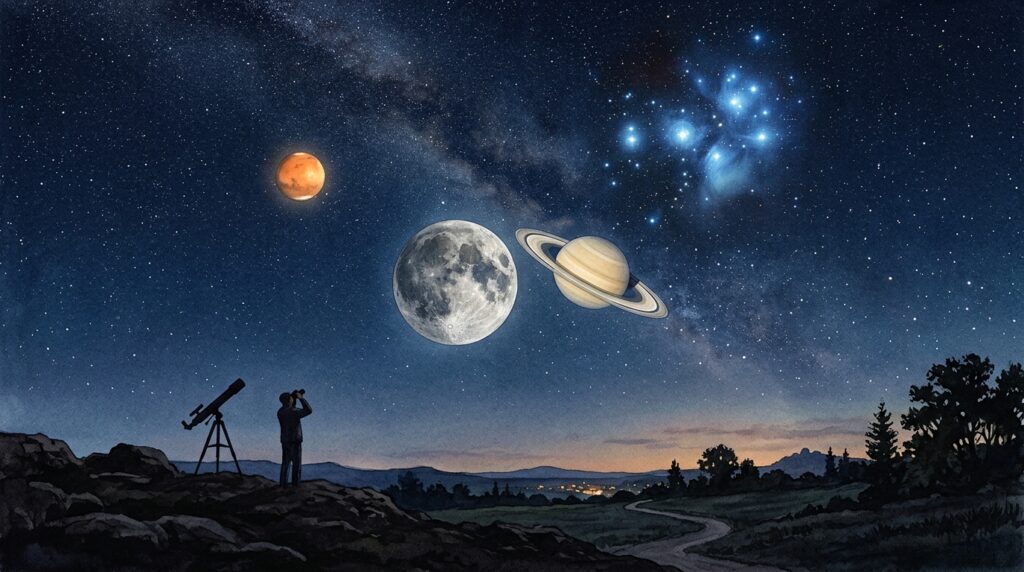
The first half of July will reward those willing to get up early. On the nights of July 7 and 8, Saturn will pass near the Moon in its last quarter phase — look for the pair near the eastern horizon after midnight. They will remain visible together until dawn, creating one of the most beautiful sights of the month, accessible without any equipment. By morning, Mars and the famous Pleiades star cluster will join them.
On July 11, a particularly photogenic scene will unfold: a thin crescent Moon will form a compact triangle with orange Mars and the bluish stars of the Pleiades. The group will rise above the eastern horizon about two hours before sunrise.
Everything is perfectly visible to the naked eye, but binoculars dramatically enhance the experience — they reveal dozens of additional stars within the Pleiades, one of the nearest and most recognizable open clusters. The thin crescent Moon at this time is also excellent for observation: along the terminator line, the boundary between light and shadow, craters, mountain ridges, and valleys stand out clearly.
How the July 14 New Moon Reveals the Bright Heart of the Milky Way
The most valuable opportunity of the month is tied to the new Moon on July 14. When the Moon’s bright light isn’t interfering, stars, distant nebulae, and globular clusters suddenly become visible in dark locations. This period is considered the best in July for observing the glowing center of the Milky Way, whose dense core contains about 100 billion stars.
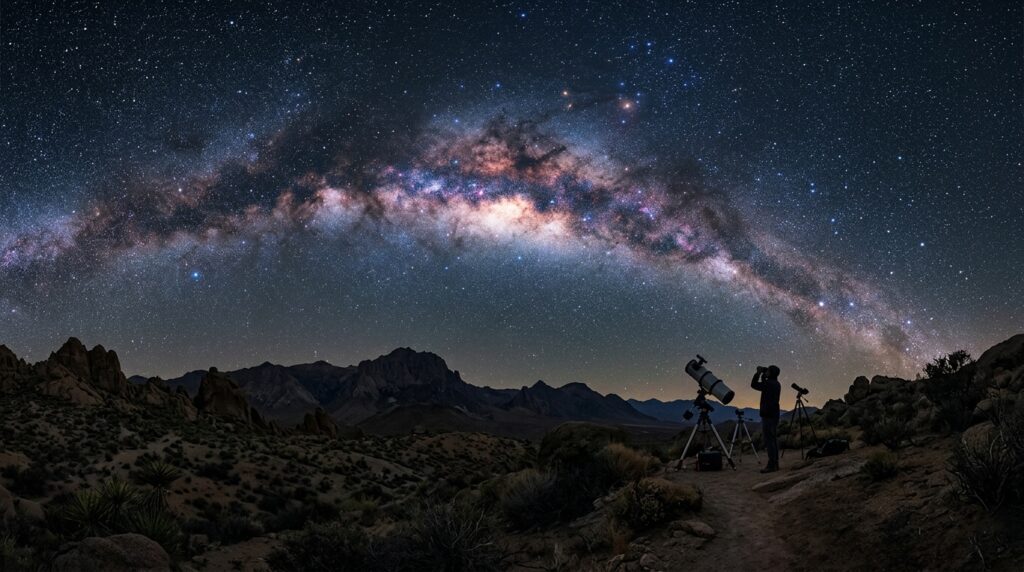
On a moonless night, the Milky Way’s core stretches across the southern sky
A small practical note: your eyes need about thirty minutes to adapt to the darkness. If you drive away from city lights and let your vision adjust, the galactic center will be visible across the southern sky without any optics. National parks and certified dark sky zones are especially good for this.
Experienced observers can look for the Ring Nebula and the Great Hercules Cluster, while a simple landmark called the “Teapot” in the constellation Sagittarius points to the brightest part of our galaxy. These are some of the best conditions for viewing the Milky Way all year.
Venus, the Buck Moon, and the Giant Moon Illusion
Evening observers will get their reward too. On July 17, bright Venus will appear near a thin crescent Moon above the western horizon shortly after sunset. Venus is only visible for a couple of hours before setting below the horizon, but its brilliance makes this conjunction one of the easiest-to-observe events of the month. For photographers, it’s an excellent target during twilight, when the fading daylight paints the western sky.
Then attention shifts to the full Moon on July 29 — the so-called Buck Moon. The name is associated with the period when male deer rapidly grow new antlers. This full Moon looks especially striking when rising or setting near the horizon.
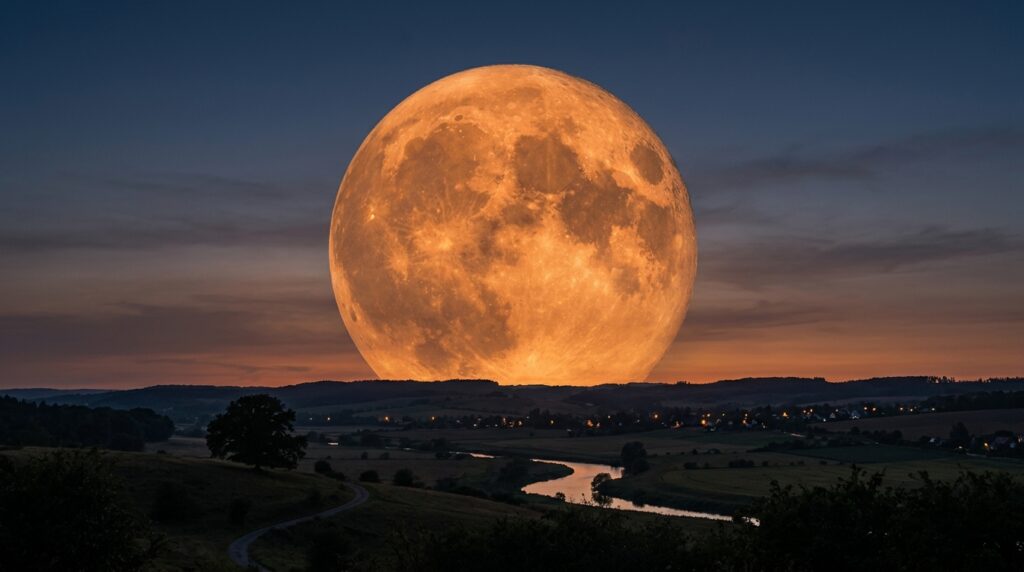
Near the horizon, the full Moon appears noticeably larger than it actually is
It’s at moments like these that the Moon illusion kicks in — an optical effect that makes the Moon’s disk appear larger near the horizon than when it’s high in the sky. In reality, the Moon’s size doesn’t change; it’s all about how our brain perceives it. The effect will be strongest on the evenings of July 28 and 29.
Two Meteor Showers in Late July: the Delta Aquariids and Alpha Capricornids
The month wraps up with two meteor showers that peak almost simultaneously. The Southern Delta Aquariids are active from July 12 to August 23 and reach their maximum on the nights of July 30 and 31. Under ideally dark skies, they produce about 20 meteors per hour. The shower is more convenient for Southern Hemisphere observers, but many meteors are visible further north as well, especially from lower northern latitudes.
Peaking at the same time are the Alpha Capricornids — a small shower of only about five meteors per hour, yet famous for its exceptionally bright fireballs. These flashes can break through even moonlight glare. However, there’s a catch: this year, the peak of both showers coincides with a bright waning Moon. Its light will hide some of the fainter meteors, so fewer “shooting stars” will be visible.
The Return of Comet 10P for Patient Observers
July offers more than just planets and meteors. Throughout the month, periodic comet 10P gradually brightens — it rounds the Sun approximately once every five years. In early July, a small telescope is usually needed to find it near the constellation Capricornus. But by the end of the month, the comet becomes bright enough to be spotted with binoculars under dark skies.
Comet 10P will reach its maximum brightness in early August, but July provides an excellent opportunity to follow its return. Together with planetary conjunctions, lunar phases, Milky Way viewing, and two meteor showers, the comet rounds out a program that makes it worth going outside nearly every week of July — after sunset or before dawn.