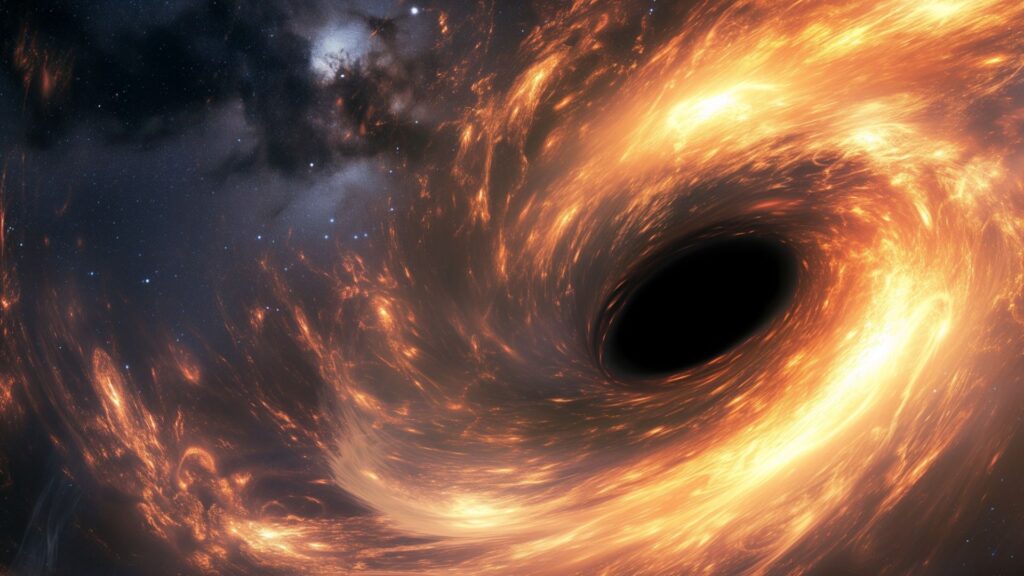
The first photograph of a black hole was taken only in 2019, and many more discoveries lie ahead
Black holes were long considered something out of the realm of science fiction. Books were written and movies were made about them, but nobody truly knew whether they actually existed. However, scientists confirmed their existence in the 20th century, and in the 21st century obtained the first images. And it turned out that these objects are far more complex than just “cosmic vacuum cleaners” sucking in everything around them. Some of their properties still puzzle scientists and force them to reconsider the laws of physics. We’ve gathered amazing facts about black holes, and some of them will definitely surprise you.
Photographing a black hole required a telescope the size of Earth
According to Interest Engineering, the famous orange ring shown in the 2019 photograph could not have been captured using a single observatory. To obtain this image, scientists linked radio telescopes around the world into a unified Event Horizon Telescope network.
This complex synchronization created a virtual telescope the size of our planet. In reality, we don’t see the gravitational funnel itself, but superheated material that glows brightly just before disappearing forever into the darkness.
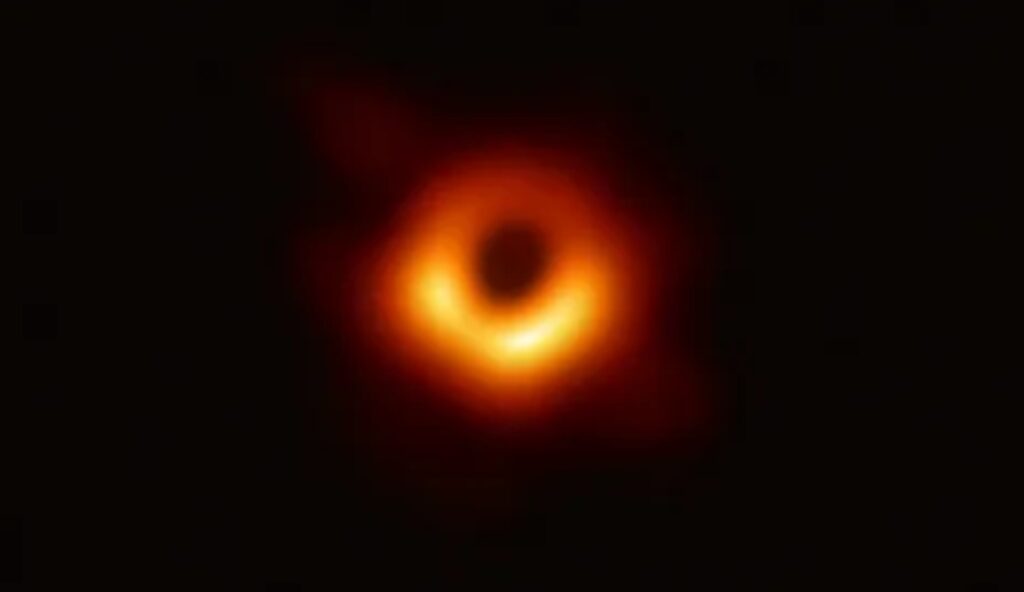
The first photograph of a black hole, taken in 2019. Image source: NASA
The darkest objects in the universe create incredible luminosity
A black hole itself emits no light, but the matter falling into it shines blindingly bright. Gas and cosmic dust spiral into a dense disk that heats up to millions of degrees.
Supermassive black holes can power quasars — objects so bright that their light easily outshines entire galaxies containing hundreds of billions of stars.
How astronomers find black holes in space
Since a black hole cannot be seen through a regular optical telescope, researchers look for it by its influence on its surroundings. They observe stars orbiting an empty spot, or detect powerful radiation from superheated gas.
Modern science relies on indirect methods that have already helped discover thousands of such objects throughout the universe and confirm the correctness of theoretical physicists.
Energy jets from black holes exceed the size of galaxies
Although nothing can escape from the inside, different rules apply at the boundary of a black hole. Powerful magnetic fields capture some of the infalling matter and violently eject it in the form of narrow jets at nearly the speed of light.
Such plasma ejections extend for millions of light-years. Remarkably, these energy jets turn out to be much larger and longer than the galaxies at whose centers they form.
A black hole’s rotation distorts space
Black holes spin incredibly fast around their axes. By consuming interstellar gas, dust, and even merging with each other, they continuously increase their speed.
Some of them spin at the limit allowed by Einstein’s theory of relativity. Because of this, a black hole literally twists space and time around itself, creating physical anomalies.
Why black holes don’t suck in everything around them
Contrary to popular myth, these objects don’t function as giant cosmic vacuum cleaners that ceaselessly pull matter into themselves. If you remove gas and dust from their immediate vicinity, they become completely calm and unnoticeable.
Stars and planets can safely orbit a black hole for billions of years. The key condition is to stay at a sufficient distance from the so-called event horizon, from which there is no return.
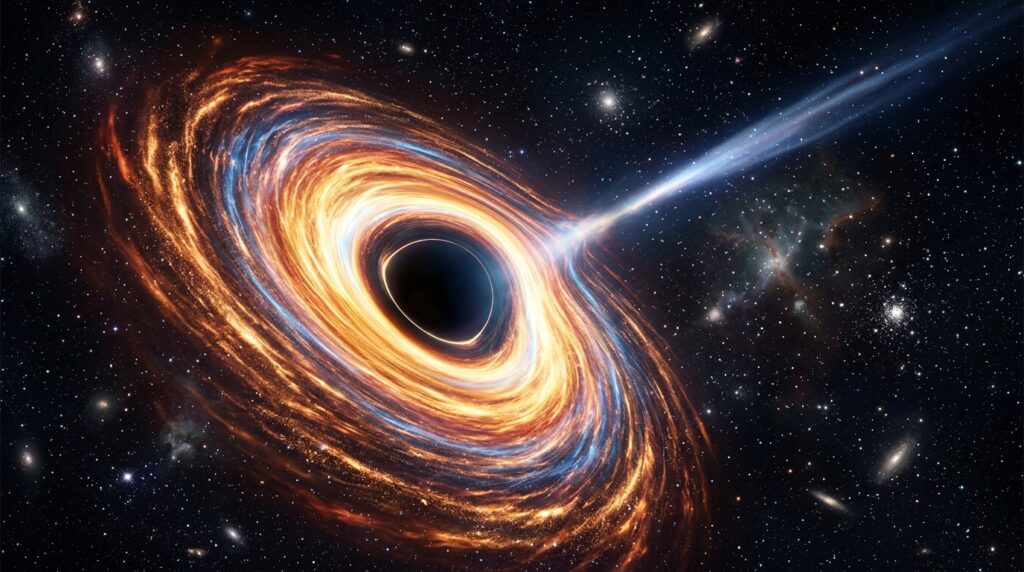
If there is no matter nearby, a black hole becomes invisible to telescopes
Black hole collisions create ripples in the fabric of the universe
When two black holes attract each other and merge into one, a catastrophe of unimaginable scale occurs. This process is accompanied by the release of such colossal energy that it generates gravitational waves.
These waves spread through space like ripples from a stone thrown into water. Thanks to modern technology, ground-based observatories have learned to physically detect these oscillations of space.
Today, the study of black holes has gone far beyond dry theory. By observing them, scientists test fundamental laws of nature and try to understand how the world works. Each new observation proves that the cosmos operates in ways far more complex and fascinating than we previously thought.