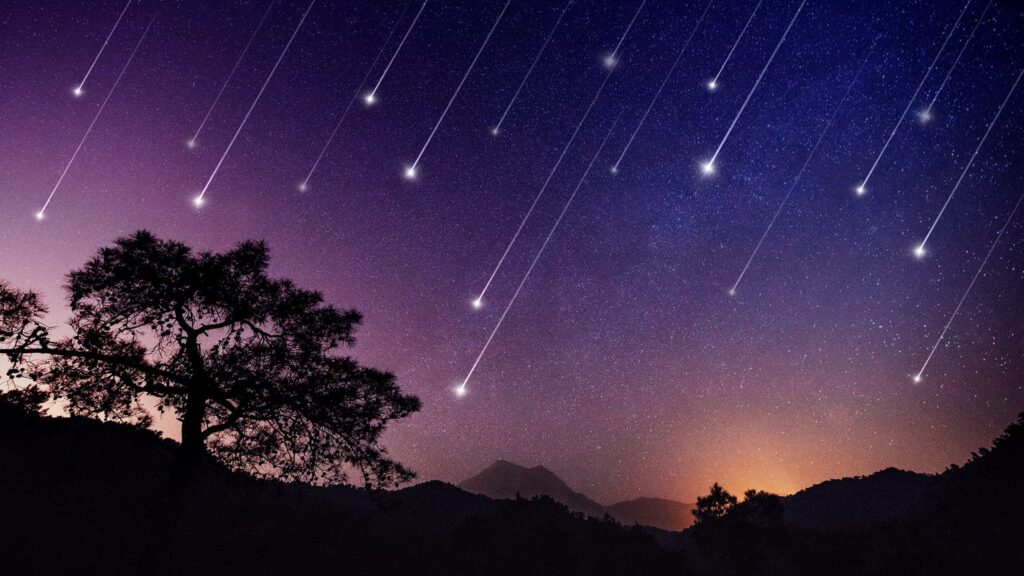
July meteor showers 2026: what to expect and when to watch. Image source: starwalk.space
In July 2026, the sky will treat us to five meteor showers — from the barely noticeable Pegasids to the fairly active Southern δ-Aquariids. But there’s a catch: the Moon will interfere with half of the showers this year, while conditions in the first days of the month are quite good. Below is a simple breakdown by date so you know exactly which night is worth heading out under the open starry sky.
What Is a Meteor Shower in Simple Terms
A meteor shower isn’t stars falling, nor asteroids or meteorites — it’s tiny dust particles and pebbles left by a comet along its path around the Sun. When Earth passes through this dust trail, the particles enter the atmosphere at tremendous speed and burn up, leaving a bright streak across the sky. That’s all the magic there is.
Each shower has a radiant — a point from which meteors appear to originate and spread out. Usually the shower is named after the constellation where the radiant is located: Pegasids come from Pegasus, Aquariids from Aquarius. You don’t have to look directly at the radiant — meteors can flash across any part of the sky.
The decisive factor for observation is the Moon phase. A bright Moon washes out the sky and “swallows” faint meteors. That’s why the best nights are those that coincide with a new moon or a thin waning crescent. With that knowledge, let’s go through the dates.
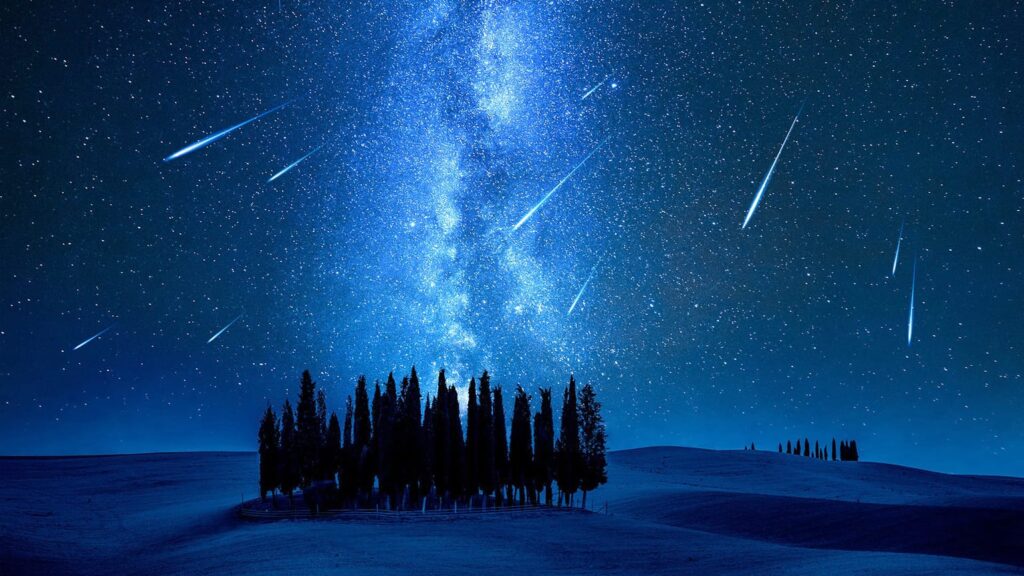
Meteors enter Earth’s atmosphere and burn up, leaving a bright trail. Image source: starwalk.space
July 9–10: July Pegasids — the First Meteor Shower of the Month with Good Conditions
The month opens with the July Pegasids, peaking on the night of July 9–10. The shower is weak and not very well studied — under ideal conditions it produces only about three meteors per hour. Its radiant is located near the star Markab in the constellation Pegasus, and the parent body is most likely comet C/1979 Y1 (Bradfield).
However, the lunar conditions are favorable: the peak falls on a waning crescent moon, which won’t interfere with observations. At mid-northern latitudes the radiant stays above the horizon all night, but the best time to watch is after midnight local time — that’s when your chances of catching a flash are higher. The shower isn’t spectacular, but it’s a pleasant warm-up before the main events of the month.
July 28: July γ-Draconids and Southern Piscids
On the same day, July 28, two showers reach their maximum — and both are unlucky with the Moon. The July γ-Draconids are a small shower with an unknown parent body, typically producing about five meteors per hour. Interestingly, in 2016 there was a surge of up to 30–40 meteors per hour, and on July 28, 2026, Earth will pass through roughly the same point. In theory there could be more meteors than usual, but the peak nearly coincides with a full moon, so the bright moonlight will seriously hamper observations.
The second shower of the day is the Southern Piscids, a faint and little-known shower with its radiant near the bright star Fomalhaut. It also typically produces about five meteors per hour and is better seen from the Southern Hemisphere. The best time to observe it is in the pre-dawn hours, but here too the near-full moon spoils everything — catching these meteors in 2026 will be nearly impossible.
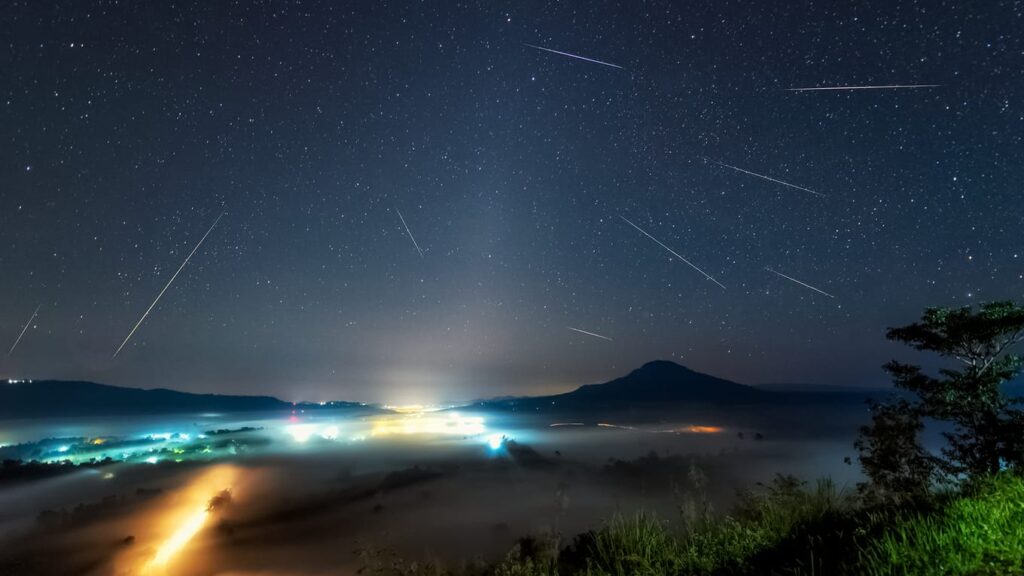
The best way to watch a meteor shower is to lie down and take in as much sky as possible. Image source: starwalk.space
July 30–31: Southern δ-Aquariids and α-Capricornids — the Best Night of the Month
July saves the most interesting part for the end. On the night of July 30–31, two showers peak simultaneously, and together they offer the best chance to catch many “shooting stars.”
The Southern δ-Aquariids are one of the most active showers of the southern sky — under good conditions they can produce up to 25 meteors per hour. The radiant is in the constellation Aquarius, and the likely parent body is comet 96P/Machholz. Peaking alongside them are the α-Capricornids: this shower is less abundant (about five meteors per hour), but it’s famous for its slow, bright meteors and occasional real fireballs. Its parent comet is 169P/NEAT.
The downside is that both showers peak shortly after the full moon, so moonlight will be a nuisance. But you shouldn’t write off this night entirely: if you head to a dark location and hide the Moon behind a tree, building, or hill, the chance of seeing bright meteors remains quite real.
How to Watch the July 2026 Meteor Showers and Not Miss a Thing
You don’t need much for a successful observation — no telescope, no binoculars. A dark sky, warm clothing, and a bit of patience are enough. Here are the key tips for watching meteor showers:
- Get as far away from city lights as possible — the darker the sky, the more meteors you’ll see.
- Choose an open spot without tall trees or buildings blocking your view.
- Let your eyes adjust to the darkness for 15–20 minutes and avoid looking at your phone.
- Don’t stare at one point: lie on your back and scan a wide area of the sky.
- Plan your outing for nights when the Moon isn’t a problem — in July, that’s primarily the night of July 9–10.
If the summer season hooks you, there will be plenty more reasons to look at the night sky later in the calendar. In autumn, for example, the Orionid meteor shower is worth watching, and in winter, don’t miss the Geminids — one of the most beautiful meteor showers of the year.