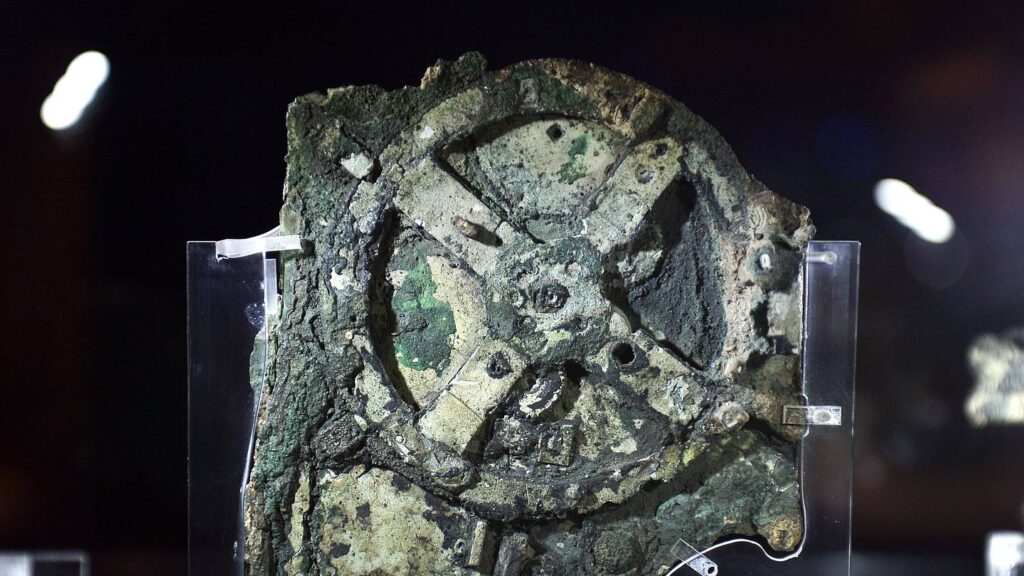
Antikythera mechanism, 205 BC.
We tend to think that science only moves forward: one discovery builds upon another, and nothing is ever lost. But history knows of cases to the contrary: lost technologies sometimes have to be recovered centuries later. Some inventions were created and then completely lost — along with their creators, secret recipes, or burned records. And what’s particularly interesting is that some of them modern science still hasn’t been able to reproduce. Let’s clarify right away: classic examples like Stradivarius violins and Damascus steel don’t belong here. Their techniques were once lost, but modern craftsmen have essentially learned to make instruments and blades that are just as good. But the five stories below are about things we still haven’t fully figured out.
Girolamo Segato’s Petrification Method
Italian anatomist and naturalist Girolamo Segato first went on an archaeological expedition to Egypt in 1818. Inspired by ancient Egyptian embalming, five years later he developed his own technique for preserving bodies. But his approach was fundamentally different from the Egyptians: they dried corpses, while Segato literally turned bodies into stone, mineralizing them while preserving their original shape and color.
American surgeon Valentine Mott, who visited Segato, later wrote that after treatment the body became “hard as stone, it could be sawn into slabs” and polished. It sounds eerie, but it was precisely this durability that astonished his contemporaries.

Portrait of Girolamo Segato
The problem is that Segato categorically refused to reveal his method. After several attempted burglaries at his home in Florence, he destroyed all his scientific notes. When the scientist died in 1836, the secret of petrification went with him. On his tombstone in the Basilica of Santa Croce, a bitter inscription reads: “Here lies Girolamo Segato, his body hard as stone — if only his art had not perished with him.”
Greek Fire — Byzantium’s Napalm
If you’ve watched “Game of Thrones,” you’ll remember wildfire — green flames that couldn’t be extinguished with water. This fictional weapon had a real prototype, though without the dramatic green color.
It is believed that Greek fire was invented by Kallinikos of Heliopolis around 672 AD. Its recipe was the strictest state secret of the Byzantine Empire. Up until the 13th century, the Byzantines successfully used this weapon in wars, especially in naval battles. The incendiary mixture was either hurled in pots like grenades or sprayed in streams from special tubes directly onto enemy ships.
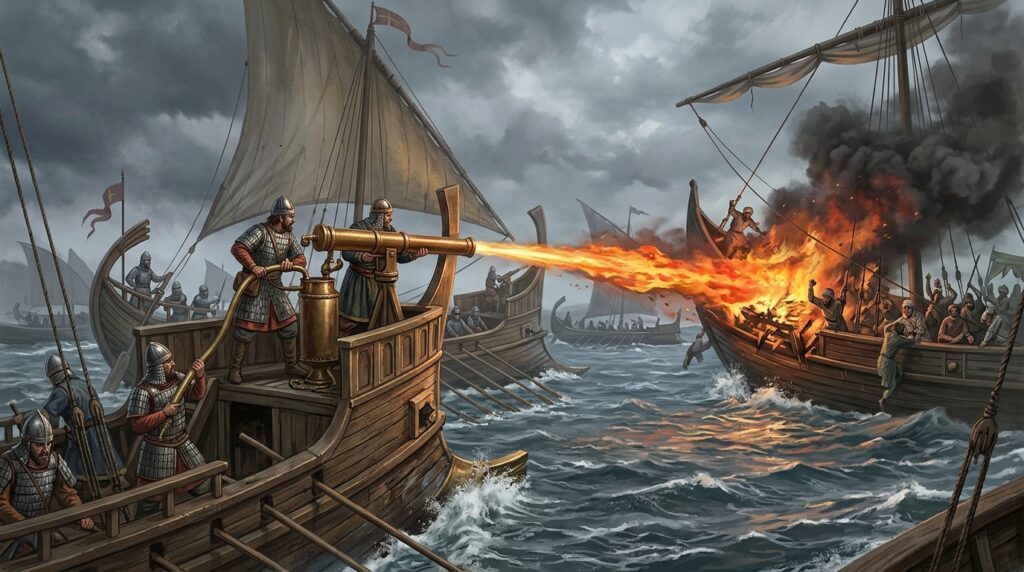
Byzantines sprayed Greek fire in streams from tubes onto enemy ships
The exact composition of Greek fire remains unknown to this day. Historians suggest that the base of the mixture was petroleum. Historian John Haldon believes it may also have included naphtha (a highly flammable variety of crude oil) and pine resin, which made the compound burn longer and hotter. But this is merely a reconstruction: the true recipe remains unsolved.
Why Roman Concrete Is Stronger Than Modern Concrete
Concrete is literally one of the building blocks of civilization. But here’s the surprise: Roman concrete, used 2,000 years ago, is in some respects better than ours. Modern concrete deteriorates over time, while ancient Roman concrete grows stronger, especially when in contact with seawater.
“Contrary to the principles of modern cement-based concrete, the Romans created a rock-like material that thrives in open chemical exchange with seawater,” explains geologist and geophysicist Marie Jackson. This is remarkable: what corrodes our structures only strengthened the Roman ones.
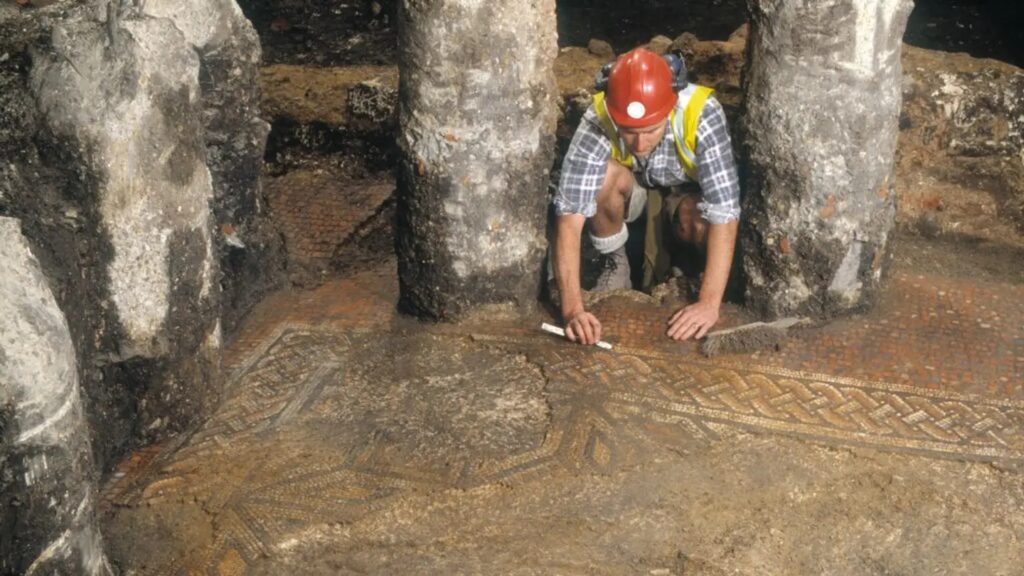
An archaeologist excavates a mosaic floor with a complex geometric pattern in a late Roman extension
The secret lies in a chemical reaction. When lime and volcanic ash in the concrete’s composition come into contact with seawater, new minerals begin growing directly inside the material. These minerals additionally reinforce the concrete from within. Scientists are currently mapping these compounds, trying to recreate the incredibly durable material. If they succeed, the benefits for the construction industry would be enormous — but no exact recipe has survived in written sources.
How Zhang Heng’s Seismoscope Worked
Zhang Heng was an outstanding Chinese scholar and statesman of the Han Dynasty era. He contributed to mathematics, astronomy, and cartography, and in 132 AD he created the first known seismoscope — a device for detecting earthquakes. The only problem is that exactly how this device worked remains a mystery.
Based on written descriptions, its external appearance has been recreated. The device resembled a large urn, around whose circumference eight dragon heads were arranged, oriented toward eight cardinal and intercardinal directions. When the device detected underground tremors, a ball would drop from a dragon’s mouth directly into the mouth of a bronze toad sitting below — indicating the direction from which the seismic wave had come.
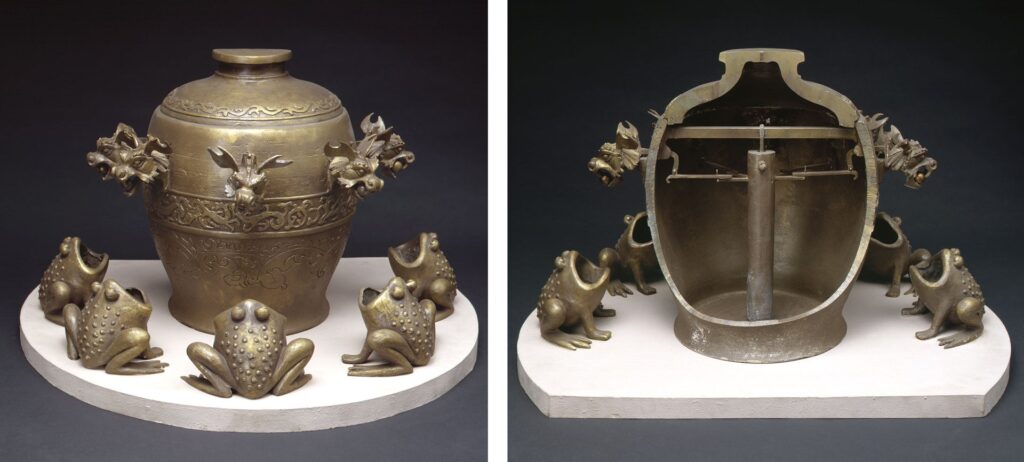
Zhang Heng’s seismoscope, 132 AD
However, the internal mechanism of the device has been lost. Many scholars believe that a pendulum system must have operated inside. But no modern reconstruction has been able to replicate the claimed accuracy and range of the original — according to reports, Zhang Heng’s device once detected an earthquake at a distance of about 640 kilometers.
The Antikythera Mechanism — The First Computer of Antiquity
In 1901, divers recovered a mysterious object the size of a shoebox from an ancient Roman shipwreck near the tiny island of Antikythera. For decades, this wood-and-bronze object was ignored alongside other treasures from the same wreck. It was only when serious study began in the 1970s that it was revealed to be an engineering marvel.
It is often called the first analog computer in the world. The Antikythera mechanism demonstrates technologies that were believed simply not to have existed in the ancient era. The device, with its system of bronze gears, could calculate the positions of celestial bodies and predict astronomical events. Remarkably, after its creation, a similar level of mechanical complexity does not appear again for over a thousand years.
These five stories illustrate an important point: scientific progress is not always linear. Important knowledge can be lost — due to secrecy, destroyed records, or the death of the sole bearer of a technology. Sometimes it seems that our distant ancestors were “smarter”…
Some of these mysteries are already yielding to modern science: Roman concrete is being actively studied and its chemistry has almost been decoded. Others — like the exact recipe for Greek fire or Segato’s method — remain open questions for now. And that’s precisely what makes them truly fascinating: somewhere near us lie answers that humanity once already knew.