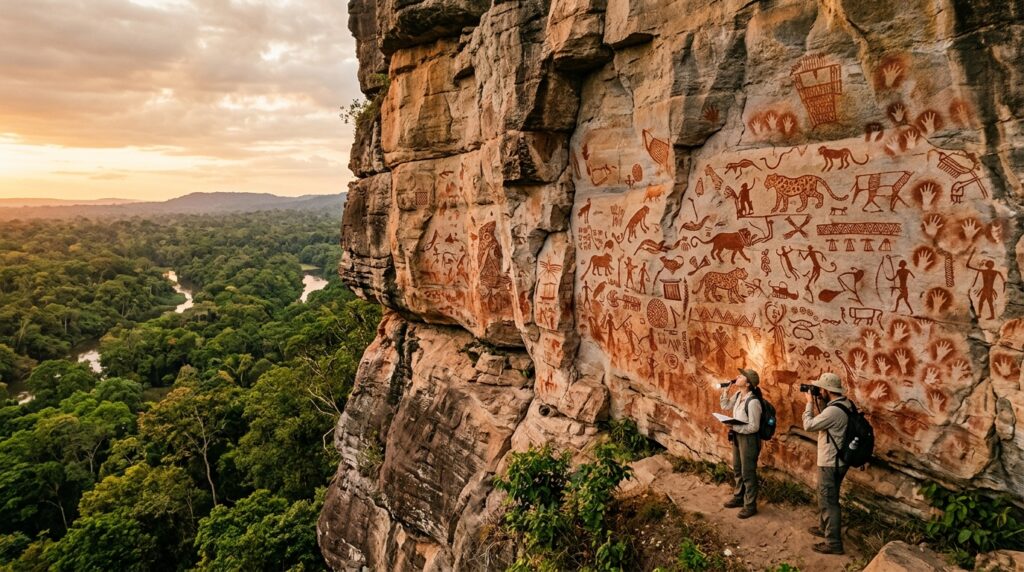
Keepers of ancient knowledge explained what the symbols on the handprints mean
In the Colombian Amazon, scientists found 496 ancient handprints on two rock walls, and most of them are covered with strange spirals, zigzags, and ellipses. A new study suggests that these drawings may not have been mere decoration, but a way to record shamanic knowledge. In essence, they represent ancient people’s conceptions of the world, spirits, and territorial authority. This is still a cautious hypothesis, but it is based on a rare source: conversations with indigenous elders whose traditions reach deep into antiquity.
The Wall of Handprints in the Amazon
The site in question is the Serranía de la Lindosa rock formation in the Colombian part of the Amazon. This place is adorned with thousands of paintings estimated to be around 11,000 years old — a gigantic painted landscape that some researchers call one of the most impressive collections of rock art in the world. These paintings had previously been linked to shamanic practices.
Through conversations with local elders, anthropologists had earlier learned that many images on these rocks depict shamanic transformations: ancient leaders are shown entering a spiritual dimension and taking on the form of jaguars or snakes. In the new study, researchers focused specifically on the unusual decorated handprints on the two main rock surfaces of the formation.
How Many Handprints Were Found and How Are They Decorated
The two painted sections are called Cerro Azul and Paredones del Potrero. Together they contain 496 handprints, and 70% of them are covered with vivid patterns on the palms and fingers. These are not random smears but recurring, recognizable motifs.
Among the patterns, spirals and linear ornaments are the most common. Breaking down the finds by type, the picture looks like this:
- 256 prints are decorated with spiral patterns;
- 84 prints bear zigzags and ellipses;
- The remaining hands were left undecorated.
There is also another important detail hinting at the special significance of these drawings. Most of the prints are located at a height of 2 to 3 meters above the ground. To reach that high, the ancient artists would have needed a ladder or some kind of scaffolding, meaning these images were not created casually but with effort and intention.
Why the Handprints Are Linked to Shamanic Knowledge
To understand the meaning of these patterns, the researchers once again turned to indigenous elders — and this is the key aspect of the work. Without living people, deciphering the symbols would have been nearly impossible.
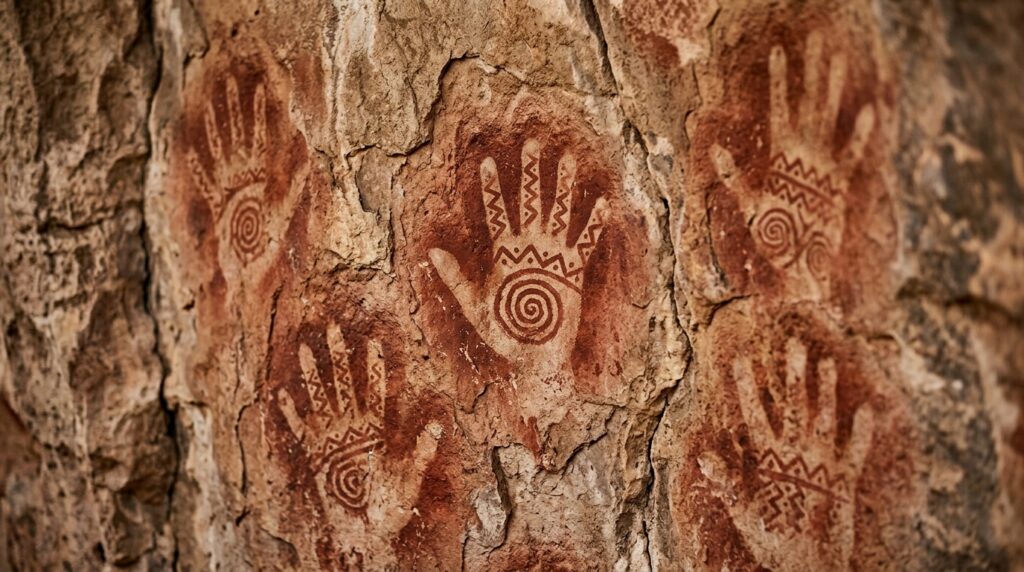
Ancient handprints decorated with spirals and zigzags
According to the study’s authors, ritual specialist from the Matapí group Ulderico Matapí explained that each handprint represents a form of shamanic knowledge. For example, the ability to cultivate land or gather medicinal plants — skills critically important for managing territory. Elder of the Desana people Víctor Caicedo offered a different interpretation: in his view, differences in hand styles indicate different tribes, each asserting its spiritual or social identity.
Amazon Rocks as a Boundary Between Worlds
One of the most fascinating ideas of the study is how the ancient people themselves perceived the rock wall. According to the interview data, rock art traditions reflected a belief system in which stone walls were considered threshold zones where the worlds of humans, ancestors, and spirits converge.
Seen in this light, a handprint ceases to be merely a mark on stone. It becomes a way of touching the boundary between worlds — almost like a signature or seal left on a door between the visible and the invisible. This is likely why the drawings were placed high up and executed so carefully: it was not play, but a statement of knowledge and power.
Are These Really the Handprints of Shamans
It is important to remain level-headed. The researchers deliberately do not ascribe specific meanings to individual patterns. They do not claim that a spiral strictly means one thing while a zigzag means another. The interpretations were obtained from oral traditions of modern indigenous peoples, and although these traditions may reach back into deep antiquity, science has no direct proof that 11,000 years ago the symbols meant exactly the same thing.
The main value of the work lies elsewhere. It demonstrates how important collaboration with indigenous communities is when studying ancient art. Often, only living bearers of tradition can offer clues about what mysterious signs might have meant. The study was published in the journal World Archaeology.
Such discoveries are changing the very approach to Amazonian archaeology: instead of imposing modern explanations on ancient drawings, scientists listen to those who preserve the cultural memory of the region. And that means these rocks surely still hold stories that we are only beginning to unravel.