Researchers at the University of Waterloo in Canada have developed a method to 3D-print custom silicone contact lenses in roughly 20 minutes — potentially eliminating the months-long wait and high cost that people with irregular corneas currently face when ordering bespoke lenses. The technology, still in the lab stage, pairs a new hydrophilic silicone formula with specialized software and an ultra-thin smoothing coating to produce lenses that, according to the team, match the transparency and durability of commercially available products.
What you need to know
- The technique was developed at the University of Waterloo’s Department of Chemistry and targets patients whose non-standard corneal shapes make mass-produced lenses uncomfortable or ineffective.
- A new hydrophilic silicone material was created specifically for layer-by-layer extrusion printing, retaining the biocompatibility and oxygen permeability of medical-grade silicone.
- An ultra-thin coating is applied after printing to eliminate the microscopic “staircase” ridges inherent in 3D-printed objects, which would otherwise irritate the eye and distort light.
- The team is now preparing for real-world trials and filing patents; the lenses have not yet received regulatory approval for clinical use.
Why standard contact lenses don’t work for everyone
Most modern contact lenses are made from soft silicone hydrogel and manufactured to fit average corneal dimensions. For people with an irregular corneal shape, however, standard lenses may sit poorly on the eye, causing dryness, discomfort, or inadequate vision correction. Custom-made lenses exist but require multiple fitting appointments and carry a significant cost premium.
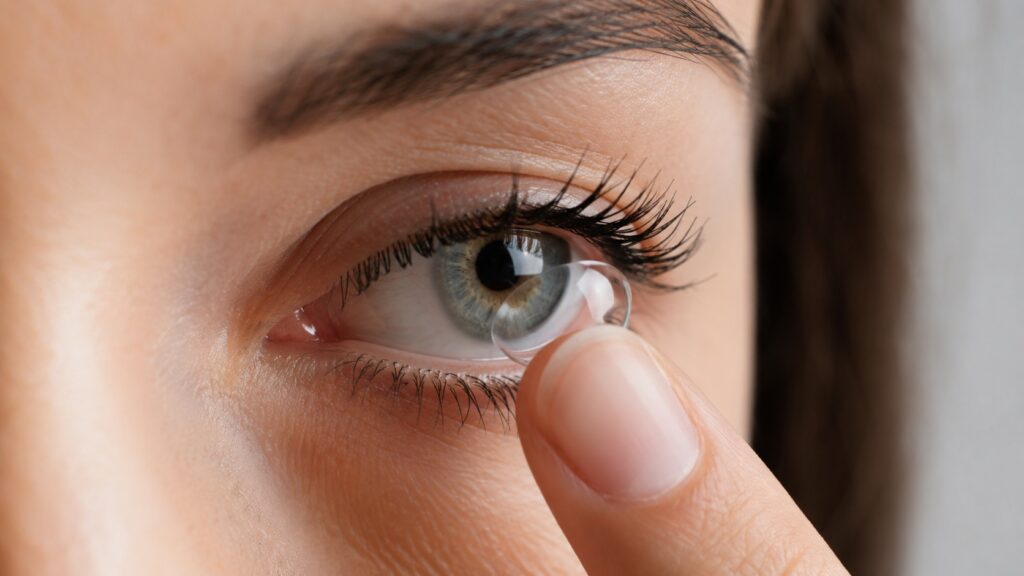
In the future, contact lenses could be produced right in the ophthalmologist’s office.
How the 3D-printing process works
The core idea is to move lens production into the doctor’s office. Specialized software first creates a precise digital model of the lens. The inner surface is designed to replicate the patient’s unique corneal topography down to the micron level, while the outer surface is calculated to deliver the correct optical correction.
Key advantages cited by the researchers include:
- No waiting for factory delivery;
- Elimination of multiple fitting sessions;
- Lower overall cost for the patient.
The entire workflow — from scanning to finished lens — takes approximately 20 minutes, according to the university.
Overcoming the silicone challenge
Medical-grade silicone is the gold standard in contact-lens manufacturing because it is soft, biocompatible, and highly oxygen-permeable. However, conventional silicone formulations are incompatible with 3D printing: they are either too fluid or do not cure quickly enough for reliable layer-by-layer deposition.
The Waterloo team developed a new hydrophilic silicone formula from scratch. According to the researchers, the material retains all the beneficial properties of medical silicone while being suitable for extrusion-based 3D printing.
Solving the surface-smoothness problem
Layer-by-layer printing inherently produces microscopic step-like ridges on the surface of any object. On a contact lens, such texture would cause irritation during blinking and distort light refraction — both unacceptable outcomes.
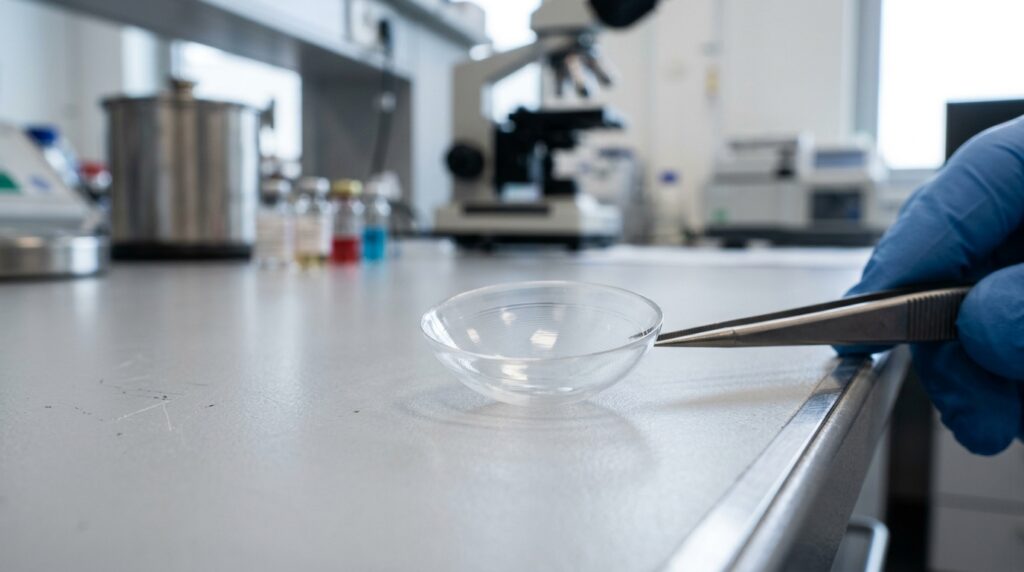
A transparent contact lens produced by a 3D printer.
To address this, the researchers applied a specialized ultra-thin coating that fills in the microscopic ridges, producing a completely smooth surface without altering the lens’s individualized shape.
According to Dr. Sayan Ganguly, a co-author of the research, recent laboratory tests confirmed the safety of the finished lenses. The printed lenses reportedly caused no tissue rejection, and their transparency and mechanical strength were comparable to commercial lenses available in pharmacies. These findings were reported on the University of Waterloo’s website.
What comes next — and what remains uncertain
The team is currently preparing for real-world trials and filing the necessary patents. It is important to note that the technology has not yet undergone clinical trials or received regulatory approval, so it remains uncertain when — or whether — it will become available in ophthalmology practices. If the technology clears those hurdles, the researchers envision a future in which patients with complex eye anatomy could walk into a clinic and leave 20 minutes later with perfectly fitted, individually printed lenses.