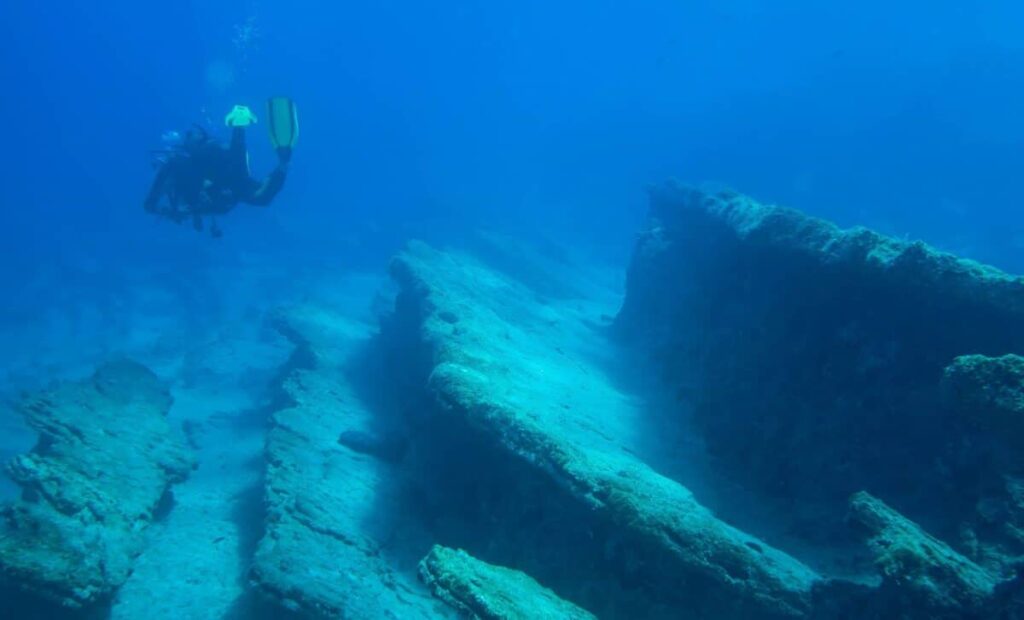
Divers discovered a 1,000-year-old city beneath a lake: a powerful earthquake wiped it out overnight
Beneath the waters of Lake Issyk-Kul in Kyrgyzstan, an international team of underwater archaeologists has found new traces of a medieval city. Scientists believe the settlement ended up underwater after a powerful earthquake that occurred more than 600 years ago. The findings reinforce a long-held idea: what lies at the bottom of the lake is not simply a fishing village but a major city connected to the Great Silk Road.
What Underwater Archaeologists Found at Toru-Aigyr
Lake Issyk-Kul has long been surrounded by stories of ancient settlements hidden beneath the water. It sits in a region that for centuries played a key role in the Silk Road network connecting China with lands far to the west. In 2025, a team of divers returned to one of these submerged sites — the Toru-Aigyr settlement — to understand what it truly was.
The expedition surveyed sections of the lake at relatively shallow depths — up to four meters — and discovered several signs of urban life at once. According to the Russian Geographical Society, the divers found brick structures, remains of wooden constructions, ceramics, and a stone millstone that was likely used to grind grain into flour.
The researchers singled out the remains of a large building with exterior cladding. Its exact purpose is still unclear — archaeologists suggest it could have been a mosque, a bathhouse, or a small Islamic school.
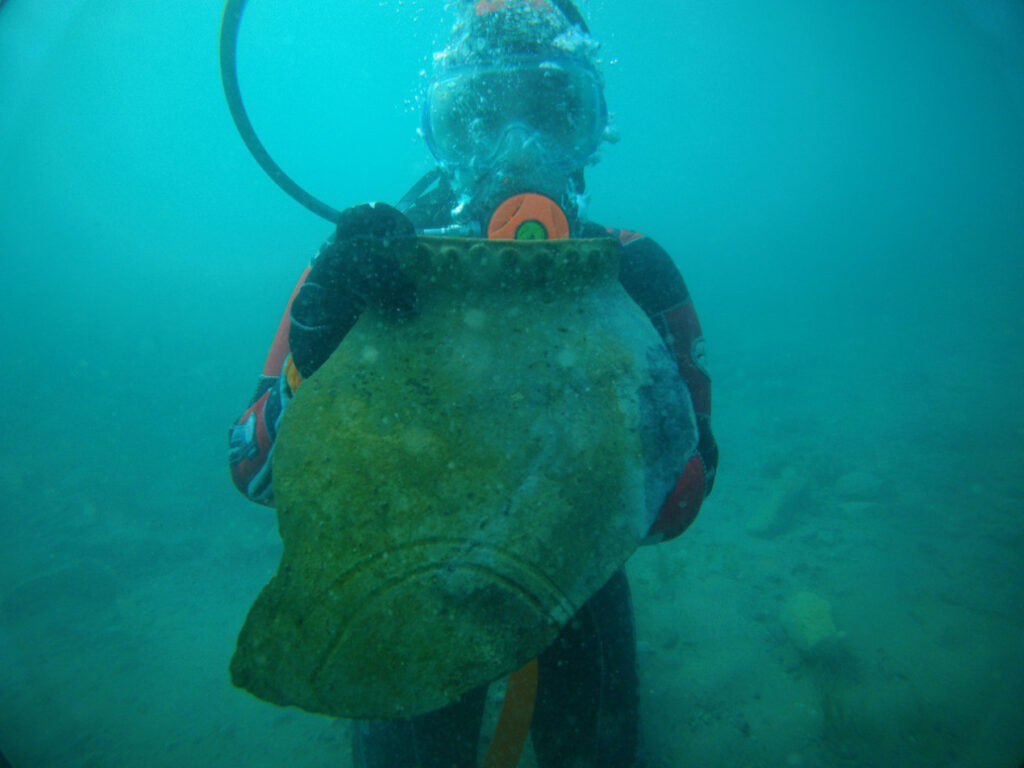
A diver with part of an ancient jug from the submerged ruins discovered at the bottom of Lake Issyk-Kul. Image source: rgo.ru
The preservation of the finds is impressive: stone structures and wooden beams spent centuries underwater but survived. According to expedition leader on the host side, Valery Kolchenko, the site under study is a city or a major trading settlement on one of the key sections of the Silk Road.
A 13th–14th Century Muslim Necropolis Underwater
One of the most notable discoveries was a Muslim burial site that archaeologists date to the 13th or 14th century. This section is currently being eroded by the lake’s waters, making it especially valuable for science: the data is literally washing away and needs to be recorded in time.
The team discovered two buried individuals lying facing Mecca — a typical feature of Muslim burial rites. Nearby, they found an older burial ground with rounded and rectangular structures. In addition to human remains, the divers recovered ceramics and a fully intact khum (vessel), remarkably well preserved underwater. The archaeologists planned to retrieve it on the next visit, as the artifact had sunk deep into the ground.

Skeletal remains discovered at Toru-Aigyr. Image source: rgo.ru
These finds are important not just in themselves. The Muslim burial rites show that Islam had reached the city and help to more precisely understand how the religious map of Central Asia changed over time.
How the Early 15th Century Earthquake Changed the Region
Scientists believe the settlement went underwater after a powerful earthquake in the early 15th century. However, as Kolchenko notes, by the time of the disaster the city had most likely already been abandoned. In other words, the earthquake did not destroy a thriving metropolis overnight before its residents’ eyes — rather, it accelerated changes that were already underway in the region.
The researchers’ wording is cautious for a reason: underwater ruins rarely allow for precise reconstruction of what exactly happened and how quickly. If you’re curious about how natural disasters reshape landscapes, this story is a good example of how earthquakes send cities underwater for centuries.
Why Toru-Aigyr Matters for the History of the Silk Road
The findings also reflect a broader historical turning point. As Maxim Menshikov from the Institute of Archaeology of the Russian Academy of Sciences explained, around the 10th century this territory came under the control of the Karakhanid state. This Turkic dynasty included followers of various religions, but its ruling elite later adopted Islam.
According to Menshikov, Islam spread widely across Central Asia in the 13th century — under the Golden Horde — and the remains at Toru-Aigyr vividly illustrate this shift. The section of the Silk Road in the Issyk-Kul area was controlled by the Karakhanids. Also curious is the connection with China: the Chinese considered these lands a zone of their interests but could not actually control them — and yet the place is mentioned in Chinese sources. This raises hopes of cross-referencing written accounts with excavation results.
Toru-Aigyr is valuable because the legend of the “sunken city” is now backed by finds: structures, burials, and artifacts that can be dated. This is a rare case where water not only destroys but also preserves history — wooden beams and intact vessels have reached us precisely because they ended up at the bottom. Although many questions remain open: the purpose of the large building, the exact boundaries of the city, and the sequence of events surrounding the earthquake. We await further research and discoveries.