
You’re not lazy – your brain is simply hitting the brakes before difficult tasks
A familiar story: you know perfectly well that you need to fill out that report, clean up the mess in your closet, or finally tackle your tax return. The reward is obvious — freedom from a hanging task. But instead, your hand reaches for your phone, and your brain offers up a dozen “more urgent” things to do — a classic procrastination scenario. A new study has shown that the brain has a separate neural pathway that inhibits motivation to take on difficult or unpleasant tasks — regardless of what reward awaits at the end. And this isn’t a matter of character, but a matter of biochemistry.
How the Brain Blocks Motivation Before Difficult Tasks
Researchers from Kyoto University (Institute for the Advanced Study of Human Biology) studied a phenomenon they call “motivational paralysis.” This is a state in which a person — or animal — understands that a task needs to be done, sees the reward, but still cannot force themselves to start. The issue isn’t that the reward seems small, but that the path to it is perceived as too costly.
Motivation is usually explained quite simply: if the brain considers the reward valuable enough, the person starts acting. But the authors of the new study, published in the journal Current Biology, suggest that initiating behavior and evaluating reward are two separate processes controlled by different neural mechanisms. In other words, you may perfectly understand that completing a project on time is a good thing, but your brain will still hit pause if the path to the goal seems too unpleasant.
Why the Brain Avoids Unpleasant Tasks Even for a Reward
To study this mechanism, the scientists worked with macaques. The monkeys were offered two tasks. Both led to the same reward — a portion of water. But in one case the path was simple, while in the other — before receiving the reward, the animal had a stream of air blown directly in its face. Unpleasant, but tolerable.
Before each trial, the monkey could see which path lay ahead. And here’s what’s important: the researchers were interested not in the choice between the two options, but in the speed and readiness of the monkey to start acting in each case. Because the reward in both cases was the same — only the “cost” of the path to it differed.
The result was predictable from a behavioral standpoint: before the unpleasant task, the monkeys hesitated. But the main discovery awaited at the neuronal level.
Which Brain Areas Inhibit the Desire to Act
Using electrophysiological recordings, the scientists tracked neuronal activity while the monkeys performed tasks. They focused on the connection between two brain structures: the ventral striatum (VS) and the ventral pallidum (VP). Both regions are part of the brain’s reward system, but as it turned out, they don’t only serve the function of “I want to get the prize.”
When the monkey faced the “unpleasant” version of the task, activity in the VS-VP pathway spiked sharply — and it was precisely this activity that coincided with slowing down, indecisiveness, and reluctance to start. This pathway worked exactly like a brake: the more costly the task seemed to the brain, the harder it pressed the brake pedal.
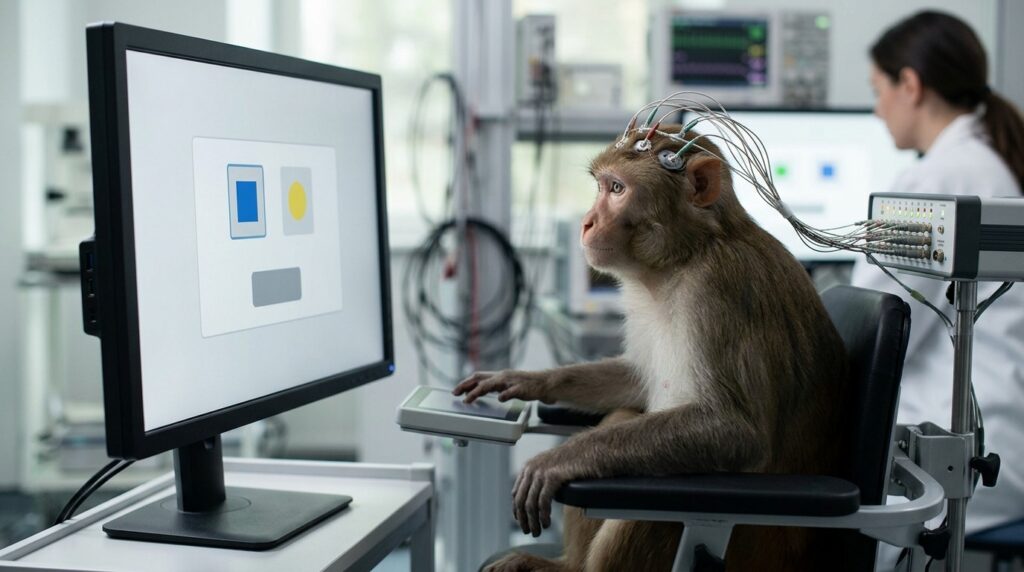
Macaques performed tasks with varying degrees of ‘unpleasantness’ while scientists recorded their neuronal activity
And when the researchers used chemogenetics (a method that allows temporarily “switching off” certain neurons) to block this pathway, something remarkable happened: the monkeys stopped hesitating. They tackled both pleasant and unpleasant tasks with equal readiness. Importantly, the evaluation of the reward itself didn’t change — the animals still understood they would receive water. What changed was specifically the readiness to start acting.
Why Procrastination Isn’t Just About Dopamine
The popular explanation for procrastination usually comes down to dopamine: the brain chooses what brings quick pleasure and avoids what doesn’t. But the results of this study paint a more complex picture.
The fact is that the VS-VP pathway didn’t respond to the value of the reward — it was the same in both cases. It responded to the context of the task: how unpleasant, difficult, or costly it was. Moreover, as the authors note, the inhibitory effect depended on the recent history of failures, not on how attractive the goal was. If the monkey had recently “failed” at an unpleasant task, the inhibition during the next attempt intensified. This clearly shows that the reward system is more complex than the simple “wanted it — did it” scheme.
Usually everything is explained simply: the more attractive the reward, the higher the motivation. But this study shows that the brain may be thinking about something entirely different and looks not only at the prize at the end. The brain calculates not “what will I get” but “what will it cost me.” And if it doesn’t like the price — it simply won’t let you start. As if you’re sitting in a car with the engine running, the light is green, but your foot won’t come off the brake.
How Procrastination Is Connected to ADHD and Depression
People with ADHD, depression, and other brain function differences are well familiar with this state: you know perfectly well what needs to be done, you see all the benefits of completing the task, but you physically cannot force yourself to start. This is often followed by feelings of guilt and shame — because others (and you yourself) perceive it as laziness or weakness of will.

The inability to start an important task is a familiar feeling for millions of people
Of course, we’re not yet talking about direct proof for humans: the study was conducted on monkeys. But the mechanism itself turned out to be too similar to what many people with ADHD or depression experience. The authors note that understanding the separation of reward evaluation and action initiation mechanisms could change the approach to treating motivational disorders. If the problem isn’t that a person “doesn’t want to” but rather that a specific neural pathway is too actively inhibiting the start, then the solution should be different — not persuasion and not punishment, but possibly targeted correction of this mechanism.
How Scientists Plan to Treat Pathological Procrastination
Lead researcher Ken-ichi Amemori emphasizes that the results need to be interpreted carefully. The “motivational brake” exists for a reason — it helps the body conserve energy and avoid rushing into potentially dangerous or unprofitable situations. And if you remove it entirely, on the other side of the scale you’ll find impulsivity and a tendency toward risky behavior.
“Excessive weakening of the motivational brake could lead to dangerous behavior or excessive risk-taking,” warns Amemori. “Careful verification and ethical discussion about how and when such interventions should be applied is necessary.”
Nevertheless, in the future we may be talking about non-invasive brain stimulation or new medications that could gently modulate the activity of this pathway — not switching it off completely, but reducing excessive inhibition where it interferes with normal life. This is especially relevant for people whose motivational difficulties are clinical in nature. And while such methods remain a matter for the future, there are practical ways to start an unpleasant task without persuasion, guilt, or self-punishment right now.