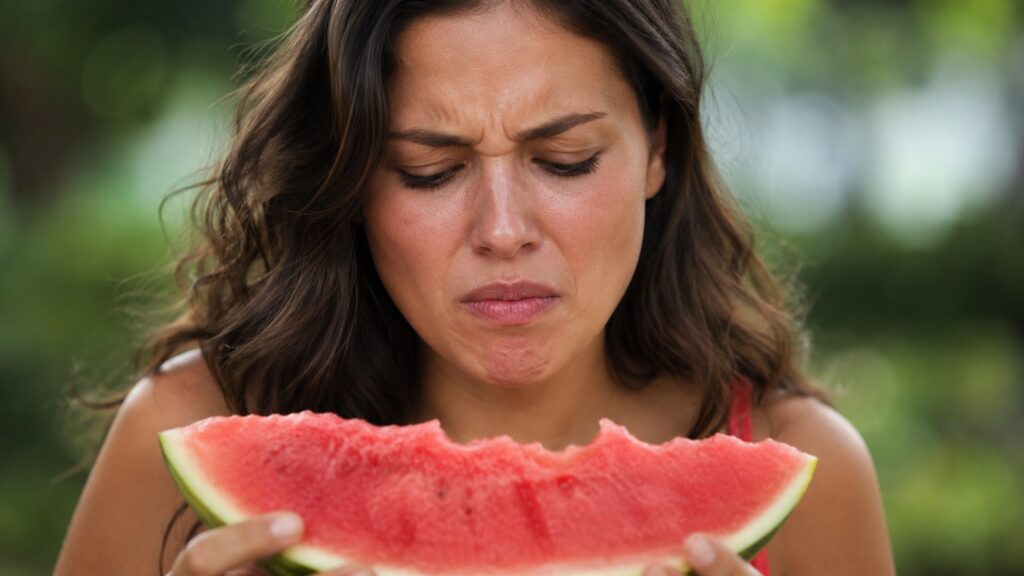
A watermelon may look good, but the taste can be disappointing
Red flesh, a resonant knock, and a dry tail on a watermelon don’t always guarantee that your purchase will please you. The lack of flavor in a red fruit is most often explained by the fact that color and sugar accumulation are controlled by completely different chemical processes. Let’s explore why even perfect-looking watermelons can taste like diluted syrup and how weather, varieties, and storage conditions affect this.
Why a Red Watermelon Can Be Tasteless
The most common reason for a bland taste is early harvesting of the watermelon. Producers find it profitable to pick fruits before they are fully ripe so they don’t crack or spoil on the way to the store. On the outside, such a specimen looks large and ripe, but its sugar content is still critically low.
Many buyers are deceived by the rich color. The thing is that the pigment lycopene is responsible for the coloring, while sucrose, fructose, and glucose are responsible for sweetness. The flesh can turn an appetizing red long before the fruit accumulates enough carbohydrates. Roskachestvo experts note that sweetness is assessed by the amount of soluble dry matter. If this indicator is around 11%, the taste will be weak, and the flesh becomes truly sweet at an indicator of around 14%.
The most important feature of melon crops is that sugar accumulation in watermelon stops immediately after separation from the vine. If bananas or pears can ripen on a kitchen table, becoming softer and sweeter, a watermelon will not gain sugar no matter how long it sits in warmth.
The Effect of Prolonged Rain on Watermelon Sweetness
Water is vital for the plant during the fruit formation stage, but its excess directly harms the taste. If constant rains fell during ripening or the field was over-irrigated, the amount of moisture inside the plant increases sharply.
Under such conditions, the plant continues to actively deliver water to the fruit, while sugars accumulate at the same slow pace. As a result, prolonged rains reduce sugar content, making the taste diluted. This is similar to a situation where too much plain water was poured into a glass of sweet compote.
Sunlight also plays a major role. Sugar doesn’t come from soil or fertilizers — it is produced in the leaves through photosynthesis. If the weather was overcast during the last weeks of ripening, the plant simply couldn’t produce enough nutrients. This is precisely why two outwardly identical fruits from neighboring farms can differ dramatically in taste.
Watermelon Variety Characteristics
The ability to accumulate sugar is a genetic trait, just like rind thickness or the number of seeds in a watermelon. Producers often choose hardiness over dessert qualities.
For example, some watermelon varieties are genetically less sweet but have dense flesh, thick rind, and tolerate transportation over thousands of kilometers excellently. That’s why a huge, even, and beautiful fruit from a supermarket may simply be a representative of an industrial hybrid.
Technical recommendations for agronomists also highlight physiological disorders inside the fruit. If the plant experienced stress, internal tissues may develop unevenly. In such cases, one edge of the watermelon turns out sweet and crispy, while the center is mushy and bland.
How Overripening and Storage Ruin Watermelon
Wateriness is characteristic not only of unripe but also of fruits that have been stored too long. As the fruit ages or overripens, the flesh structure changes irreversibly. Cell walls gradually break down, and tissues lose their firmness.
As a result, juice begins to separate easily from the fibers. When you eat such a watermelon, you feel water and a mushy mass separately in your mouth, although the total amount of liquid inside has barely changed. If a sour, wine-like smell appears at the same time, it means the watermelon has started to ferment.
The texture suffers especially badly if the watermelon was accidentally frozen during transportation. Water inside the cells turns into ice crystals that tear the tissues from within. After thawing, the juice leaks out and the flesh turns into an unpleasant slimy mass, although the rind looks completely intact on the outside.
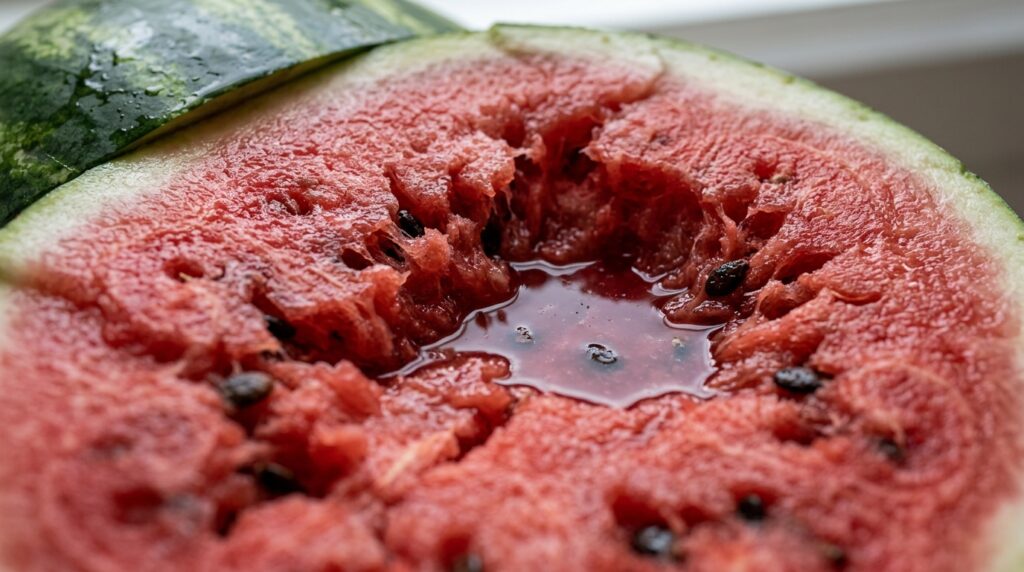
In an overripe watermelon, cell walls break down, causing the flesh to resemble wet cotton
Is It True That a Bland Watermelon Is Pumped with Chemicals
Among buyers, there is a persistent myth that a bland or mushy watermelon must be pumped with chemicals. In reality, it is impossible to determine the level of fertilizers by texture, taste, or the presence of white streaks.
As specialists from Rospotrebnadzor emphasize, it is impossible to determine the presence of nitrates by taste or using household devices — only professional laboratory tests give accurate results. A tasteless watermelon is the result of bad weather, early harvesting, or prolonged storage, not a sign of toxicity.
How to Choose a Ripe and Delicious Watermelon
No single external sign provides a one-hundred-percent guarantee of sweetness, as it is impossible to see through the thick rind. A dry tail may have simply dried out during the long journey, and a resonant sound depends on the thickness of the skin and the size of internal voids.
To buy a delicious watermelon, it’s best to follow these rules:
- Buy watermelons in season — for Russian varieties, mass ripening occurs in August and September;
- Look for fruits with an intact, firm rind without dents, cracks, or matte spots;
- Pay attention to the ground spot — it should be bright yellow or orange, not white;
- Choose a watermelon that feels heavy for its size, avoiding both the smallest and giant specimens.
Ultimately, a watery watermelon taste is the result of an imbalance between accumulated moisture and carbohydrates. Understanding how a watermelon grows helps you take unsuccessful purchases more easily and not look for traces of dangerous chemicals in bland flesh.