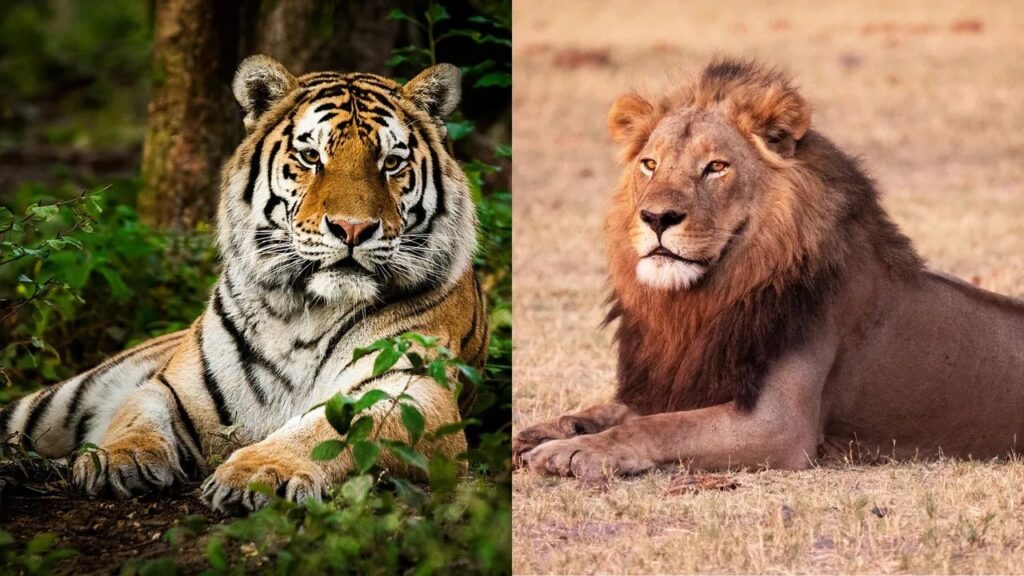
How a tiger differs from a lion beyond appearance. Image source: livescience.com
Lions and tigers seem similar: both are huge, both are predators, both belong to the genus Panthera, meaning big cats. But there are more differences between them than you might think — from social behavior and communication methods to evolutionary history. Moreover, they aren’t even each other’s closest relatives.
Lions and Tigers Are Not Closest Relatives
Many people assume that lions and tigers are something like cousins among big cats. In reality, that’s not the case. As paleontologist Jack Tseng from the University of California, Berkeley explained to Live Science, tigers are closer to snow leopards, while lions are closer to leopards and jaguars.
All five species belong to the genus Panthera, and their common ancestor, according to genetic modeling, appeared at least 5.57 million years ago. Fossil remains of this ancestor haven’t been found yet, but according to Tseng’s estimates, it was notably smaller than both modern lions and modern tigers.
Another curious fact: tigers as a species are significantly older than lions. The oldest suspected tiger fossils date back roughly 2 million years, whereas fossil lions don’t appear in the paleontological record until no earlier than a million years ago, and likely even later.
Why Lions Live in Prides and Hunt Together
The most notable behavioral difference between these cats is their attitude toward their own kind. Lions are the only truly social cats and one of the most dangerous predators of the savanna. They live in prides — matriarchal groups consisting of several related females and one or two adult males.

A lion pride at a watering hole. Image source: pixnio.com
This structure creates constant competition. Males regularly fight over territory, access to females, and resources. This is precisely why male lions have manes — and it’s not just decoration.
“Cats often target the neck when fighting or killing prey,” explained Jacob Shanks, wildlife care manager at San Diego Zoo. “The mane protects males from neck injuries during territorial fights.”
Tigers don’t have this protection — they simply don’t need it, because adult tigers rarely interact with each other.
Why Tigers Hunt Alone and Avoid Their Own Kind
Tiger cubs stay with their mother for about two years and then go their separate ways to lead solitary lives. Adult tigers avoid each other and essentially only meet for mating.
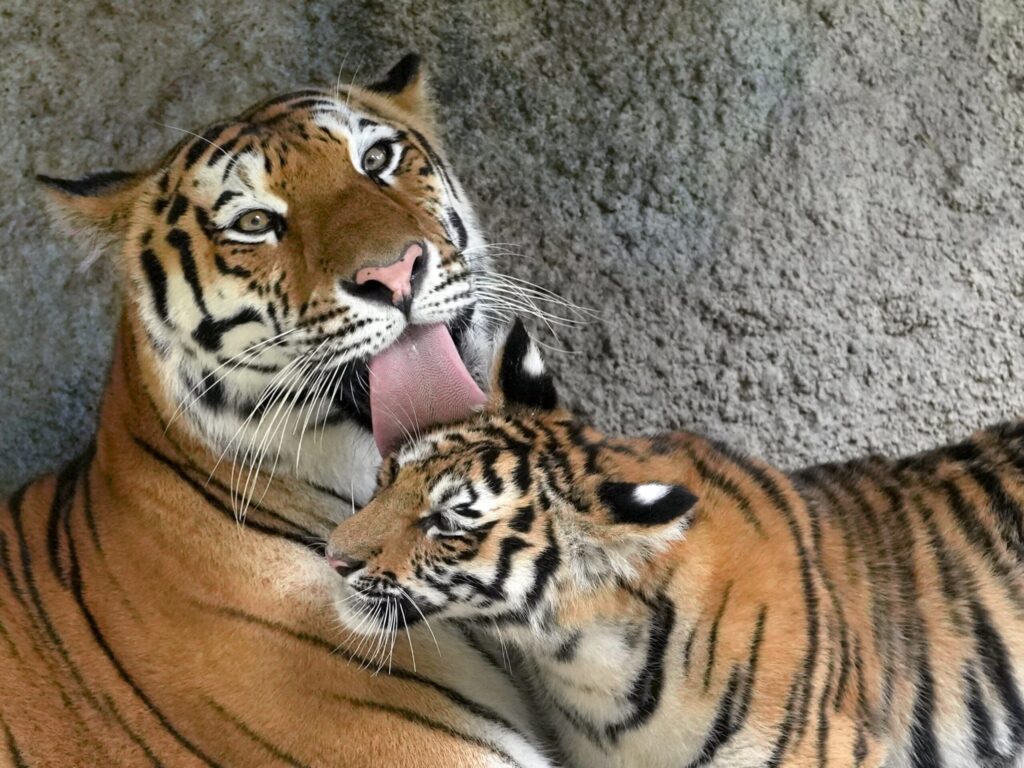
In their natural habitat, tigers behave differently from lions. Image source: reactor.cc
But when a tiger does need to approach another individual, it uses a special signal — the so-called “chuffing” (chuff). This is a short puffing sound that the tiger makes by blowing air through its nose. If the second tiger agrees to the approach, it chuffs back. This is one of the unusual ways animals communicate with each other.
“Tigers are one of the few cats that use this sound,” said Dell Guglielmo, a big cat keeper at the Smithsonian’s National Zoo.
Lions don’t do this. They rely on body language or simply approach and see what happens.
How a Lion Differs From a Tiger Beyond the Mane and Stripes
Besides the obvious — stripes on a tiger and mane on a male lion — there is another important external difference. Lions have pronounced sexual dimorphism: a male can be easily distinguished from a female by its mane. In tigers, however, males and females look virtually identical — the only difference is size.
As for size itself, both species independently evolved toward large bodies. According to Tseng, one possible reason is adaptation to cooler climates. A large body has a lower surface-area-to-volume ratio, which helps retain heat. However, the paleontological record is not yet detailed enough to confirm that both species grew larger for the same reasons.
Where Lions and Tigers Live and Whether They Can Meet
Can a lion and a tiger meet in the wild? Virtually no. They live on different continents, and even in the paleontological record their ranges don’t overlap. This rules out both natural competition and crossbreeding.
However, in captivity, humans have managed to produce a hybrid — a liger, a cross between a male lion and a female tiger. According to Jacob Shanks, hybridization of lions and tigers has never been documented in the wild, and artificial crossbreeding benefits neither species.
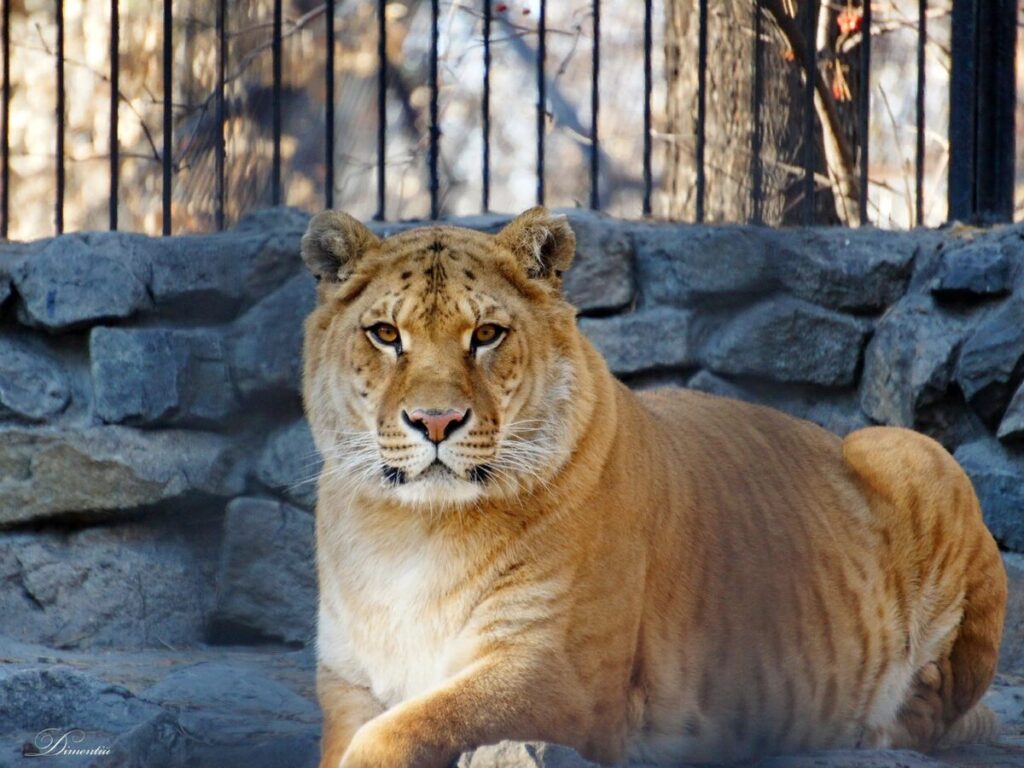
A liger is a hybrid of a lion and a tiger. Image source: imageban.ru
At the same time, both species face the same threats. Tigers have “endangered” status, while lions are classified as “vulnerable” according to the International Union for Conservation of Nature (IUCN). The main threats to them are human conflict, habitat loss, and climate change.
“They need active protection, otherwise we risk losing them,” emphasized Jacob Shanks.
So, surprisingly, the key similarity between lions and tigers lies in the threats they face.