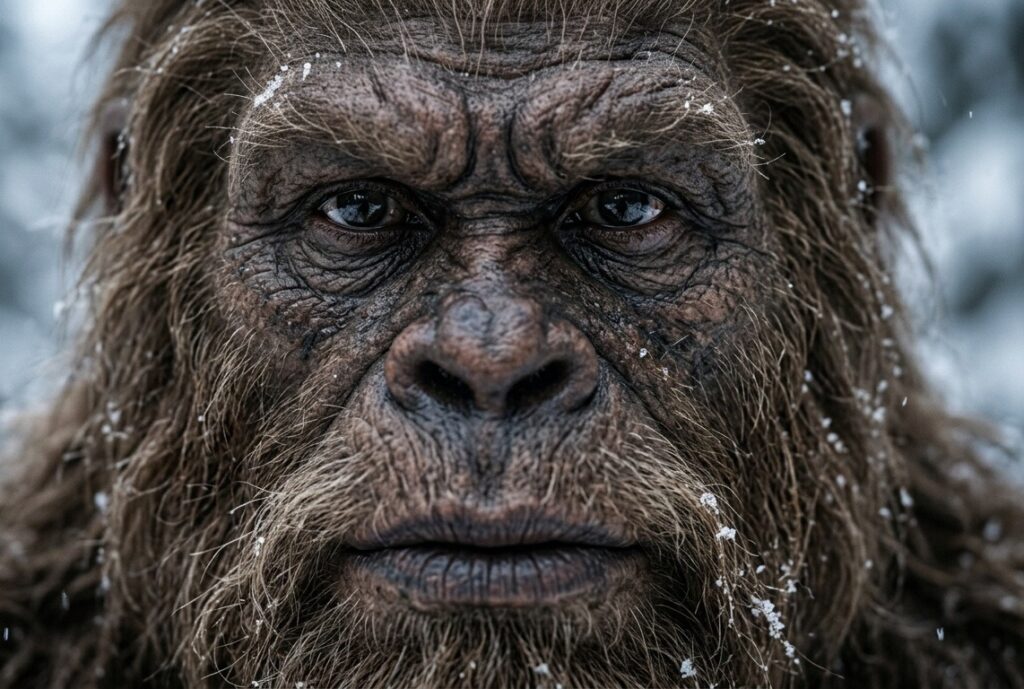
Sociologists talked to Bigfoot hunters and learned a lot of new things
Two sociologists from the United Kingdom spent three years and conducted over 150 interviews with people who seriously search for Bigfoot in the forests of North America. It turned out that these hunters don’t oppose science but rather try to imitate it, using drones, thermal imaging cameras, and microphones. But is their activity real science? Do they truly believe that Bigfoot exists in reality? After all, science suggests that such a creature could have lived only in the distant past.
Studying Bigfoot Hunters
According to IFL Science, it all started with a TV show. Dr. Jamie Lewis from Cardiff University, during the COVID-19 pandemic, stumbled upon the show Finding Bigfoot on a channel that normally aired serious nature documentaries. What surprised him wasn’t Bigfoot itself, also known as sasquatch, but a different question: why was this being shown on a science channel?
Together with his colleague from the University of Sheffield, Dr. Andrew Bartlett, Lewis set out to investigate not whether Bigfoot exists, but how the community of people who build their lives around this search is organized. Over three years, they interviewed more than 150 people, from field researchers to anthropologists and stars of Bigfoot TV shows. Then they published a book about it.
Title screen of Finding Bigfoot
Who Searches for Bigfoot
There are thousands of Bigfoot hunters in North America. But the truly serious ones, by Lewis’s estimate, number only a couple of hundred. These people spend days, weeks, and sometimes months in dense forests, collecting what they consider evidence: tracks, hair, unexplainable sounds, and images from infrared cameras.
The Bigfoot hunting community is diverse. There is a clear division into two groups:
- “Apers” — believe that Bigfoot is simply an unknown primate, an ordinary biological creature;
- “Woo-woos” — believe that Bigfoot is something mystical, like an interdimensional traveler or an alien.
The research by Lewis and Bartlett focused on the first group — those who position themselves as rational investigators. According to surveys, about 28% of Americans believe that Bigfoot “definitely” or “probably” exists. This makes “Bigfooting” not just a fringe hobby but a notable cultural phenomenon.
How People Search for Bigfoot
From the outside, it might seem like Bigfoot hunting is just aimless walks through the forest with a flashlight. But Lewis’s research revealed a different picture. The fieldwork of Bigfooters is structured observation based on specific skills.
Hunters use a quite serious arsenal:
- drones for surveying hard-to-reach areas;
- thermal imaging cameras for nighttime observations;
- parabolic microphones for recording sounds;
- trail cameras on forest paths;
- homemade DNA collection kits for analyzing found hair samples.
Bigfooters track footprints, collect and systematize findings such as footprint casts, damaged branches, unexplainable tree structures, and so on. The organization BFRO (Bigfoot Field Researchers Organization), founded in 1995, maintains a massive database of sightings containing thousands of geolocated reports. These are classified by reliability from Class A (direct observation) to Class C (indirect signs).
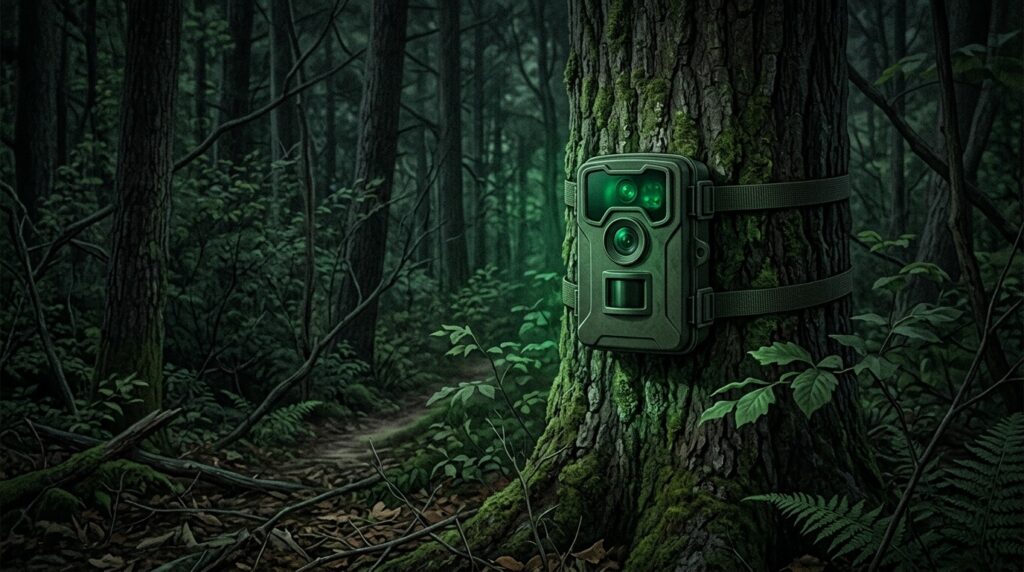
An infrared trail camera in the forest — a standard Bigfooter tool
Why Bigfoot Hunting Is Not Science
One of the sociologists’ key findings is that Bigfooters don’t reject science. On the contrary, they actively use scientific rhetoric, technology, and the very idea of empirical evidence. Many of them see themselves as citizen scientists — people who collect data outside academic institutions.
But this is where the line is drawn. In academic science, knowledge is verified through peer-reviewed publications, reproducibility of experiments, and independent review. Bigfooters instead rely on self-published books, conferences for like-minded people, YouTube channels, and podcasts. As Bartlett noted, this is not necessarily a good way to create and verify scientific claims.
There’s another important detail. The most common type of “evidence” in the community remains eyewitness testimony — stories of personal encounters with the creature. The sociologists note that many Bigfooters became active precisely after their own “contact.” These stories are internally consistent and told in a format accepted within the community, but they cannot be independently verified, meaning they cannot be considered scientific evidence.
At the same time, the researchers also discovered a capacity for self-criticism within the community. Some Bigfooters openly acknowledged that they had been misled by fake tracks and reconsidered their beliefs. Some of them admitted that Bigfoot might not exist, but wanted science to take their efforts seriously.
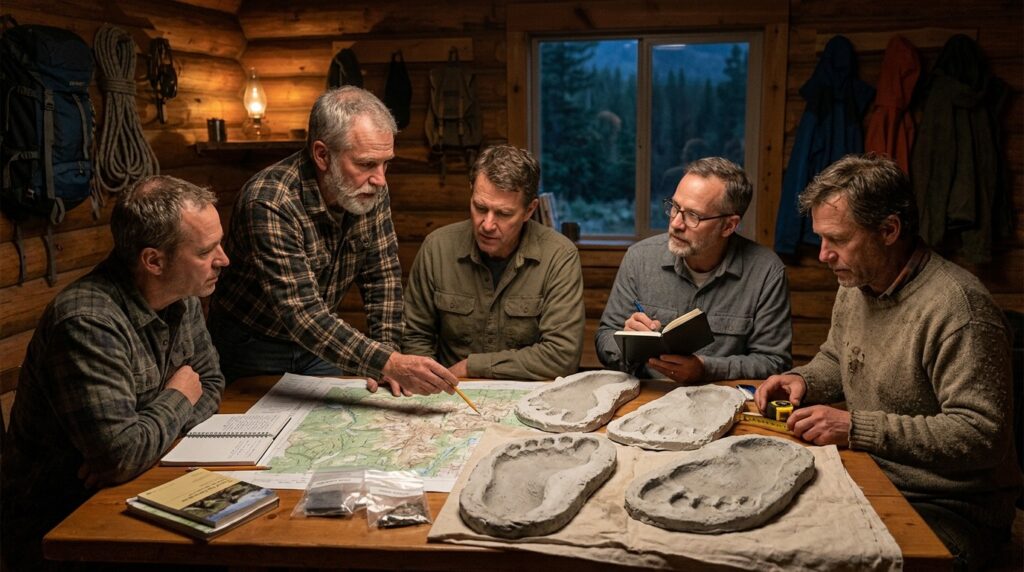
Bigfooters examine plaster casts of footprints at a field base
Profile of a Typical Bigfoot Hunter: Their Jobs and Beliefs
Who are these people? According to the research, the typical Bigfoot hunter is a middle-aged white male from a rural area with a blue-collar job, often a military veteran. Lewis describes the community as permeated with “masculine energy” and a pioneer spirit.
Many were drawn into this activity by childhood impressions or stories from family members. The researchers spend weekends, vacations, and sometimes entire months in the forest. For these people, Bigfooting is not just a hobby but a way to “re-enchant the world,” as Lewis put it. The idea that an unknown giant primate still hides in the forests of America is, for them, akin to discovering a new gold vein.
The community is growing, meanwhile. Women are increasingly joining Bigfooting, although the culture of the movement remains predominantly male. There are dozens of local organizations across North America, and Bigfoot festivals are held annually — for example, in California in 2025, the first annual festival was held in Running Springs.
Lewis and Bartlett emphasize that Bigfooters are not conspiracy theorists and not anti-science. They don’t reject the scientific method — they try to master it, but they do so outside the institutions that give science its reliability: peer review, reproducibility, and skeptical verification. Their case shows that respecting science and knowing how to properly practice it are not the same thing.
This observation extends far beyond Bigfoot hunting. In an era when YouTube and podcasts become sources of “knowledge” for millions of people, the question of how ordinary people create and verify their beliefs becomes truly important. The research by Lewis and Bartlett is not about Bigfoot. It’s about how belief in evidence works when there is no scientific community nearby to verify it.