Scientists have figured out under what conditions humans could fly to Saturn
The Artemis 2 crew in 2026 set a record by traveling 406,771 kilometers from Earth and returning safely. The minimum distance from Earth to Saturn is 1.2 billion kilometers, and it might seem like we won’t be able to reach it for a long time. But physicist and rocket engineer from NASA, Geoffrey Landis, and his team have already calculated how to send people there — and even bring them back. The plan sounds ambitious: fly to the Saturn system, collect samples from icy Enceladus and methane-covered Titan, refuel on-site, and return to Earth. The entire mission would take about 17 years.
Why a Flight to Saturn Is Needed
Saturn is the sixth planet from the Sun, and reaching it is far more difficult than reaching Mars. A flight to Mars under favorable planetary alignment takes about seven months. A flight to Saturn could take years. But it is precisely in the Saturn system where two of the most scientifically interesting objects are located — the moons Enceladus and Titan.
Enceladus is an icy moon of Saturn with a deep subsurface ocean. Titan is Saturn’s largest moon, the only body in the Solar System (besides Earth) with liquid lakes on its surface — though filled not with water but with liquid methane. Organic compounds on Titan, called tholins, are found only in the outer Solar System and could help us understand how life originated on our planet.
The study, conducted by Landis’s team as part of NASA’s Innovative Advanced Concepts program, assessed the feasibility of a mission to deliver samples from the Saturn system back to Earth. And the result turned out to be encouraging: most of the necessary technologies already exist.
Fuel from Titan’s Atmosphere
The main problem of any long-distance space flight is fuel. The more fuel you carry, the heavier the spacecraft, and the heavier the spacecraft, the more fuel you need to move it. Engineers call this vicious cycle the tyranny of the rocket equation.
The solution proposed by the team from Glenn Research Center (NASA) is elegant. The scientists suggest not hauling all the fuel from Earth but producing it right on Titan. Methane on Titan already exists in liquid form, and it can literally be collected from the atmosphere. Oxygen for the oxidizer is obtained through electrolysis of water ice, which makes up the “rocks” on Titan’s surface. A nuclear heat source is proposed for melting the ice.
Producing approximately 3,000 kg of fuel (liquid methane plus liquid oxygen) would take about three years. The return rocket is designed to be inflatable — it would expand as it fills with fuel.
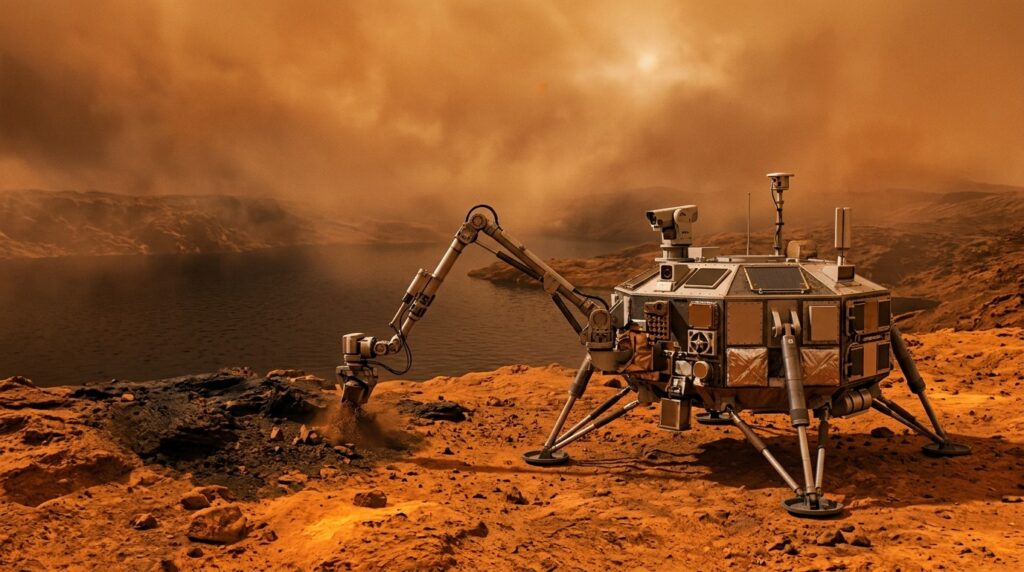
Concept of a landing module on Titan’s surface near a methane lake
How Long Does It Take to Fly to Saturn
Even if the fuel problem is solved, 17 years in interplanetary space is an enormous challenge for humans. Landis himself admits that this is perhaps too long for a crew.
Let’s start with food. Astronauts consume more calories than people on Earth, and we don’t yet know how to produce food in space on an industrial scale. At a rate of about 2 kg of food per person per day, over 17 years that amounts to more than 12 tons of provisions for a single astronaut. And that’s without counting water and packaging.
There are other problems as well:
- Space radiation — beyond Earth’s magnetic field, the crew is exposed to galactic cosmic rays and solar flares, requiring heavy shielding;
- The mass of the protective shielding adds weight to the spacecraft, meaning even more fuel is required;
- Psychological strain from years of isolation in a confined space;
- Weightlessness destroys bone and muscle tissue during prolonged exposure.
Everything comes down to a parameter engineers call delta-v — the total change in velocity needed for all maneuvers: acceleration, braking, and orbit changes. The greater the spacecraft’s mass, the higher the delta-v, and therefore the more fuel is needed. You can save fuel by using gravitational assists around planets, but a crewed mission cannot be sent on too slow a trajectory — the crew simply won’t endure it.
Nuclear Engines for a Flight to Saturn
The first thing that needs to be developed is a propulsion system capable of delivering a spacecraft to Saturn and back. On chemical engines, the trip would be unbearably long.
The solution is nuclear thermal propulsion. The principle is simple: instead of a chemical combustion reaction, liquid hydrogen is heated in a nuclear reactor and expelled through a nozzle. Nuclear thermal engines are at least twice as efficient as the best chemical ones — they provide higher specific impulse with greater thrust.
NASA worked on this back in the 1960s as part of the Nuclear Engine for Rocket Vehicle Application project. Over nearly two decades of work, more than twenty reactors were built and tested. The program was shut down in 1973 due to budget cuts, but in 2023 NASA and DARPA announced a joint development of a new nuclear thermal engine for future crewed missions to Mars.
For Mars, a nuclear engine could reduce travel time from 8–9 months to 3–4. One estimate even suggests 45 days. It would still take years to reach Saturn, but suddenly this is no longer science fiction — it’s an engineering problem with specific parameters.
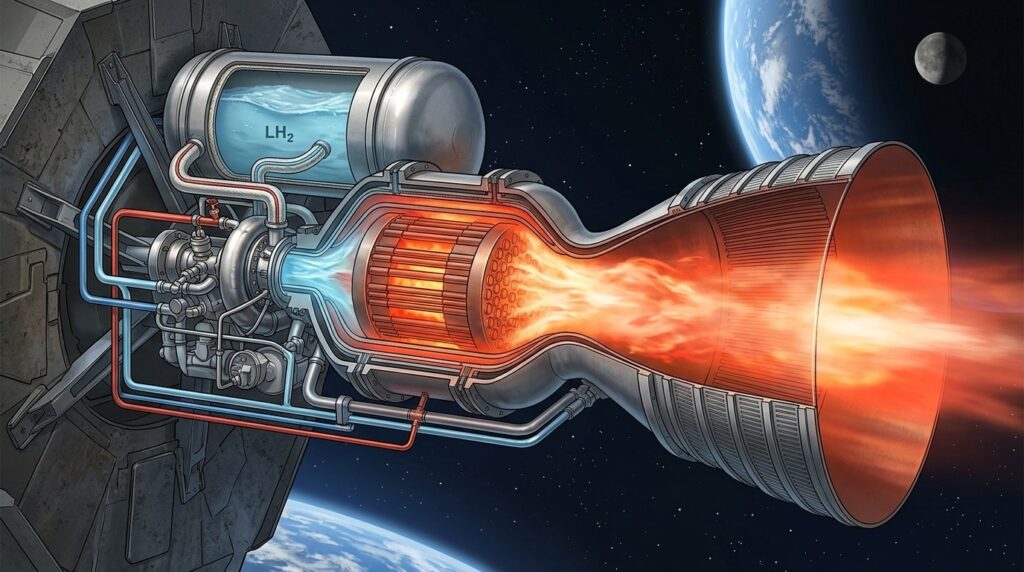
Diagram of a nuclear thermal rocket engine: the reactor heats hydrogen, creating thrust
Can We Send People to Saturn Right Now
Technically — yes. But, as Landis ironically notes, if the goal is to almost certainly kill the crew, then you could launch tomorrow. Existing chemical engines are in principle capable of delivering a spacecraft to Saturn, but the journey would be so long and conditions so harsh that the chances of survival would be minimal.
But with nuclear propulsion, the picture changes. Travel time is reduced, fuel mass decreases, and on-site fuel production solves the problem of the return trip. The Saturn system, with its remarkable moons, ceases to be an unreachable goal.
It’s important to emphasize that Landis’s study is a conceptual work within the NIAC program, which funds precisely early-stage ideas. This is not an approved NASA mission or a plan for the coming years. But the calculations demonstrate fundamental feasibility, and that is already a serious step.
It’s fascinating that we live at a moment when humanity has only just returned to the Moon: the Artemis 2 crew in April 2026 broke the distance record set by Apollo 13 in 1970. From 400 thousand kilometers to 1.4 billion (the average distance to Saturn) — the journey is enormous. But each technology, from nuclear engines to fuel production on other worlds, makes that journey a little shorter. And most importantly, for the first time in history, scientists can calculate exactly how much food, fuel, and time would be needed to complete it.
Source: Mission Incredible: A Titan Sample Return Using In-Situ Propellants