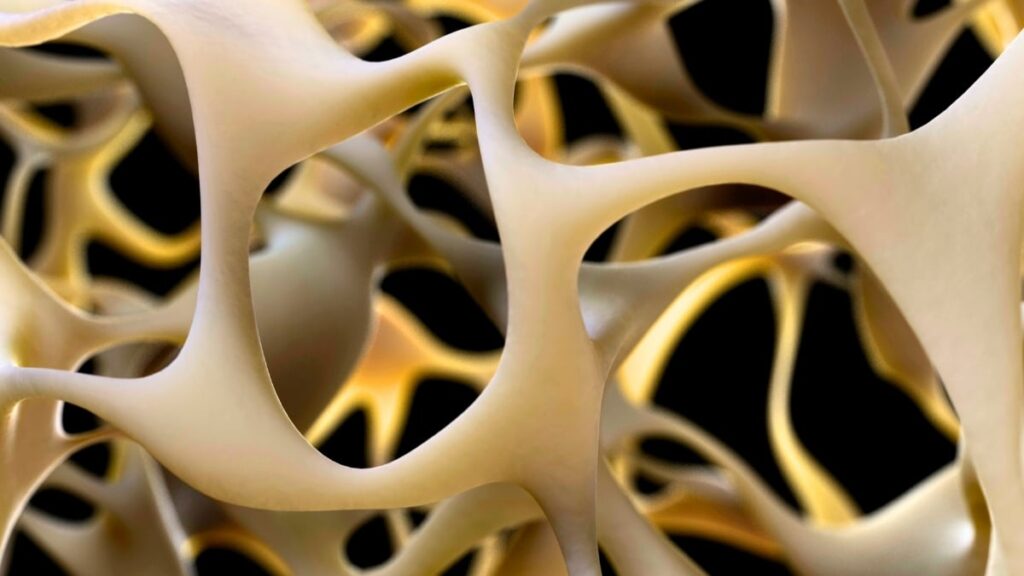
It turns out osteoporosis can be defeated, and scientists already know how
Osteoporosis is a disease in which bones become fragile because the body stops rebuilding bone tissue as quickly as it breaks it down. Today’s medications can only slow the disease but not reverse it. Scientists have found a cellular “switch” for bone strength, the activation of which strengthened bones in mice, including those with osteoporosis.
What Happens to Bones in Osteoporosis
Bone is not a dead stone but a living tissue that is constantly being renewed. Some cells break down old tissue, while others build new tissue. As long as these two processes are in balance, the skeleton remains strong. Osteoporosis occurs when the body cannot replace destroyed bone fast enough, and it becomes brittle, fragile, and heals poorly after fractures.
This is exactly why elderly people are so afraid of falls: a hip fracture in old age is not just an injury but an event that often changes the entire course of one’s remaining life. The disease affects millions of people worldwide, and so far no medication can fully cure it.
What Determines Bone Strength
A team of scientists from Leipzig University in Germany and Shandong University in China found in a 2025 study that the receptor GPR133 (also known as ADGRD1) plays a key role in bone density. It works through osteoblasts — cells that build new bone tissue.
Interest in this receptor was not accidental. Previously, scientists had noticed that changes in the GPR133 gene were linked to bone density and decided to study in more detail the protein encoded by this gene. Essentially, the receptor turned out to be the very link through which the body controls skeletal construction.
How the Substance AP503 Makes Cells Build Bone
To test the receptor’s role, the researchers conducted experiments on mice. In some animals, the GPR133 gene was completely absent, while in others, the receptor could be activated using a special chemical substance called AP503.
The result was striking. Mice without the GPR133 gene grew up with weak bones, and their condition resembled osteoporosis in humans. But when the receptor was present and activated with the substance AP503, bone tissue production and its strength noticeably increased.
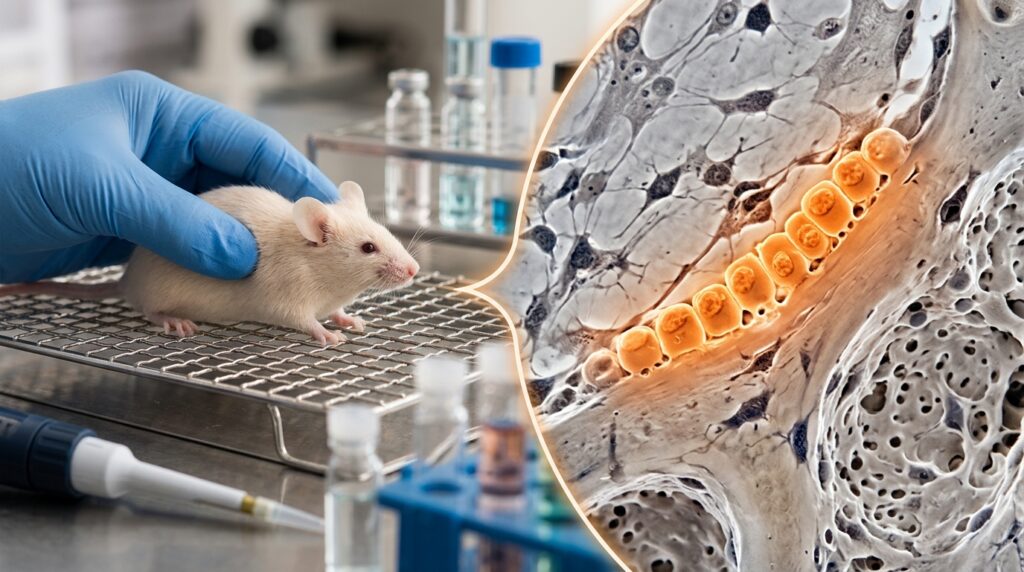
The activated receptor makes bone cells work more actively
The substance AP503 itself was recently discovered through computational screening — it works as a GPR133 stimulator. AP503 acts as a biological button that makes osteoblasts work harder. As Leipzig University biochemist Ines Liebscher notes, this substance significantly increased bone strength in both healthy mice and those with osteoporosis.
Another important point: the scientists showed that the substance can work in combination with physical exercise, strengthening bones even further. This aligns with the long-known fact that movement and sports are beneficial for the skeleton on their own, and here they complement the drug’s effect.
What Mouse Trials Tell Us
It’s important to be honest here: all results were obtained using an animal model, not in humans. This is not a ready-made medication that will appear in pharmacies tomorrow, but a fundamental discovery of a mechanism.
At the same time, there are grounds for optimism. The underlying processes in mice and humans are likely similar. According to Liebscher, when the receptor is disrupted due to genetic changes, mice already show signs of bone density loss at an early age — just like osteoporosis in humans.
The researchers’ main hope is that in the future, similar drugs will be able to not only strengthen healthy bones but also restore already damaged ones — for example, in women during menopause, when the risk of osteoporosis sharply increases. Today’s treatment methods either carry serious side effects or lose effectiveness over time.
Ways to Strengthen Bones in Osteoporosis
GPR133 is not the only research direction in this field. Bone strength is influenced by many factors, giving scientists a broad field for finding new ways to fight osteoporosis and achieve healthy aging.
Among other recent findings, two directions stand out:
- In 2024, scientists created a blood-based implant: synthetic peptides improve the structure of the natural clot that forms during blood coagulation. In experiments on rats, the gel-like substance, which can be 3D-printed, successfully repaired bone damage.
- That same year, a team from the University of California, San Francisco discovered a hormone called maternal brain hormone (MBH). It increased bone density, mass, and strength in mice of both sexes, with the resulting bones being noticeably stronger than normal.
Samples of the blood-based implant created in the laboratory
The common idea behind all these studies is one: our body already knows how to repair itself, but these processes weaken with age. Scientists are trying to “boost” the natural repair mechanisms — whether through bone cells, hormones, or properties of the patient’s own blood.
The discovery of the GPR133 receptor is important primarily because it reveals a specific target for future drugs. As molecular biologist Juliane Lehmann from Leipzig University notes, the parallel bone strengthening once again underscores the great potential of this receptor for medicine in the context of an aging population.