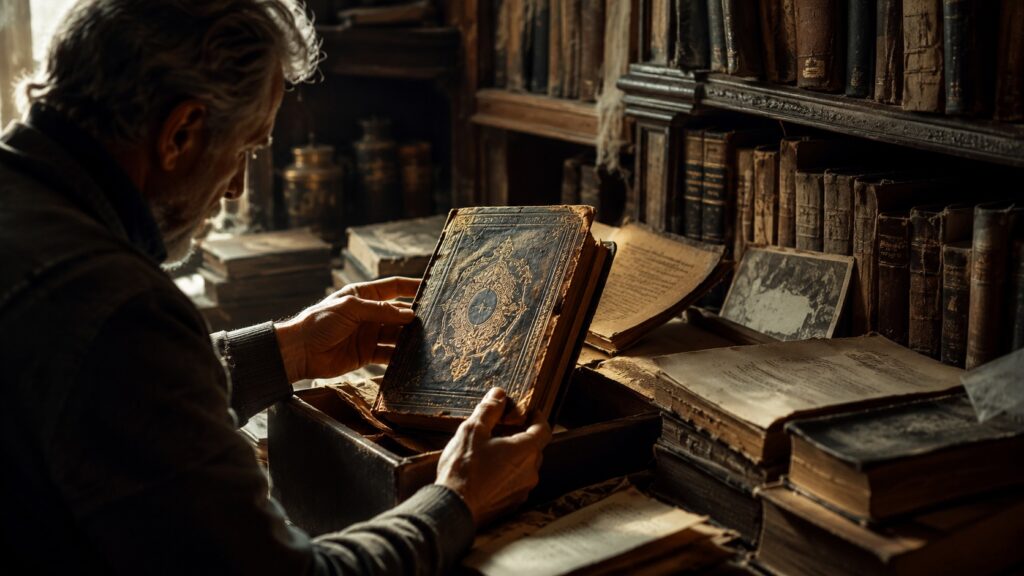
The value of a book doesn’t depend on its print date — sometimes even ancient editions are worth pennies due to large print runs
When sorting through an old home library, many people toss dusty volumes into the trash or send them off for recycling without a second thought. However, sometimes a rare book may be hiding beneath an unremarkable cover — one that collectors are willing to pay serious money for. Before getting rid of yellowed pages with a strange smell, it’s worth taking a closer look at them. Most Soviet reference books or mass-market novels are indeed worth next to nothing, but a rare volume that happened to end up among them could turn out to be a treasure with a high market value.
Why Not All Old Books Are Valuable
It’s worth noting right away that the year of publication alone doesn’t make a book expensive. A huge print run of a popular 19th-century edition may hold no interest for the market, while a thin pamphlet by avant-garde artists from the 1920s could cause a real stir. What matters to collectors is demand, condition, and completeness, not just the age of the book.
First and foremost, pay attention to old book editions that were published in small print runs before the mid-20th century. For the Russian-language segment, these include lifetime editions of classic authors, émigré literature, early Soviet print runs, and illustrated children’s books.
Key Signs of a Rare and Valuable Book
Even if you’re not a professional antiquarian, there are several basic markers that signal a book should not be thrown away without a thorough check.
- First appearance in print. Collectors value first editions the most. These most often convey the author’s original intent without later revisions. Look for confirmation on the title page or its reverse side;
- Small print run. The fewer copies were originally printed and the fewer have survived to the present day, the higher the price. If a copy is rare and still has an intact spine with no loose pages, its value increases significantly;
- Dust jacket and completeness. A surprising fact: for many 20th-century editions, a simple paper dust jacket can account for up to 90% of the value. Original inserts, fold-out maps, and complete multi-volume sets are also highly prized;
- Provenance. Don’t erase pencil notes or cover up bookplates. If a page bears an autograph or a dedication inscription from a famous person, an ordinary copy instantly moves into the category of historical documents;
- Errors and production quirks. Often, a manufacturing defect makes a book desirable. Typos in the earliest print run, a rare cover color, or pages that were later removed — all of these are signs of uniqueness.
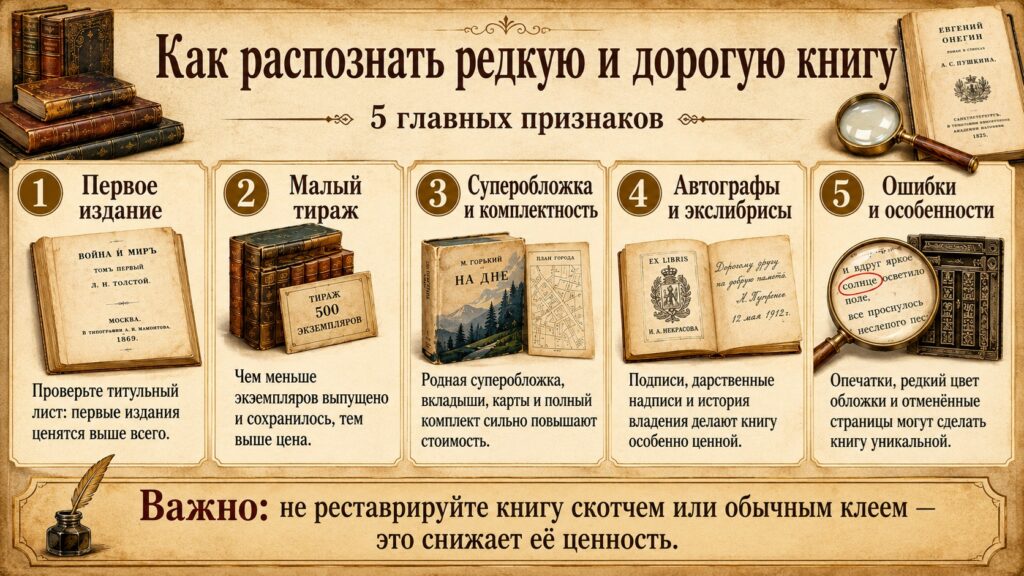
A guide on how to identify a rare and valuable book
How to Assess the Condition of a Rare Book
If you’ve found a book that fits the description of a rarity, don’t rush to improve it. The desire to bring a chance find to perfect marketable condition very often ends in disaster.
Remember the golden rule: DIY restoration with tape or regular glue instantly kills a book’s collectible value. Leave the book exactly as it reached you.
For an initial assessment, it’s enough to photograph the title page, its reverse side showing the year and print run, the spine, the binding, and any visible defects. Pay special attention to the presence of library stamps and inventory numbers. If the provenance of the item is unclear, selling it legally will be extremely difficult.
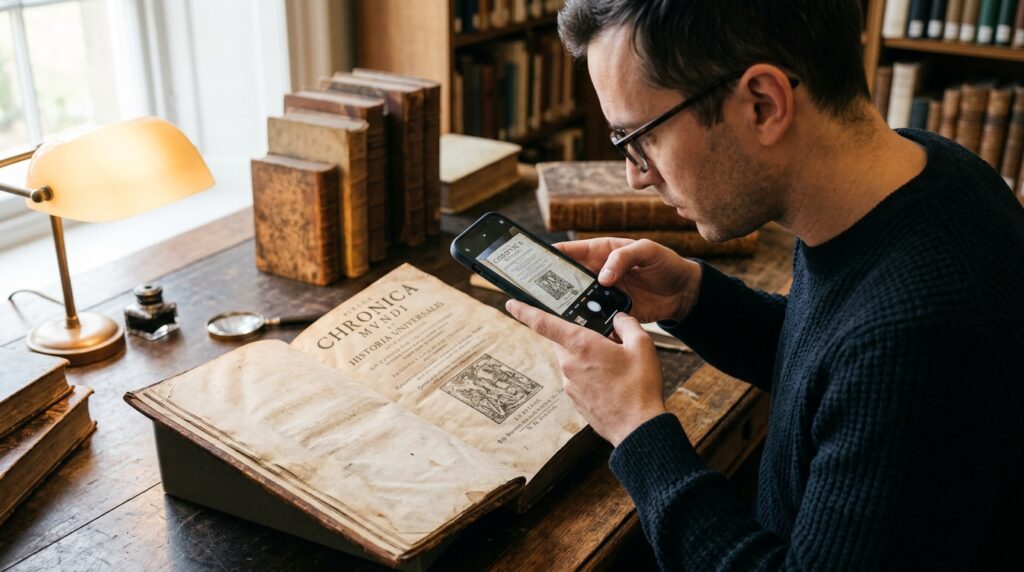
For a preliminary assessment, it’s enough to take a few high-quality photographs
Where to Sell Books Profitably in Russia
When you have a potentially valuable copy in hand, the question of finding a buyer arises. Different types of books have their own optimal selling platforms.
- Auction houses. Suitable for truly expensive, rare items, autographs, and archives. In Russia, the Litfond auction house specializes in this area, regularly dealing with historical papers, posters, and first editions;
- Online platforms. If you’re willing to communicate with buyers yourself and ship packages, use specialized antiquarian book websites. The most well-known Russian-language resource in this niche is the Alib platform;
- Antiquarian bookshops. An option for those who want to sell everything at once without any hassle. The shop will conduct its own appraisal, but keep in mind that the buyback price will be lower than the retail market value;
- Niche communities. If you have rare literature on chess, technology, or medicine, it makes sense to look for collectors directly on specialized forums.
Don’t rush to take your old home library to the dumpster. Paying careful attention to paper history allows you not only to save cultural heritage from destruction but also to receive very real financial compensation for it.