Scientists say Artemis astronauts could find scientifically valuable material on the Moon
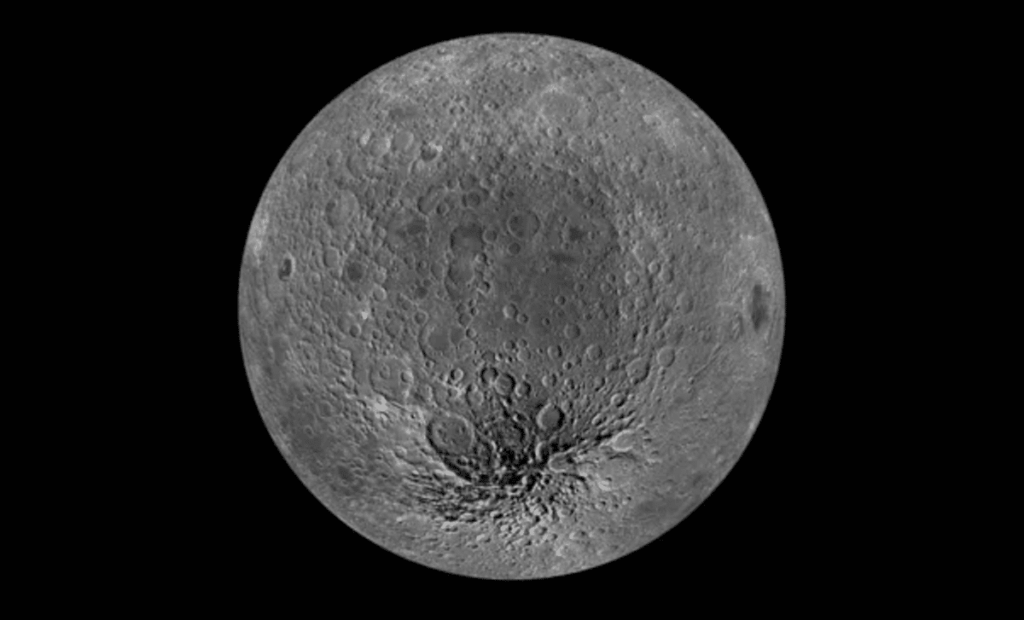
The South Pole–Aitken basin is the largest and oldest impact crater, located on the far side of the Moon. It has remained a mystery to scientists for decades. A new study has for the first time determined the exact direction of the impact that created this giant depression. It turns out the asteroid struck not from south to north, as previously believed, but the other way around — from north to south. This fundamentally changes the map of lunar mantle ejecta distribution and means that the Artemis program landing sites could be literally covered with priceless deep material.
South Pole–Aitken Basin: The Moon’s Largest Crater
On the far side of the Moon lies a depression of truly planetary scale. According to NASA, the South Pole–Aitken basin stretches from the small Aitken crater to the Moon’s south pole, occupying nearly a quarter of the lunar surface. Its diameter exceeds 2,500 kilometers, making it the largest impact crater in the Solar System. The basin’s average depth is about 10 kilometers.
To put the scale in perspective, it’s as if a bowl the size of half of European Russia had been pressed into the lunar surface. Scientists estimate the basin formed approximately 4.2–4.3 billion years ago, during the so-called Late Heavy Bombardment — a period when the inner planets and their moons were subjected to intense asteroid impacts.
The tallest mountains on the Moon are located along the basin’s rim, with peaks reaching 8,500 meters. The crust beneath the basin floor is thinned to 30 kilometers, compared to an average of about 50 kilometers for the rest of the Moon. This is precisely why scientists have long suspected that the impact may have punched through the crust entirely and exposed the mantle — the deep layer that makes up the bulk of the Moon.
How the Moon’s Largest Crater Was Formed
The elliptical shape of the South Pole–Aitken basin has long sparked debate. Oval craters form during oblique impacts, and their outlines can reveal where the impacting object came from. But in the case of this lunar crater, researchers argued for years: did the asteroid travel from south to north or the other way around?
A new study published in the journal Science Advances used advanced three-dimensional impact simulations and provided a definitive answer. The observed shape of the basin — an ellipse narrowing toward the south — is best reproduced by modeling an impact from a differentiated body 260 kilometers in diameter, traveling from north to south.
Key arguments supporting this trajectory:
- The basin narrows toward the south — that is, in the “downstream” direction of the impact;
- The crustal thickness gradient is steeper on the northern side;
- To the southwest of the basin, beyond its rim, there is a characteristic patch with elevated thorium and iron content — a typical signature of asymmetric ejecta.
This conclusion overturns views that had dominated the scientific community. Previously, many researchers assumed an impact from south to north, and predictions about ejecta distribution were built on that model.
Where Did the Asteroid That Left the Crater on the Moon Come From
The modeling also allowed scientists to reconstruct the properties of the asteroid itself with unexpected precision. According to the best match between the simulation and the basin’s actual geology, a body 260 kilometers in diameter struck the Moon at an angle of about 30 degrees at a speed of roughly 13 kilometers per second.
For scale, the asteroid that wiped out the dinosaurs on Earth was about 10 kilometers in diameter. The lunar asteroid was 26 times larger.
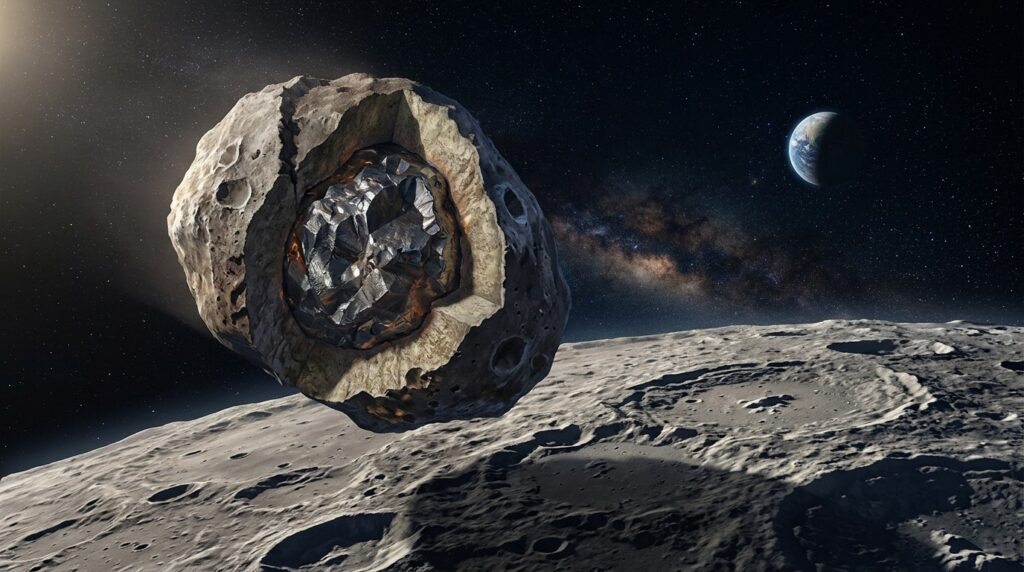
A giant asteroid with a metallic core approaches the Moon at a low angle
The asteroid was differentiated, meaning it had its own dense core and shell, like a small planet. It was a body that had undergone internal density separation.
The impact speed of 13 kilometers per second suggests the object was in a near-Earth orbit with low inclination before the collision. According to the study authors’ calculations, the most likely source of this body is the so-called Mars zone — the region of space between Earth’s and Mars’s orbits, where vast amounts of planetary building material orbited in the early Solar System.
Astronauts May Find Treasures on the Moon
The most practically significant result of the study is a new map of mantle material ejecta distribution. During the formation of the South Pole–Aitken basin, the impact ejected rocks from the Moon’s deep layers, and these ejecta spread around the crater in a characteristic pattern resembling butterfly wings.
Mantle rocks flew up to 550 kilometers beyond the basin rim in the direction of impact and up to 650 kilometers in the lateral direction. Most of this material then collapsed back inside the basin, which is consistent with gravity measurement data. But a significant portion remained on the surface beyond the crater’s edge.
And here’s where it gets really interesting. If the impact had come from south to north, as previously assumed, then the Moon’s south pole region — exactly where the Artemis program is targeted — would have been “upstream” from the impact. There would have been virtually no mantle ejecta there. But with a north-to-south impact, it’s exactly the opposite: the areas near the lunar south pole, where Artemis mission landings are planned, should contain abundant ejecta from the enormous crater, including mantle rocks.
Essentially, a single correction to the impact direction transformed the landing site from geologically “empty” to potentially the richest ever.
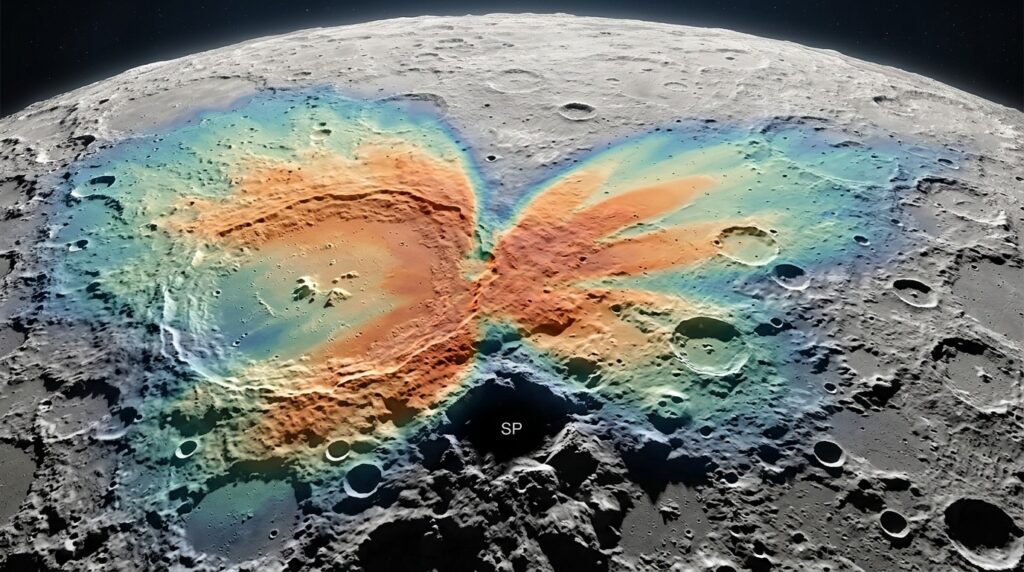
Diagram of mantle ejecta distribution around the giant crater, showing the characteristic “butterfly” pattern
A New Goal for the Artemis Space Program
The Artemis program is NASA’s ambitious plan for a costly return of humans to the Moon.
In February 2026, NASA Administrator Jared Isaacman confirmed the revised plan: the Artemis III mission will test lunar landing modules in Earth orbit, and the first crewed Moon landing as part of the Artemis IV mission is scheduled for 2028. NASA plans to land two astronauts in the Moon’s south pole region — precisely in the zone that, according to the new study, is covered by mantle ejecta.
If the authors’ model is correct, Artemis astronauts will find themselves on a surface where fragments of the lunar mantle, ejected to the surface over four billion years ago, literally lie at their feet. No previous mission has had the opportunity to collect such samples. For example, the Apollo missions operated on the near side of the Moon and never reached such deep rocks.
The mantle makes up the bulk of the Moon’s volume but has remained virtually inaccessible for direct study until now. Its samples would help answer fundamental questions: what lies inside the Moon, how the crystallization of the lunar magma ocean occurred, and what the early history of the Solar System was like.
What Questions Will the Artemis Program Answer
It’s important to emphasize that so far these are results of computer modeling. The authors showed that the impact model best reproduces the observed characteristics of the South Pole–Aitken basin: its shape, crustal thickness, and distribution of chemical anomalies. But final confirmation is only possible by obtaining actual samples from the south pole.
Some progress has already been made: China’s Chang’e-6 mission delivered the first samples from the far side of the Moon to Earth, providing a unique window into the Moon’s interior, especially its mantle.
Analysis of these samples allowed Chinese scientists to date the basin’s formation at 4.25 billion years ago. However, Chang’e-6 operated inside the South Pole–Aitken basin, not on its southern rim, where, according to the new model, the most interesting ejecta are concentrated.
A number of open questions remain. How much mantle material has survived on the surface over more than four billion years? Has it become mixed with other material over time?