Removable batteries were once one of the most practical features of mobile phones. A dead or degraded battery meant a quick trip to a shop, a snap-off back cover, and a swap that took under a minute — no tools, no service center, no downtime. That era is effectively over: modern smartphones glue their batteries inside sealed unibody shells, making replacement a multi-step repair job. But the reasons behind the shift are more nuanced than simple planned obsolescence, and regulatory pressure may be forcing a partial return to user-replaceable batteries.
What you need to know
- Removable batteries disappeared primarily for engineering reasons: thinner bodies, custom-shaped cells, wireless charging coils, and water resistance all favor sealed designs.
- The trade-off surfaces after two to three years, when battery capacity can degrade to roughly 70% of its original level, requiring a costly professional replacement.
- Fairphone has demonstrated that a user-replaceable battery is still possible in a modern smartphone, though with compromises in thickness, weight, and water resistance.
- The European Union is set to require manufacturers to make batteries accessible for replacement starting in 2027.
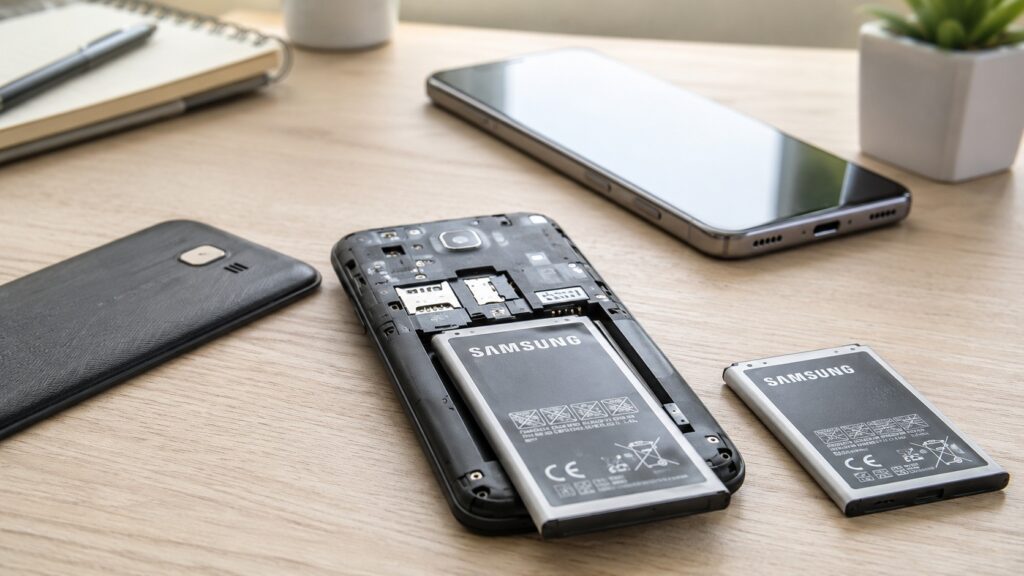
Removable batteries are now a relic of the past
How battery replacement used to work
The era of Nokia and Samsung phones with snap-off back covers made battery replacement intuitive: pry off the rear panel with a fingernail, pull out the old cell, drop in a new one. No screwdriver, no heat gun, no service appointment. The whole operation took about a minute.
Contrast that with today’s process for a non-removable battery. Reaching the battery in a modern smartphone typically requires:
- Removing the rear panel or display, depending on the phone’s construction;
- Disconnecting multiple ribbon cables and connectors;
- Dissolving adhesive with heat or a chemical solvent;
- Carefully extracting the battery without puncturing it.
The result is a repair that can take days and involves backing up data in advance as a precaution.

What made removable batteries so useful
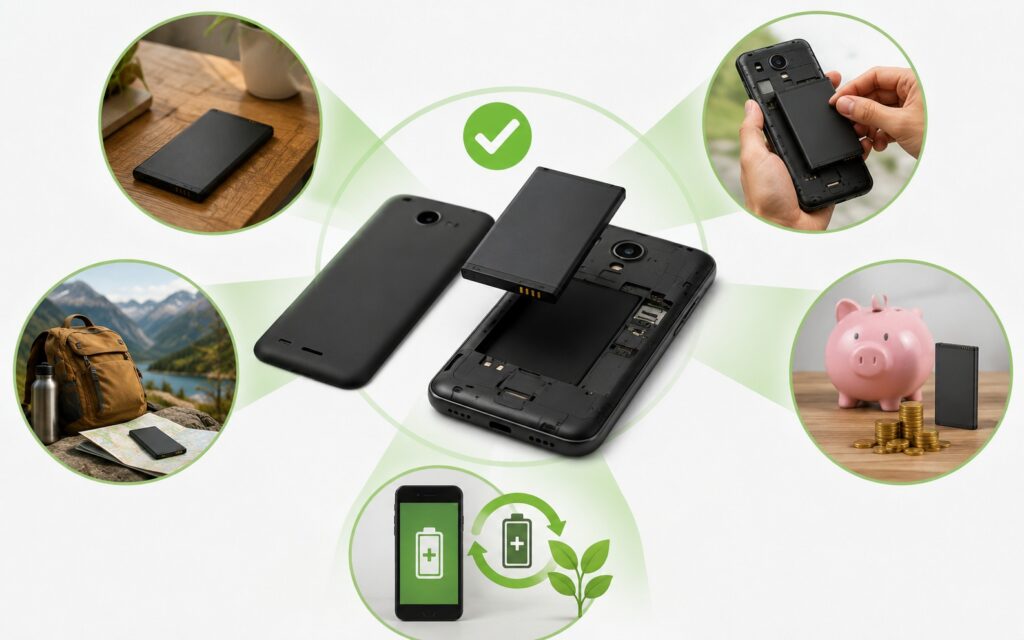
Removable batteries had many practical advantages
The benefits went beyond simple end-of-life replacement. Several scenarios made removable batteries especially valuable:
- Spare battery for travel. A second battery weighing 50–80 grams could be charged in advance and swapped in on the go — no power bank or cable needed. The only downside was that each spare was model-specific.
- Guaranteed hard reboot. If a phone froze completely, pulling the battery and reinserting it provided an instant restart — no need to hold down the power button for 15 seconds and hope.
- Instant power-off after water exposure. When a phone fell into water, the first priority is cutting power immediately. A removable battery made that instantaneous. With a sealed battery, the user must wait for the phone to shut down on its own or hold the power button, while water continues to cause damage to energized circuits.
Why manufacturers switched to sealed batteries
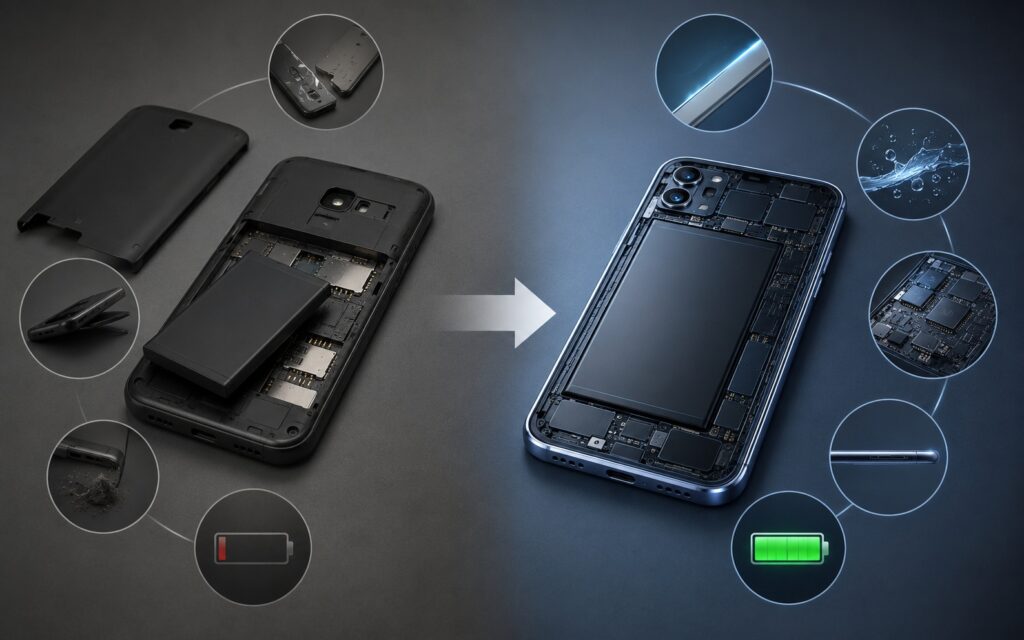
Modern smartphones with non-removable batteries have their own advantages
It is important not to reduce the shift to a manufacturer conspiracy. The reasons are genuinely technical:
- Thinner, more rigid bodies. A unibody shell without a removable cover is easier to make thin (7–8 mm) and structurally stiff. Removable covers introduced flex, creaking, and the need for gaskets.
- Efficient use of internal space. A sealed design allows irregularly shaped batteries — L-shaped, curved, or varying in thickness across different sections — that fill every available millimeter. A removable battery must be a simple rectangle that slides out easily.
- Wireless charging and water resistance. The wireless charging coil must sit securely beneath the rear panel, not rattle on a removable cover. Sealing against water is also far simpler without a user-accessible panel.
- Camera modules. Modern multi-lens camera arrays occupy a large portion of the phone’s interior and require rigid mounting. Designing a removable cover with cutouts for several lenses is an engineering challenge without a clean solution.
What sealed batteries made possible
Non-removable batteries brought real improvements, and it would be dishonest to deny that:

- Bodies became noticeably stiffer, thinner, and more refined — no creaking covers or play in the chassis;
- Battery capacities have grown substantially (the realme P4 Power, for example, reaches 10,001 mAh);
- Fast wired charging became standard;
- Wireless charging became practical;
- Water and dust resistance ratings such as IP68 and IP69K became achievable.
The catch is that these benefits are most apparent when a phone is new. After two to three years, when the battery has degraded to around 70% of its original capacity, the owner faces a service visit and significant expense — a problem that removable batteries once solved trivially.
Can removable batteries come back?
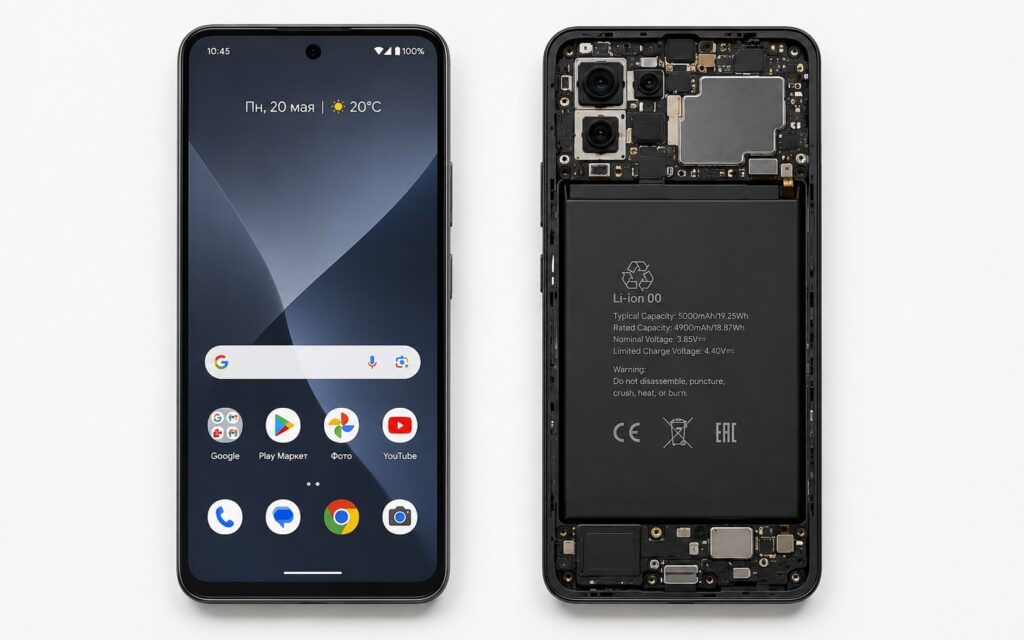
Some modern smartphones do allow users to replace the battery themselves
Simply reverting to a snap-off plastic cover is not straightforward. A modern smartphone’s interior is densely packed with multiple camera modules featuring large sensors, wireless and MagSafe charging coils, vapor chamber cooling systems, multiple antennas for 5G, Wi-Fi 7, and Bluetooth, plus haptic motors, speakers, and resonators. A simple removable cover would demand serious compromises in thickness, rigidity, water resistance, and component layout.
However, a fully glued-in battery is not the only alternative. Fairphone has demonstrated that a smartphone with a user-replaceable battery is possible even today: its battery is held in place by clips and can be swapped without tools. The trade-offs are real — Fairphone devices are thicker and heavier than competitors and lack IP68 water resistance — but the phone exists, and it represents an important signal to the industry.
Looking ahead, the European Union is set to require manufacturers to make batteries accessible for replacement starting in 2027. This does not necessarily mean a return to Nokia-style snap-off covers, but it does mandate that batteries be at least repairable with standard tools. Repairability is returning — slowly, driven by regulators rather than by manufacturers’ goodwill.