If you are choosing an Android phone in 2026, the single hardware number worth checking first is the amount of physical RAM — and it is the figure manufacturers are least eager to show. That is the argument of the original author, who contends that any Android phone above the budget tier now ships with an adequate processor, a decent camera and a reasonable battery, while RAM still decides how long the device stays fast and which AI features it can even run. The practical takeaway: 8 GB covers everyday use, 12 GB is the sweet spot, and “virtual” or “extended” RAM should not be counted at all.
What you need to know
- Both the Google Pixel 11 and Samsung Galaxy S26 ship with 12 GB of RAM, yet their official product pages list it after colours, cameras, batteries and cooling systems.
- According to the author, Gemini Intelligence on the Pixel 11 only works with at least 12 GB; on the Pixel 10 roughly 3.5 GB is reserved for AI, leaving about 8.5 GB for the user.
- A three-hour measurement on a 16 GB vivo X300 showed an average of 8.7 GB in use during messaging, music and email — with no browser open.
- “8+8 GB” configurations use flash storage as swap; the author advises comparing such phones only with other 8 GB models.
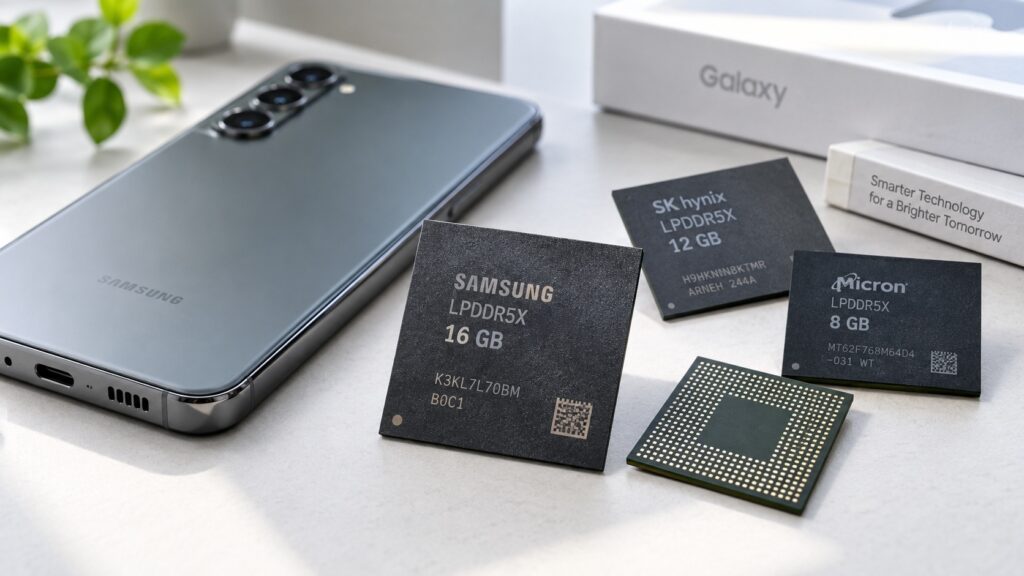
A Samsung smartphone with different RAM chips
Product pages talk about cameras, not memory
The author compared the official product pages of the Google Pixel 11 and the Samsung Galaxy S26 — the most affordable models in their respective lineups, which also carry the same price. On the Pixel 11 page, a shopper learns in turn about the body colours, Gemini, the Magic Capture feature, the battery and wireless charging, the size of the camera module and the camera itself — and only then about RAM and storage.
The Galaxy S26 page is even more telling: camera, display, dimensions, chipset, cooling system, fast charging, storage, and then the camera again. The amount of RAM appears only inside a collapsible block about storage options, which is easy to scroll past. Yet both models come with 12 GB of RAM, which the author calls the most important line in the entire description.

How Google and Samsung describe their phones on the official websites
The likely reason for this silence, the author suggests, is simple: RAM does not look impressive on an advertising banner. A body colour and a zoomed-in photo sell better than an abbreviation and a number of gigabytes.

Why manufacturers keep the RAM figure quiet
According to the author, the memory market remains in shortage: demand from AI data centres has pushed up chip prices, and this is already feeding into smartphone costs. One might expect manufacturers to economise and design phones around smaller memory pools. The opposite is happening — new features demand ever more RAM.
In particular, the author states that Gemini Intelligence, the headline software feature of the Pixel 11, works only with at least 12 GB of RAM. Google is therefore compelled to put that much memory in every new Pixel, or it would have no way to promote its AI features. On the Pixel 10, around 3.5 GB is reserved for AI tasks, leaving the user with roughly 8.5 GB. The author adds that the system app AICore can be disabled to reclaim that memory and storage — it is simply not something the manufacturer wants.
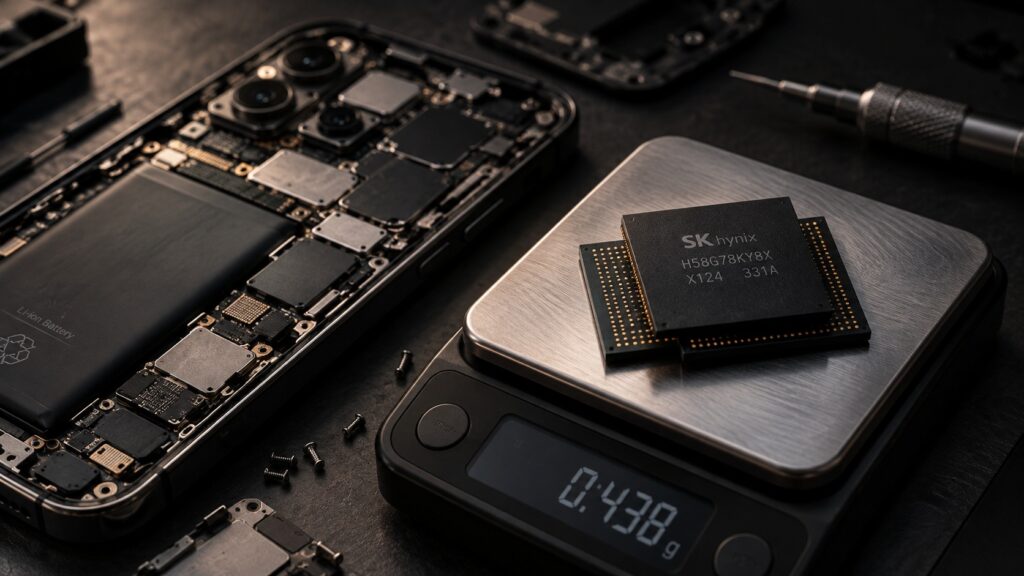
A disassembled smartphone with its RAM chip
The result, in the author’s view, is that buyers pay for memory twice: first because chips have become more expensive, and then for gigabytes needed not by them but by marketing promises about AI. The same applies, to varying degrees, to other brands that build their own neural-network assistants into their firmware.
How much RAM a smartphone needs in 2026
The article cites a measurement by one of the outlet’s own writers on a vivo X300 with 16 GB of RAM: over three hours, the phone used an average of 8.7 GB. During that time he was messaging friends, listened to four songs and checked email — without even opening a browser. This was an ordinary usage scenario, not gaming or video editing.
From this, the author derives a practical guideline for 2026:

- 8 GB — enough for messengers, social networks, music and navigation;
- 12 GB — the optimal choice;
- 16 GB and more — for those who genuinely load the phone with games, emulators, or dozens of apps kept in the background.
The processor, the author argues, is almost never the bottleneck: to find a phone that stutters because of its chip rather than a lack of memory, you would have to dig deep into the budget segment. That is why RAM is the first figure the author checks in any leak or announcement — it best describes the character of a phone and the set of AI features it will receive. Manufacturers, however, prefer to sell other things.
“Extended” RAM from storage is not a substitute for real memory
A separate trap is the “memory extension” feature that many brands list in their specifications and even in configuration names such as “8+8 GB”. It works like this: the system uses part of the built-in storage as swap space, offloading data from apps that did not fit into RAM. Formally the phone “sees” more memory, but flash storage is noticeably slower than real RAM chips.
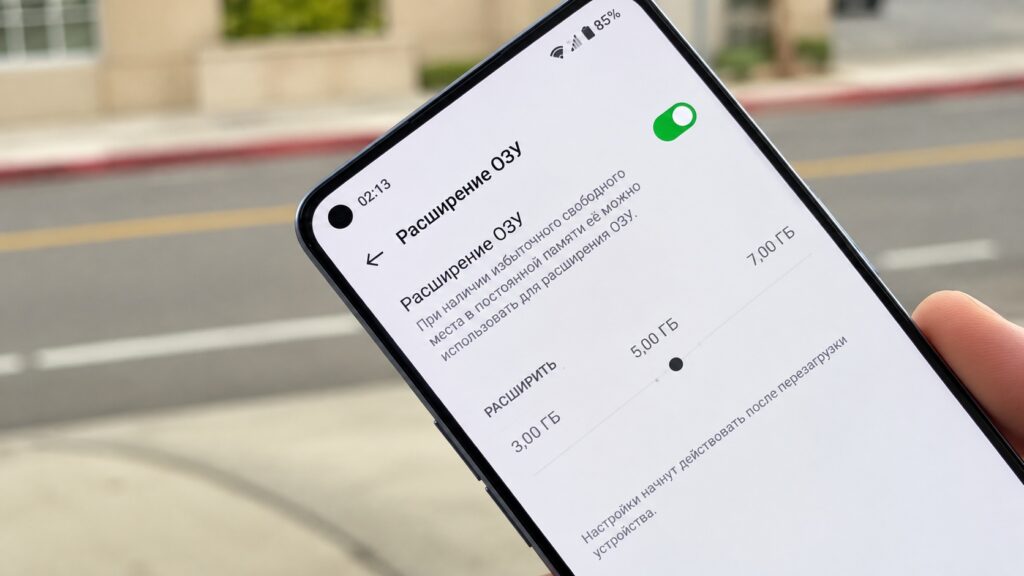
The RAM extension feature in a smartphone’s settings
In practice this means a background app will not disappear, but switching back to it will take noticeably longer than on a phone with a real 12 GB. Constant writes to the storage also accelerate its wear. The author’s advice is to look only at the physical amount: “8 GB extendable to 16” is an 8 GB phone, and it should be compared with other 8 GB models.
How to check the RAM before you buy
Since manufacturers are in no hurry to display this number, the author recommends finding it yourself. The steps are the same for any brand:
- On the model’s official page, find the “Technical specifications” or “Specs” section and expand the block about storage — as the Galaxy S26 example shows, the RAM figure is often hidden there.
- Check which memory is listed for the specific configuration: the 128 GB and 256 GB storage versions of the same model frequently differ in RAM as well.
- In a retailer’s listing, confirm that the figure refers to physical memory, not “extended” or “virtual” memory. If it says “8+8”, the real amount is eight gigabytes.
- If the phone is already in your hands, open Settings, go to About phone (About device on some brands) and find the RAM line. Some manufacturers show the swap amount there too, separately from the real memory.
- For checking a used device, hardware-information apps from Google Play such as AIDA64 or CPU-Z will do: according to the author, they report the actual chip capacity regardless of firmware settings.
If the figure cannot be found on the manufacturer’s site or in the store listing, the author says that is a signal in itself. Manufacturers have something to advertise when there is plenty of memory — and something to hide when there is just enough to run their own AI assistant.