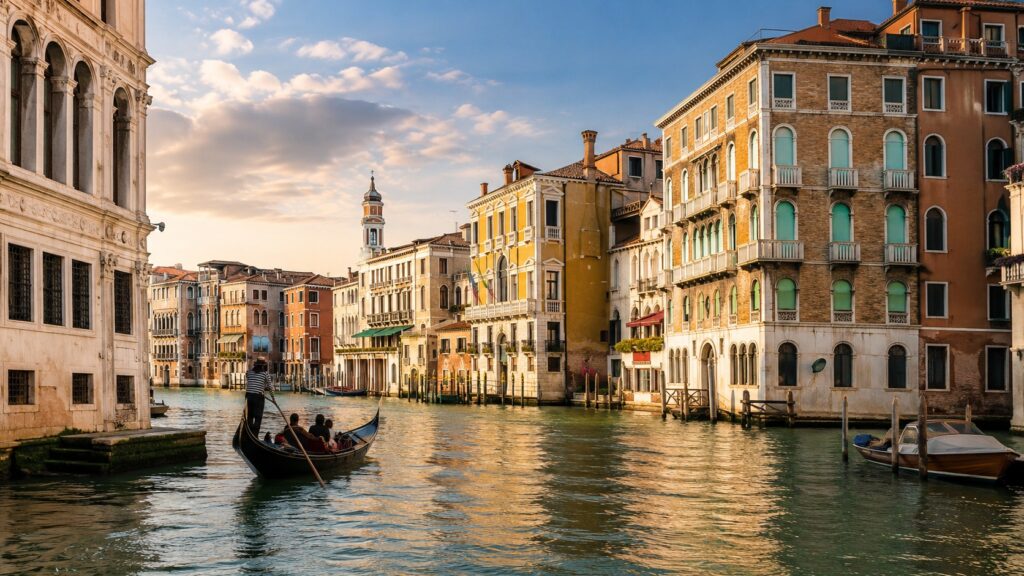
Venice is already 1,605 years old and still stands firmly on its foundation
Venice has been standing in water for over a thousand years. Stone palaces, bridges, and cathedrals don’t collapse, crack, or sink beneath the water. Yet the foundation of many buildings is made of wood, which under normal conditions rots within a few decades. So why has it withstood centuries? The answer lies in one non-obvious condition that completely overturns our understanding of building on water. What is the secret of this city where cars are almost completely banned?
How Buildings Were Constructed in Venice
From the outside, it often seems like the stone facades of buildings rise directly from the bottom of the Adriatic Sea. In reality, the construction of historic buildings took place on islands within a shallow lagoon. Their soil consists of a mixture of sand, clay, and fine river silt.
This ground most closely resembles very dense wet porridge. You can walk on it, but placing a heavy palace on top without special preparation is impossible, because the walls would begin to settle unevenly and quickly become covered with cracks. While in the North, buildings are often placed on concrete supports due to unstable permafrost, Venetian architects had to solve the problem of soft mud. They had to reinforce not the entire island, but only the areas beneath the future load-bearing walls and towers.
The Wooden Foundation Beneath Venice
First, many relatively short trunks of alder, larch, pine, or oak were manually driven into the soft ground. Workers formed groups and sang rhythmic songs to synchronously raise and lower the heavy mallets.
Contrary to popular belief, most piles did not reach the hard rocky bottom. They were held in place by lateral friction force. Driving in the wood displaced excess moisture, and the clay and silt gripped each support in a death lock.
While today the rectangular shape of buildings has become a universal norm for convenient planning and standardized construction, the outlines of Venetian palazzos were largely determined by the complex layout of the pile field. Creating a reliable foundation proceeded in several stages:
- Along the perimeter of the future foundation, the first row of trunks was driven in tightly next to each other;
- Then they progressed toward the center, forming a kind of wooden brush stuck bristles-down;
- The tops were always sawn off below the groundwater level to eliminate contact with air;
- Thick wooden beams were laid on top, and massive stone blocks were placed on them.
As a result, the dense palisade of piles distributed the enormous weight of the heavy stone walls across the entire area of soft ground, preventing the structures from sinking underwater.
Reasons for the Centuries-Long Preservation of Wood Underwater
For wood to begin rotting quickly, three conditions are necessary: moisture, suitable temperature, and oxygen. The lagoon has plenty of dampness and warmth, but fresh air barely penetrates deep into the dense silt.
The main destroyers of wood are fungi, and they cannot survive without oxygen. Insects are also unable to bore tunnels in a viscous oxygen-free environment. It turns out that the most dangerous condition for wood is the alternation of water and air, not simply being in a wet state.
An excellent example is the wooden poles used to mark the shipping channel in Venice. They stick out above the lagoon surface and regularly get wet and then dry out in the wind. It is precisely at the waterline level that they quickly deteriorate and rot through, which is why they have to be replaced regularly. Foundation piles, however, exist in far more comfortable and, most importantly, stable conditions.
The Myth of Petrified Piles Beneath Venice
A beautiful story is often found on the internet claiming that seawater supposedly saturated the trunks with minerals, the organic matter completely disappeared, and the wood beneath Venice’s buildings literally turned into granite. This is a major exaggeration.
There is no convincing evidence of complete petrification of Venice’s foundation. Mineral salts can indeed be deposited in surface pores, but they do not replace the internal structure. If genuine stone columns stood beneath the buildings, researchers would not find softened and damaged areas inside them.
Studies show that anaerobic bacteria do in fact destroy the cell walls of the wood, they just do so extremely slowly. Externally, a trunk may look intact, even though its internal strength has already been reduced. However, the wood maintains its shape thanks to constant pressure from the surrounding ground on all sides and water that tightly fills microscopic voids.
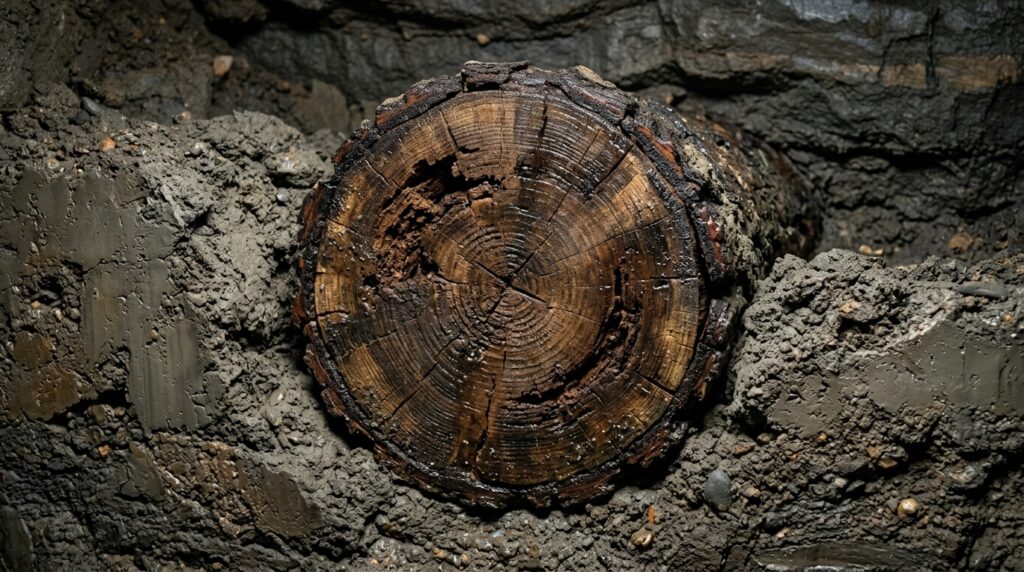
The piles haven’t turned to stone — they remain wooden but are reliably preserved in the ground
Why Venice’s Stone Buildings Continue to Deteriorate
Wooden piles are only the lower part of the building foundation. To separate the wet zone from the brick walls, Venetians used Istrian stone, a dense light-colored limestone that absorbs moisture very poorly. But even it cannot provide architecture with one hundred percent protection.
Water gradually rises through microscopic pores in the masonry upward. When it evaporates on the facade, salts remain inside the brick. Their crystals grow, press against the walls of the pores, and literally tear apart plaster and stone from the inside. Additional damage is caused by waves from motorboats, seasonal floods, and inevitable ground subsidence. It is known that the massive bell tower of the Basilica di Santa Maria Gloriosa dei Frari has sunk into the ground by approximately 60 centimeters over its history.
Therefore, Venice needs constant restoration — it is by no means an eternal or self-sustaining mechanism. The city’s stability critically depends on the water level. If it drops, the piles will be exposed and quickly rot due to oxygen exposure. If the level continues to rise, saltwater will flood the upper floors and destroy the fragile palace facades more rapidly.