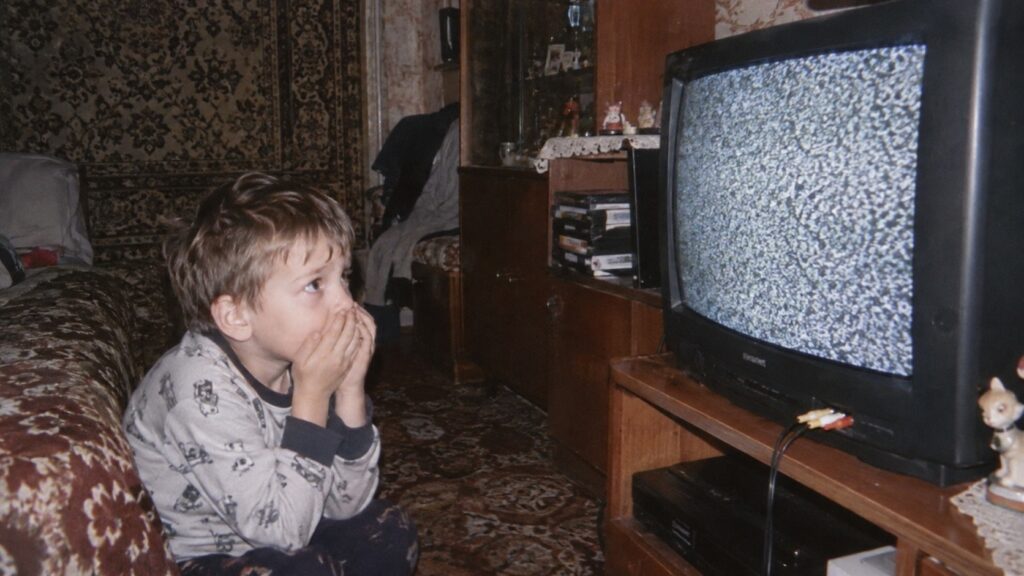
A child looking at static on an old television
The hissing black-and-white “snow” that filled old TV screens when a channel dropped out was noise. It came from random fluctuations generated inside the television’s own electronics, stray radio waves picked up by the antenna and, under certain conditions, radio emission from the Sun and other cosmic sources. With no proper broadcast to display, an analog set simply amplified and drew all of it. According to one well-known estimate, a small share of that static may even have been linked to radiation left over from the Big Bang.
What you need to know
- TV “snow” came from three sources: thermal noise in the electronics, stray radio signals, and natural radio emission from space.
- Thermal noise is present even when no antenna is connected, so an analog tuner on an empty frequency shows snow on its own.
- Astrophysicist Ethan Siegel cites an estimate that, under certain conditions, about 1% of TV static could be linked to the cosmic microwave background.
- Digital TV corrects many transmission errors, so instead of gradual snow it shows a clear picture until it breaks into blocks, freezes, or goes black.
An analog TV drew whatever the antenna caught
Old televisions worked with an analog signal. A broadcast tower sent out radio waves in which picture and sound were encoded. The antenna picked them up, and the set turned them into an image. The signal was continuous and constantly changing. Simplified to a black-and-white picture, some signal values meant dark areas and others meant light ones.
The television had no way of telling where a particular fluctuation came from. It just read the signal and drew dots of the corresponding brightness. But radio waves never arrived perfectly clean. Along with the broadcast, the antenna picked up outside interference, and small random fluctuations also arose inside the set itself. What viewers saw depended on how strong the useful signal was:
- with a strong signal, the picture looked normal and the noise was barely noticeable;
- with a weak signal, white and black dots appeared across the image;
- with no signal at all, noise filled almost the entire screen.
The noise was not transmitted by the tower. It was made up of the electronics’ own noise and unrelated radio waves captured by the antenna.
Three sources of noise: electronics, other signals and space
The first source was the electronics themselves. Electrons inside components are always moving, which produces weak random fluctuations. Engineers call this thermal noise. It exists even when no antenna is connected at all.

A child sitting on a rug in front of an old television showing static
The second source was other radio signals. Electromagnetic waves from radio transmitters and electrical appliances are always around us, and some of them found their way into the receiver. The third source was nature. The Sun and other cosmic objects also emit radio waves and, under certain conditions, add their share of interference.
On an empty channel there was no normal signal, so the television amplified everything it managed to catch, along with the random noise. Because the noise was random, each dot kept changing brightness without forming anything stable. The result was thousands of flickering dots resembling falling snow, accompanied by the familiar hiss from the speakers.
The Big Bang’s afterglow may account for about 1% of the static
In 1965, American physicists Arno Penzias and Robert Wilson discovered faint microwave radiation coming from almost every direction in the sky. Today it is known as the cosmic microwave background. It originated roughly 380,000 years after the Big Bang, when the universe had cooled enough for light to travel freely through space.
Since then, the universe has expanded and the waves of this radiation have been stretched. It now arrives mainly as microwaves, but a weak part of it also exists at lower frequencies, including those used by old televisions. In an article for Big Think, astrophysicist Ethan Siegel cites a well-known estimate: under certain conditions, about 1% of television static could have been linked to the cosmic microwave background.
An important caveat applies. This is an approximate estimate, not a fixed share for every television. The actual contribution depended on the frequency, the antenna and the other sources of noise. Nor was it possible to point to a specific dot and say the Big Bang had left it there. Still, the idea is striking: an antenna tuned to an empty channel may have been picking up an echo of the universe’s earliest history.
Digital television learned to correct errors
The snow disappeared mainly because of the switch from analog to digital broadcasting. Picture and sound are now transmitted not as a continuous signal but as data, meaning sequences of zeros and ones. The difference is roughly like that between a photo sent over an old analog line and a file sent over the internet.
A digital television first reconstructs the received data and only then assembles the picture from it. Crucially, the system can detect and correct many transmission errors. If part of the signal is distorted by bad weather or interference, an analog set would immediately show extra dots. A digital one simply fixes the error, and the viewer notices nothing.
This has nothing to do with televisions becoming flat. A flat-screen TV with an analog tuner will still show snow, while an old cathode-ray-tube set connected to a digital set-top box will produce a clean picture. What matters is how the signal is received and processed.
Blocks and black screens have replaced the snow
Interference has not gone away. Digital televisions just respond to it differently. They hold a good picture almost to the very end, but once there are too many errors, the data can no longer be recovered. The image then breaks into blocks or freezes, the sound cuts out, or the screen goes black. Engineers call this the digital cliff effect.
| Signal | Analog TV | Digital TV |
|---|---|---|
| Good | Normal picture | Sharp picture |
| Weakening | Snow gradually appears | Picture still sharp |
| Very poor | Sometimes still watchable through the noise | Blocks, freezing or a black screen |
This creates a curious paradox. With poor reception, an old television might show a football match with the players barely visible, yet it was still possible to follow the game. A digital set shows a perfect picture up to a certain threshold, after which the broadcast may cut out entirely.

A man holding a remote looks at a breaking-up TV picture
Where you can still see TV snow today
You need a television with an analog tuner. Tune it to a frequency where nothing is being broadcast, and the familiar snow will appear. This happens even without an antenna, since part of the noise is generated inside the electronics. Some newer models also retain an analog mode.
Most modern televisions, when there is no signal, simply display a “No signal” message, a black screen or a screensaver. The noise has not vanished from the physical world. During ordinary digital viewing, it is just no longer turned into a picture. An empty channel used to hiss and flicker, but now it is usually just dark.