According to Chinese insider Digital Chat Station, Apple has enlisted Samsung to develop a curved OLED display for the iPhone 20 — an anniversary model marking the 20th anniversary of the iPhone lineup. The main feature: the screen will be curved on all four sides of the body, but with minimal curvature — the so-called “four micro-curve” format. This is a rumor, not a confirmed fact, but it aligns with earlier predictions about a radical redesign of the iPhone 20.
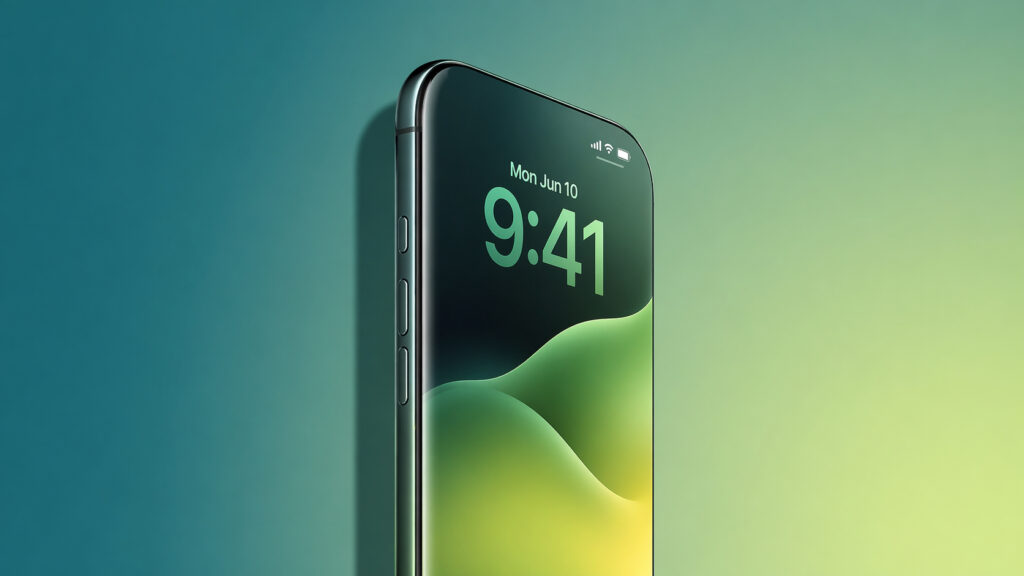
Ready for a curved screen on the iPhone
What Screen the iPhone 20 Will Have
According to a Weibo post, Apple is working with Samsung on a display with a “four-micro-curve” form factor — meaning the screen will be slightly curved on all four edges of the device. The key word here is “slightly curved.” If the leak is accurate, the curves will be noticeably more subtle than those on Samsung Galaxy devices with their aggressive curved displays of years past.
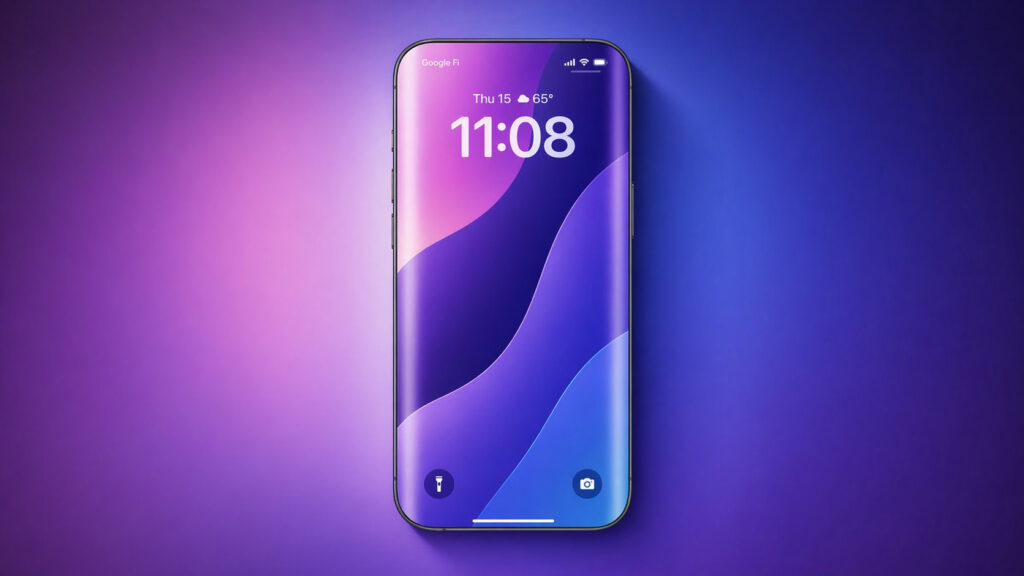
Apple will curve the screen in the iPhone XX
It’s also mentioned that Samsung is developing a so-called “pol-less” display for the iPhone 20 — a screen without a polarization layer. This aligns with an earlier prediction from September 2025 about the use of COE (Color Filter on Encapsulation) technology. In short: by removing the polarizer, the screen can be made thinner, brighter, and more energy-efficient.
How the iPhone 20’s Curved Screen Differs from Samsung’s
Curved screens are nothing new for smartphones. Samsung began experimenting with them back in 2014 with the Galaxy Note Edge and then actively used them in the Galaxy S and Note lineups. But the experience proved controversial.
Samsung devices with aggressively curved screens had characteristic problems:
- Accidental touches — the palm would brush the screen on the curved edges, causing the interface to respond unpredictably
- Color and brightness distortion on the curves
- Increased fragility — a side impact could crack the screen more easily than on flat models
- Problems with screen protectors and films
It’s no coincidence that Samsung abandoned curves in its flagships: the Galaxy S24 Ultra was released with a flat screen.
Apple, judging by the leak, has taken this experience into account. “Micro-curve” suggests that the screen only slightly wraps around the edges — enough to visually eliminate bezels, but not so much as to cause problems with false touches and discomfort in the hand.
Polarizer-Free OLED Screen in the iPhone 20
The second important detail of the leak is the elimination of the polarization layer. In standard OLED screens, a polarizer is needed to suppress reflections from external light. But it absorbs more than half of the pixel brightness and adds thickness.
COE technology (or pol-less, as it’s called in the industry) replaces the physical polarizer with color filters applied directly to the protective layer of the panel. According to Samsung Display, screens without a polarizer can be 20% thinner and consume approximately 37% less energy at the same brightness.
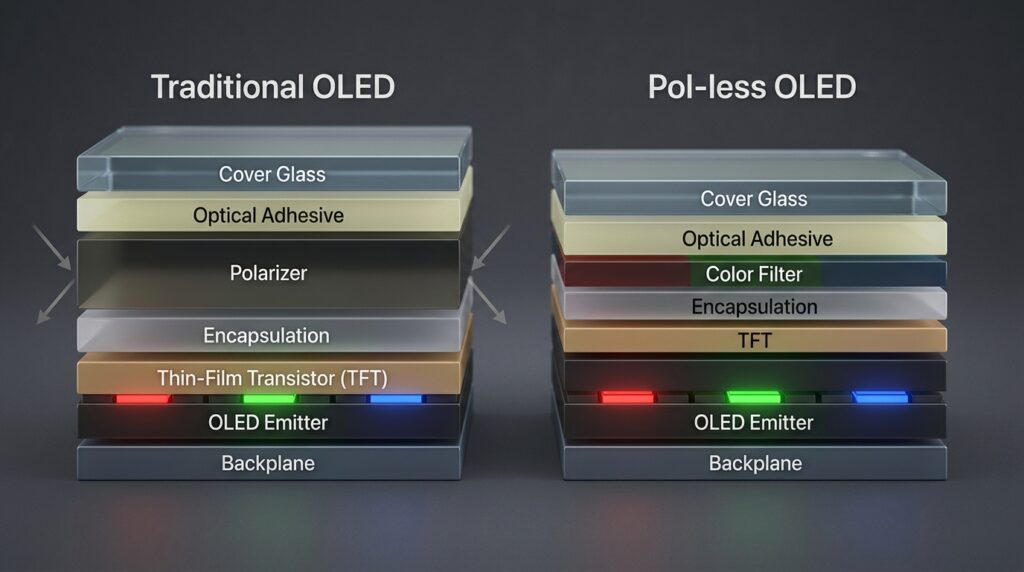
The key difference: a screen without a polarizer is thinner and brighter
For the user, this means a potentially brighter display outdoors and slightly longer battery life. Samsung already uses similar technology in the Galaxy S26 Ultra and its foldable models, so by 2027 it will be well-refined.
iPhone 20 Release Date
Apple has not announced anything yet. The anniversary iPhone is expected in the fall of 2027 — 20 years after the original iPhone launched in June 2007. According to Mark Gurman from Bloomberg, the anniversary model will launch in September 2027 — with curved glass and an under-display camera.
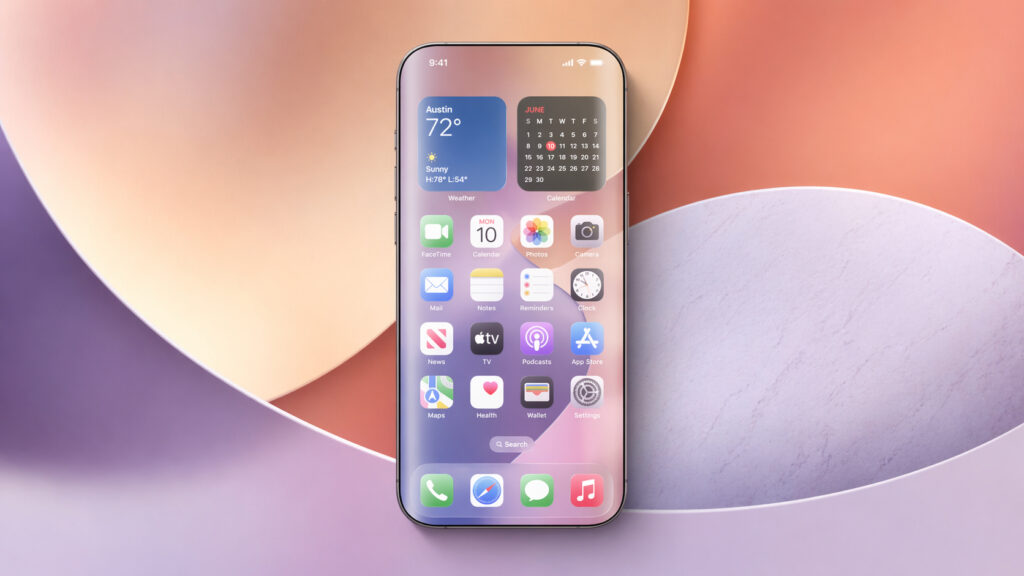
Are you waiting for the anniversary iPhone?
There’s a possibility that Apple will skip number 19 and jump straight to iPhone 20 — just as it went from iPhone 8 to iPhone X in 2017, skipping the nine. That anniversary iPhone X was revolutionary: it removed the Home button, minimized bezels, and introduced Face ID.
Before that, Apple has a packed update cycle planned: in the fall of 2026, the iPhone 18 Pro and a foldable iPhone are expected, and in the spring of 2027 — the base iPhone 18 and an updated iPhone Air.
Pros and Cons of the iPhone 20’s Curved Screen
A curved screen isn’t just about the visual effect of “bezel-less” design. The technology has specific pros and cons worth considering.
Pros:
- Bezels visually disappear — the screen looks like one continuous surface
- Back swipe gestures from the edge feel smoother
- The device subjectively feels thinner and more compact
Cons:
- False activations during normal grip, especially with aggressive curves
- Image distortion along the edges — glare and color shifting
- Increased fragility of the screen’s side edges
- Difficulty finding the right screen protector and case
- Repairs are more expensive than for flat displays
If Apple truly opts for a minimal screen curve, most of the serious drawbacks can be eliminated — leaving only the aesthetic effect of a virtually bezel-less screen. But how well this will work out is too early to judge: there’s at least a year and a half until the announcement.

Minimal screen curvature should eliminate problems with false touches
Right now, all of this is rumors and leaks from the supply chain. Apple has not confirmed any details about the iPhone 20 design. But the direction is clearly visible: micro-curves instead of aggressive bends, a polarizer-free screen for brightness and energy efficiency, minimal bezels. For those currently choosing an iPhone, it’s too early to factor this in — the device is more than a year away, and specific specifications could still change. But for owners of iPhone 14 and older who are planning a major smartphone upgrade, 2027 could be the very moment worth waiting for.