Shocking truth: what space actually smells like
When we think about space, we picture spiral galaxies, bright nebulae, silent darkness, and monstrous sounds. But space also has a smell — and not just one. That’s because the Universe is not sterile; it is filled with soot from dying stars, gases, radiation, and plasma, which together create an amazing cocktail of aromas. Most of what we know about the smell of space is based on two sources: astronauts’ accounts and chemical analysis of interstellar molecules. And the results sometimes surprise even scientists.
What Space Smells Like According to Astronauts
According to NASA, the main aroma that astronauts report again and again is a distinct metallic smell resembling a combination of ozone, gunpowder, a well-done steak, and the sweet fumes of welding. This smell lingers on spacesuits and equipment after every spacewalk.
German astronaut Alexander Gerst described it this way:
To me, space smells like a mix of walnuts and the brake pads of my motorcycle.
American astronaut Don Pettit, who served on the ISS, recounted:
It’s a pleasant, sweet metallic sensation. It reminded me of my college years when I spent hours working with a welding torch, repairing heavy equipment for a small logging company.
Interestingly, many astronauts find this smell quite pleasant because it doesn’t cause disgust but rather reminds them of something familiar and earthly.
Why Space Smells Like Metal
Why does space smell exactly like that? Scientists offer two main explanations.
The first theory involves polycyclic aromatic hydrocarbons (PAHs). According to Dr. Louis Allamandola, dying stars eject carbon that forms dense soot, similar in composition to fossil fuels. These same hydrocarbons are also found on Earth — in burnt toast, grilled meat, soot, and car exhaust. Cosmic soot is incredibly resilient; it can exist for millions of years and may well settle on astronauts’ spacesuits during spacewalks.
The second theory explains the smell through ozone formation. According to an article on Space.com, in space, ultraviolet radiation splits oxygen molecules into individual atoms that cling to spacesuit surfaces. When an astronaut returns to the airlock, these atoms interact with regular molecular oxygen (O₂) and form ozone (O₃) — a substance with a characteristic metallic smell.
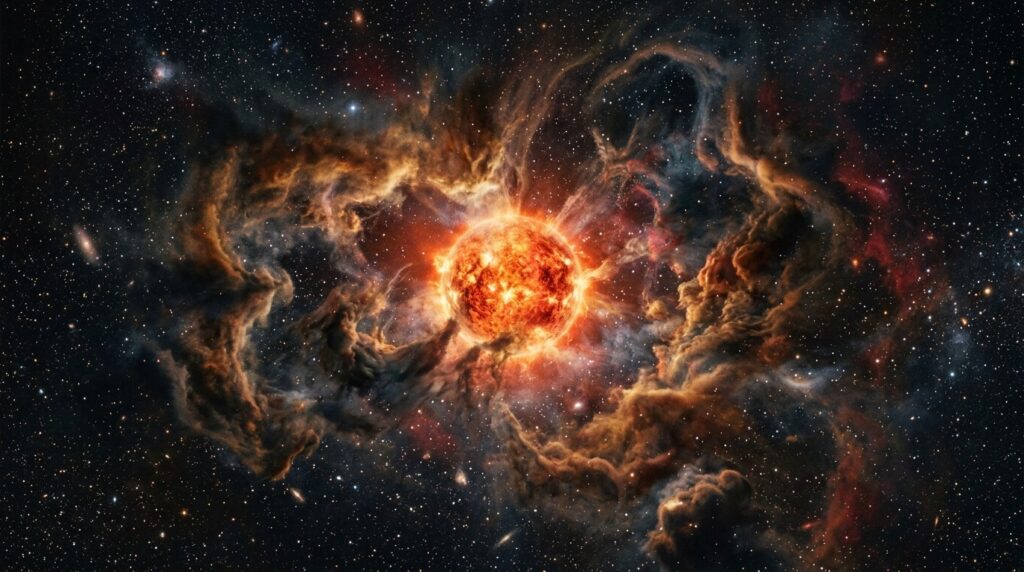
A dying star ejects clouds of cosmic soot — a possible source of space’s smell
Neither theory has been definitively confirmed yet, but they explain well why astronauts’ descriptions are so similar to one another.
Comets Smell Like Rotten Eggs and Formaldehyde
The metallic aroma is far from the only smell in the Universe. In 2014, the Rosetta probe flew past comet Churyumov–Gerasimenko and discovered a whole bouquet of molecules with completely different smells:
- hydrogen sulfide — the smell of rotten eggs;
- hydrogen cyanide — a sweet almond aroma (though the substance is lethally poisonous);
- ammonia — a sharp urine-like smell;
- formaldehyde — a specific “hospital” odor.
Dr. Allamandola explained that these molecules most likely accumulated from cosmic soot and other materials that clumped together into huge icy dust clouds — a kind of cosmic “dust bunnies”, similar to the clumps that gather under your couch.
The dark clouds would smell crazy — like an ice cream parlor with a fresh note of water ice and a knockout ammonia punch, and in some cases — with a morgue-like aftertaste from formaldehyde, — he described.
The Center of the Milky Way Smells Like Raspberries and Rum
One of the most unexpected discoveries concerns Sagittarius B2 — a giant cloud at the very heart of our Galaxy. Scientists found that it is saturated with ethyl formate — a substance that gives raspberries their characteristic flavor. Ethyl formate is formed by a reaction between alcohol and an acid, which in turn smells like rum.
It turns out that part of the Milky Way could theoretically smell like a raspberry cocktail with rum. However, throwing a cosmic party in Sagittarius B2 won’t work — the cloud also contains a high concentration of deadly propyl cyanide.
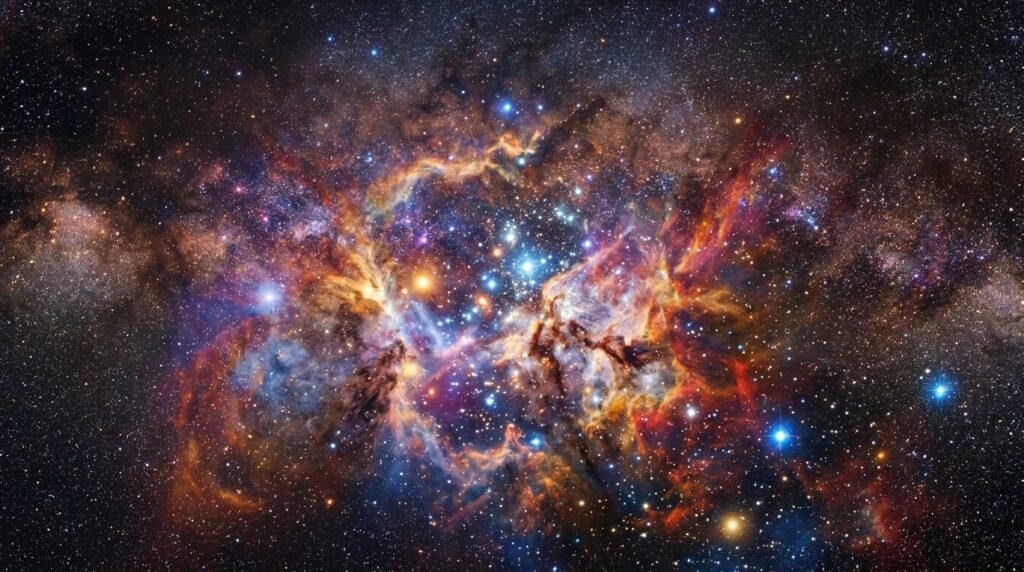
Molecular cloud Sagittarius B2 at the center of the Milky Way — a place that could smell like raspberries
NASA senior scientist Scott Sandford summed it up:
In the dark corners of our and distant galaxies, molecular clouds full of tiny dust particles contain a whole smorgasbord of aromas — from sweet sugar and rum to the stench of rotten eggs from sulfur. And they drift for millions of years, showing up in comets, meteors, and cosmic dust.
What Do the Planets of the Solar System Smell Like
No one can answer this question precisely yet, but scientists make informed assumptions based on atmospheric compositions:
- Venus and Uranus almost certainly smell like rotten eggs due to sulfur dioxide and hydrogen sulfide;
- Mars, with its carbon dioxide atmosphere and traces of acids and sulfur, likely has a faint, sour “desert” smell;
- Titan, Saturn’s largest moon, contains traces of benzene in its atmosphere, so it could smell like gasoline;
- Jupiter, whose colors are partly caused by ammonia and phosphorus, presumably smells like something between garlic and gasoline.
For now, all these estimates are based on remote atmospheric analysis rather than direct measurements. But if humanity ever begins colonizing other planets — and this is already being discussed — the question of smell will quickly shift from academic to practical.
Perfume with the Smell of Space
If after reading all of this you want to personally sniff the Universe, it’s possible — at least approximately. In 2008, NASA commissioned chemist Steve Pearce to create a perfume with the smell of space. The goal was practical: to help future astronauts prepare for the sensations awaiting them after stepping outside the spacecraft.
In 2020, this formula was released as a fragrance called Eau de Space. According to reviews, the scent does indeed resemble a mix of gunpowder, burnt metal, and something sweet — roughly what astronauts have described.
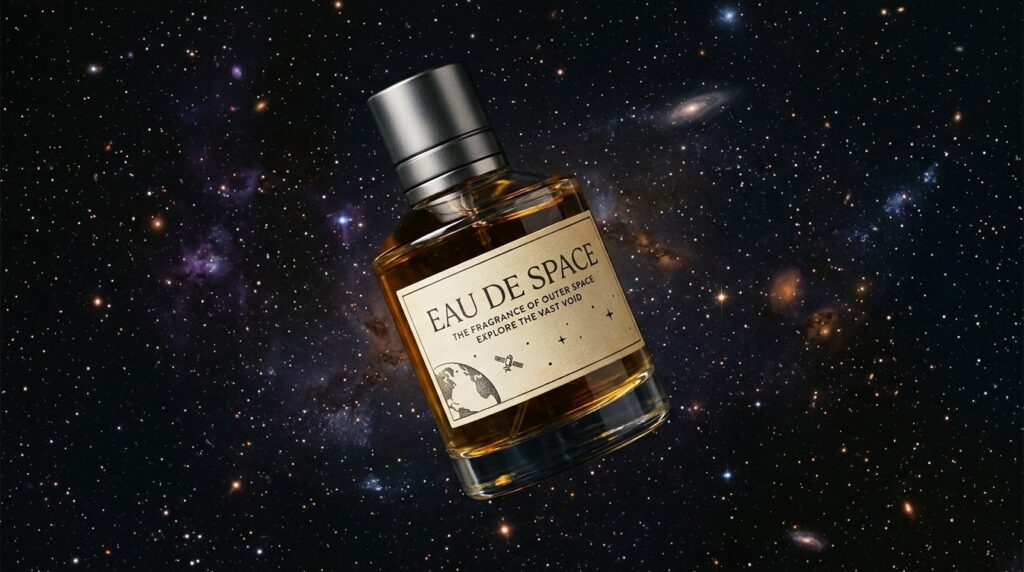
Eau de Space perfume — an attempt to recreate the smell of space on Earth
Space, as it turns out, is a rich chemical environment with a diverse palette of smells. From the metallic aroma on spacesuits to raspberry-scented clouds at the center of the Galaxy — the Universe smells far more varied than one might expect. And although most of us will probably never get to smell space in person, the very fact that interstellar space has a scent makes it feel a little closer and more relatable. After all, even familiar earthly substances can surprise us — let alone the Universe.