
We’re warned about the dangers of a sedentary lifestyle, so should we really work standing up?
The phrase that sitting is the new bad habit sounds alarming and drives many people to rush out and buy standing desks. It seems like simply getting up from a chair will make all back problems disappear on their own. We’re also scared by claims that a sedentary lifestyle increases the risk of death. However, healthcare workers, retail staff, and teachers who spend all day on their feet would hardly call that work format healthy either. It turns out that the entire approach of choosing between a chair and a standing desk is fundamentally flawed. So what’s really going on?
Pros and Cons of Sedentary Work
The advantages of sitting while working are obvious: it requires less energy and allows for better concentration on complex tasks. The body spends minimal effort maintaining balance, so overall physical fatigue sets in less quickly.
But the downsides of prolonged sitting far outweigh this comfort. When we spend hours staring at a monitor, the main static load falls on the lower back, neck, and shoulders. Muscles become stiff, blood circulation slows down, and over time this leads to chronic pain. In many European countries, musculoskeletal disorders account for the vast majority of all occupational diseases.
Pros and Cons of Standing Work
Many people try to compensate for a sedentary lifestyle by switching to tall desks. But for millions of people, working on their feet isn’t a way to stretch — it’s a harsh daily obligation that also damages their health.
If sitting takes a toll on the upper body, then prolonged standing causes leg fatigue and severe lower back pain. The problem starts at the very bottom. Our foot is a crucial mechanical foundation that supports the entire body weight. It contacts the floor and transmits tension further into the ankles, knees, hips, and spine.
A recent study of assembly line workers showed that a full day on their feet noticeably changes posture. As a result, pressure distribution across the soles becomes uneven, which directly triggers discomfort throughout the entire body. Moreover, different people’s feet react to such overloads differently, meaning there simply is no universally safe posture.
How to Protect Your Body: Simple Rules for the Workday
So what’s better — sitting or standing? There is no ideal option. Our body was evolutionarily designed for constant movement and adaptation, not for freezing in one position for eight hours straight.
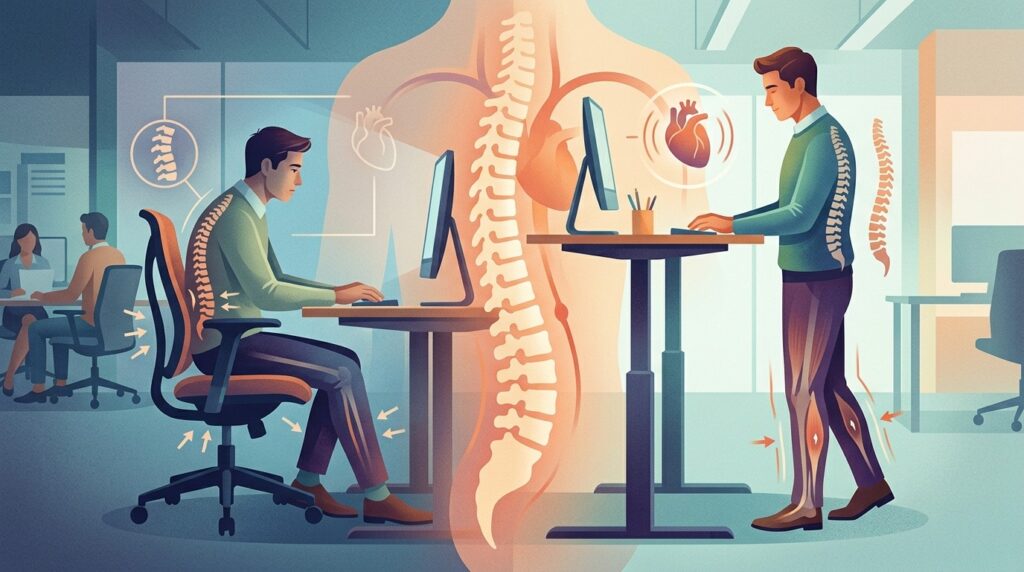
During work, you should take regular breaks and stretch at least every hour
Many people pin their hopes on miracle gadgets, posture correctors, or ergonomic cushions. However, no orthopedic devices can compensate for the harm caused by prolonged immobility. To truly maintain your health, you need to restructure the work process itself and move more frequently.
Here’s how to reduce the strain on your body during work:
- Regular short breaks during which you drastically change your body position;
- Alternating tasks: some work is done sitting, some standing or walking;
- Proper adjustment of your workstation — screen height and keyboard placement;
- Comfortable shoes that support the proper arch of the foot;
- Light physical stretching throughout the workday.
There’s no need to demonize the office chair or consider a standing desk a cure for all ailments. The main takeaway is that a comfortable workday should be an active one. Understanding this fact frees us from the need to search for the perfect posture and allows us to focus on a more important task — regular movement.