
Lack of physical activity seriously harms your health. An expert talks about a simple way to reduce the risks. Image source: healthandtrend.com
Most of us spend far more time sitting than we think — possibly up to 10 hours a day. Scientists who study the link between behavior and chronic diseases have long warned about the dangers of a sedentary lifestyle and are once again (but with new data) explaining why it’s dangerous and what to do about it. The good news: the solution turned out to be quite simple.
How much time do people spend sitting each day
According to surveys, adults spend an average of six hours a day sitting. But when researchers began measuring activity directly — using accelerometers — it turned out that the real number is closer to ten hours. The difference is enormous: people simply don’t realize how much time they spend without moving.
The World Health Organization calls a sedentary lifestyle the fourth most significant modifiable risk factor for death worldwide (these are factors related to habits that can be changed). By various estimates, if population activity levels increased by just 10%, around 500 million premature deaths could be prevented.
The WHO recommendations for adults are a minimum of 150 minutes of moderate activity (brisk walking, light cycling) or 75 minutes of vigorous activity (running, tennis) per week, plus two strength training sessions. Only 73% of adults worldwide meet these standards.

Sedentary activities include sitting, lying down, and standing. Image source: sciencealert.com
What happens to the body during prolonged sitting
From a biological standpoint, sitting is not simply “the absence of activity.” When you sit, the body triggers its own physiological processes. Metabolism slows down — which makes sense, since the body needs less energy. It’s similar to a car engine switching to idle at a traffic light.
But the consequences go beyond simple energy conservation. During prolonged sitting, fats — triglycerides — begin to accumulate in the blood. This is because the body reduces production of the enzyme lipoprotein lipase (LPL), which breaks down fats in the blood so that muscles and organs can use them as fuel. In experiments on rodents, LPL levels dropped significantly during periods of inactivity.
If this pattern continues for months and years, the excess fats can disrupt insulin and glucose metabolism, increasing the risk of type 2 diabetes. Additionally, prolonged sitting weakens muscles — without load, they literally shrink and lose strength. And for those who work extensively at screens, poor posture quickly becomes ingrained and damages spinal alignment.

A doctor revealed a simple way to protect your health from a sedentary lifestyle. Image source: sciencealert.com
There are also vascular consequences. Constant blood pooling in the legs while sitting increases the risk of varicose veins and deep vein thrombosis. And in the long term (years of a sedentary lifestyle), the likelihood of dementia, cancer, heart disease, and premature death increases.
Does exercise help offset the harm of sitting
This is one of the key questions: if I exercise in the evenings, can I stop worrying about eight hours in an office chair? The answer is both yes and no.
In a large study published in JAMA Cardiology covering more than 105,000 people from 21 countries, Professor Scott Lear and his colleagues found that prolonged sitting is associated with an increased risk of premature death regardless of physical activity level. But the risk is significantly higher for those who move very little.
An interesting detail: among people who met the WHO physical activity recommendations, sitting more than six hours a day produced roughly the same risk as those who sat less than six hours but didn’t meet the activity guidelines. In other words, regular workouts help but don’t completely cancel out the harm from sitting.
Why a standing desk doesn’t solve the sedentary lifestyle problem
Many believe that a standing desk solves the problem. The standing desk industry has indeed grown in recent years. But research shows something unexpected: prolonged standing affects metabolism in roughly the same way as sitting. The body still barely moves, and metabolic processes remain sluggish.
Moreover, standing in one place for long periods creates its own problems: muscle fatigue, varicose veins, and even a potential increase in cardiovascular disease risk. Simply replacing a chair with standing work is not the solution.
The real solution is to replace sitting (or standing) with movement. According to the same JAMA Cardiology study, replacing just 30 minutes of sitting with movement reduced the risk of premature death by 2% in people who spent more than four hours a day in a seated position. Two percent may sound modest, but at the population level, that’s hundreds of thousands of lives saved.
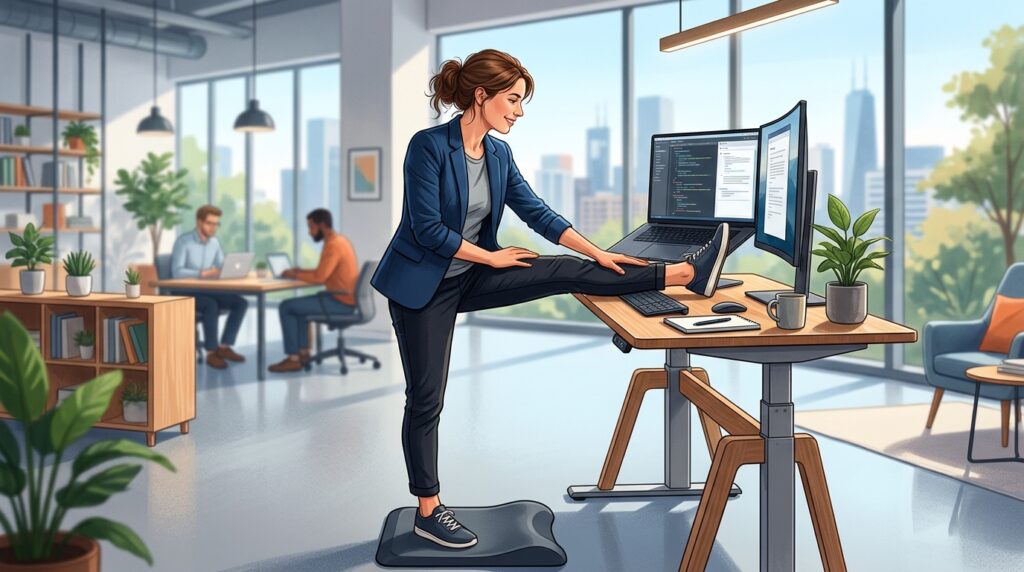
The key is not to stand or sit, but to move regularly throughout the day. Although it’s unlikely any boss would approve feet on the desk, even if it’s for health benefits.
The 2-minute rule: how to reduce the harm of desk work
Obviously, getting up and moving for half an hour in the middle of the workday isn’t always realistic. That’s why Professor Scott Lear suggests a more practical strategy: break up continuous sitting every 20–30 minutes and move for at least two minutes.
This is enough to “reboot” your metabolism and maintain normal insulin and glucose levels in the blood. What exactly you do doesn’t matter much. Any activity will work:
- A light walk around the office or apartment
- Squats
- Jumping in place
- Climbing stairs
- Any other movement that’s convenient for you
The simplest way not to forget is to set a timer on your phone for every 20–30 minutes. Alarm goes off — stand up — move around — sit back down. Two additional tips: take phone calls while standing or walking, and hold work meetings on the go.
A specific “safe limit” for sitting hasn’t been established yet — scientists simply recommend reducing total time without movement as much as possible.
The main takeaway from the data presented by Professor Lear is not that you need to drop everything and sign up for a gym. Rather, it’s that even minimal movement throughout the day has a fairly significant impact on health. Two minutes of activity every half hour is not fitness or sport. It’s basic hygiene for a body that wasn’t designed for ten hours of immobility, and a good starting point for those who want to stop leading a sedentary lifestyle without making radical changes.