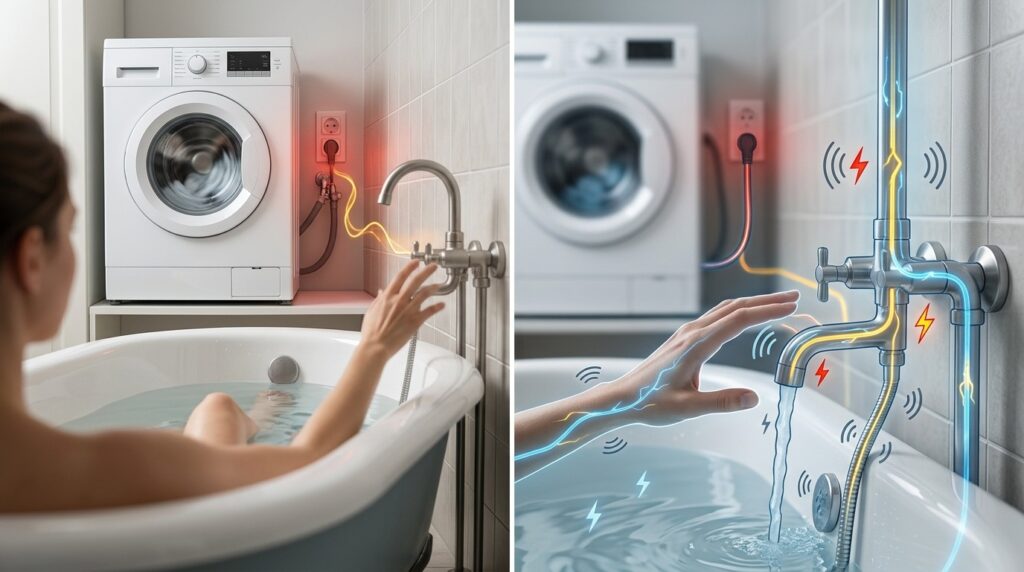
There is definitely good reason not to bathe while the washing machine is running
Many people consider the prohibition against bathing while the washing machine is running to be an old myth from the era of poor Soviet appliances. There is certainly no hard-and-fast rule that says “the moment the machine turns on, the water becomes electrified,” but electricians insist on observing this precaution. The main problem lies in things invisible to the eye: the risk of electric shock increases dramatically due to wet skin, the abundance of metal fixtures around you, and hidden electrical wiring defects. Avoiding water procedures during a wash cycle simply eliminates the most dangerous scenario, protecting you in case the appliance or wiring suddenly fails.
Why Bathing During a Washing Machine Cycle Is Dangerous
Strictly speaking, modern regulations such as the Rules for Electrical Installations do not prohibit placing washing machines and outlets in bathrooms. However, doing so is only permitted when strict protective measures are followed. If the system is installed perfectly, the risk is minimal, but in practice users can rarely guarantee the flawless condition of concealed wiring.
Danger can lurk even if the machine is simply plugged into the outlet but not currently washing anything. A residual current device (RCD) saves a person precisely at the moment they touch electrically conductive surfaces. If the machine is faulty, voltage can silently “sit” on its housing, waiting for someone wet to complete the circuit.
That’s why this household rule should be taken seriously: it’s advisable not only to avoid bathing while the washing machine is running, but also to avoid keeping any questionable appliance plugged in within a wet zone.
Why the Bathroom Poses a High Risk of Electric Shock
The bathroom is the most dangerous room in a home when it comes to electricity. Under normal conditions, dry and undamaged human skin serves as a fairly good insulator, with a resistance of 3 to 100 kΩ. But the moment we undress and get wet, the situation changes dramatically.
Upon contact with water or sweat, skin resistance drops sharply, and our body’s internal tissues have a resistance of only about 300–500 Ω. It’s simple physics: given the same leakage current, a much larger and more destructive current will pass through a wet body than through a dry one in an ordinary room.
Moreover, while taking a shower, a person simultaneously comes into contact with numerous excellent conductors. You touch water, a metal faucet, a cast-iron bathtub, and stand on a wet floor. If at that moment a dangerous potential appears on the machine’s housing or a pipe, your body acts as a perfect jumper, completing the electrical circuit.
Electrical Wiring Mistakes in the Bathroom
A washing machine by itself is a complex device with a heating element, a powerful motor, electronics, and constant vibration. Over time, the internal insulation ages, and current can begin to leak to the metal housing.
In a properly functioning electrical system, the protective devices will trip and power will be cut off instantly. But if the wiring is old or was installed with violations, dangerous voltage will remain on the appliance housing and connected pipes. This is especially common when there is no grounding, or when unskilled workers use water pipes as a “ground,” which is strictly prohibited by modern regulations.
An important technical detail: modern washing machines with motor speed controllers generate pulsating fault currents. This means that for their safe operation, a correctly selected RCD or RCBO is required, not just any cheap switch you can find. Without it, the protection simply won’t “see” the leakage.
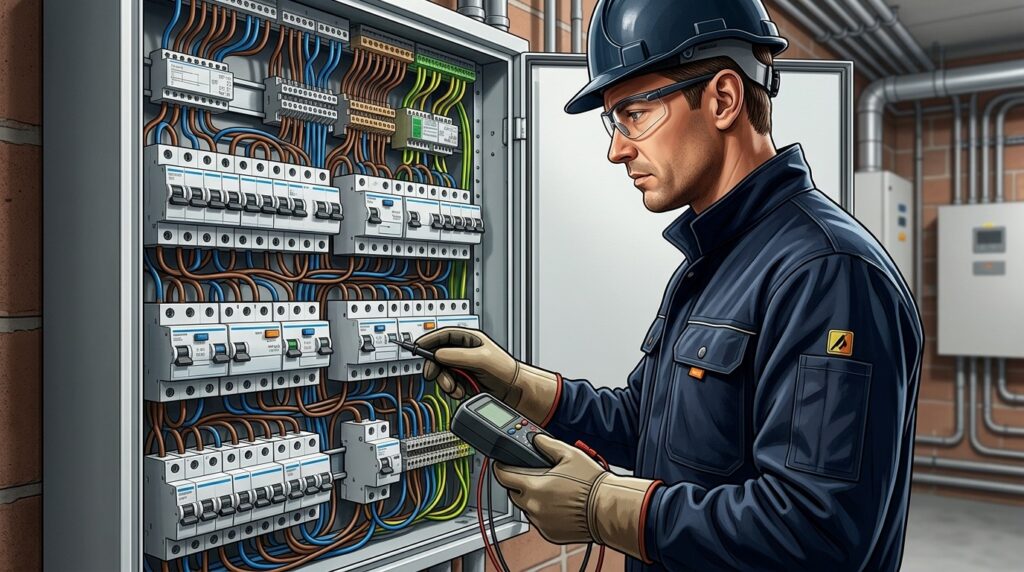
Without properly selected residual current devices, any current leakage becomes critical
Real Cases of Electric Shock from Household Appliances
Neglecting safety rules and poor wiring regularly lead to tragedies. Such stories happen every year, and the scenario often repeats itself.
In the fall of 2025 in Moscow, a woman was shocked while taking a shower with the washing machine running. The discharge passed directly through the water. Despite the appliance being brand new, the lack of grounding and old wiring turned bathing into a dangerous ordeal.
In January 2020 in Tatarstan, a man decided to move a washing machine that was plugged in. He was standing barefoot in water that had spilled on the floor and received a fatal electric shock upon contact with the housing. There was no residual current protection in the apartment.
Another telling case occurred in the spring of 2019. Due to a burst washing machine hose, water flooded the floor where a live extension cord was lying. When a young woman tried to clean up the puddle, the water became a conductor, leading to her death. This proves that any extension cord or power strip is unacceptable in a wet zone.
Safety Rules for Washing Machines
For the bathroom to remain a place of relaxation rather than a source of stress, the infrastructure must be set up according to all the rules. A user can rarely assess the quality of wires hidden inside walls on their own, but everyone should know the basic requirements.
The minimum requirements for safely installing an appliance in a bathroom:
- A dedicated power line running directly from the electrical panel;
- A proper grounding conductor;
- A working RCD or RCBO with a trip current of no more than 30 mA;
- A supplementary equipotential bonding system (where all metal pipes and the bathtub body are connected together);
- An outlet installed in a safe zone where shower spray cannot reach;
- Absolutely no extension cords on the bathroom floor.
If you have ever felt a slight tingling from water, a faucet, or the metal drum of the washing machine — this is no laughing matter. This phenomenon means a leakage already exists, and you need to immediately unplug the appliance from the outlet and call a qualified electrician.
Taking a bath while the washing machine is running really isn’t worth it. This simple, albeit conservative, household rule saves lives where old or improperly installed electrical wiring fails to protect you.