A century ago, in 1926, an urban factory worker in the Soviet Union earned roughly 54 rubles a month. That was enough to buy hundreds of kilograms of bread, ride city buses for 10 kopecks and see a film for 50 kopecks, yet a good pair of leather boots swallowed a third of a monthly wage, a full radio set cost 60% of it, and a private car was out of reach for almost everyone. Drawing on census data and Gosplan statistical handbooks cited in the original report, this explainer looks at what daily life cost during the New Economic Policy (NEP) era, when Soviet money had regained relative stability after hyperinflation, and how the balance of cheap and expensive things differed from today.
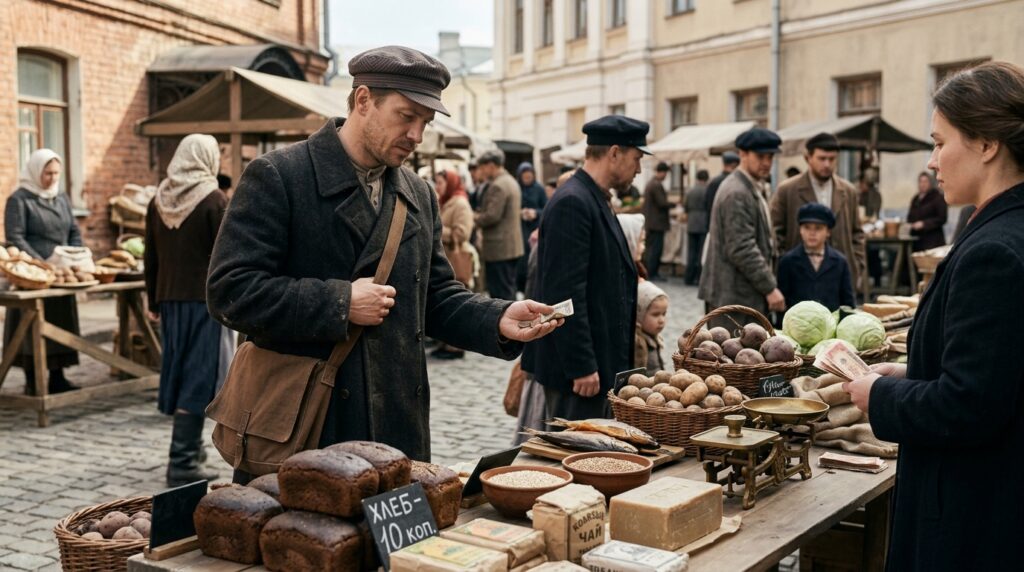
A Soviet citizen shopping at a market
What you need to know
- In 1926 the average monthly wage at large Soviet enterprises was about 53 rubles 74 kopecks, ranging from under 47 rubles for textile workers to around 70 rubles for skilled machine-building workers.
- Beef cost about 62 kopecks per kilogram, potatoes under 4 kopecks and baked bread 12 kopecks, according to Gosplan statistical handbooks cited by the source; food still took about 49% of a four-person family’s spending.
- Rent was capped by the state and took less than 7% of a worker family’s budget, but living space averaged only 4.7 square meters per person.
- Good leather boots cost 18–20 rubles and a complete crystal radio set about 32 rubles, while the whole country had only 18,600 cars for roughly 147 million people.
Who counts as an “ordinary person” in the NEP era
Taking the average worker’s wage and treating it as the income of any Soviet resident is a trap. According to the 1926 All-Union Census, the country had about 147 million inhabitants, and more than 82% of them lived in the countryside, largely outside the modern pattern of “get paid, go to the shop.”
A peasant family grew its own potatoes, grain and vegetables and kept livestock and poultry. Hired farm labor was often paid in food, and cash made up a tiny share of a rural household budget. A farmhand might receive around 10 rubles a month in cash, roughly one-fifth of an urban wage.
A 1920s photograph of street trading
For a fair comparison with the present, the source therefore focuses on the industrial urban worker: someone who genuinely received a monthly salary and paid for everyday needs in coins and banknotes.
How much a factory worker earned
In 1926 the average monthly wage at large enterprises was about 53 rubles 74 kopecks. The spread was considerable: textile workers earned less than 47 rubles, while skilled craftsmen in machine building made around 70 rubles.
That money bought an impressive quantity of basic food. Gosplan statistical handbooks of the period, as cited in the source, put beef at about 62 kopecks per kilogram, potatoes at under 4 kopecks and baked bread at 12 kopecks. In purely arithmetical terms, an average wage stretched to almost 450 kilograms of bread or nearly 80 kilograms of meat.
Yet the worker was no “food oligarch.” The problem was demographic: each earner in a family supported more than two dependents. As a result, groceries consumed about 49% of all spending in a four-person household.
Cheap square meters in crowded communal flats, expensive clothes
The most striking contrast with modern Russia, the source argues, is housing. Rent was strictly capped by the state and amounted to kopecks: worker families spent less than 7% of their budget on it.
Cheapness came at the price of a catastrophic shortage of space. There was no free rental market for separate apartments. People lived in overcrowded communal flats and dormitories or rented a “corner” of a room. On average, each person had just 4.7 square meters of living space, and a single room typically housed three or four people.
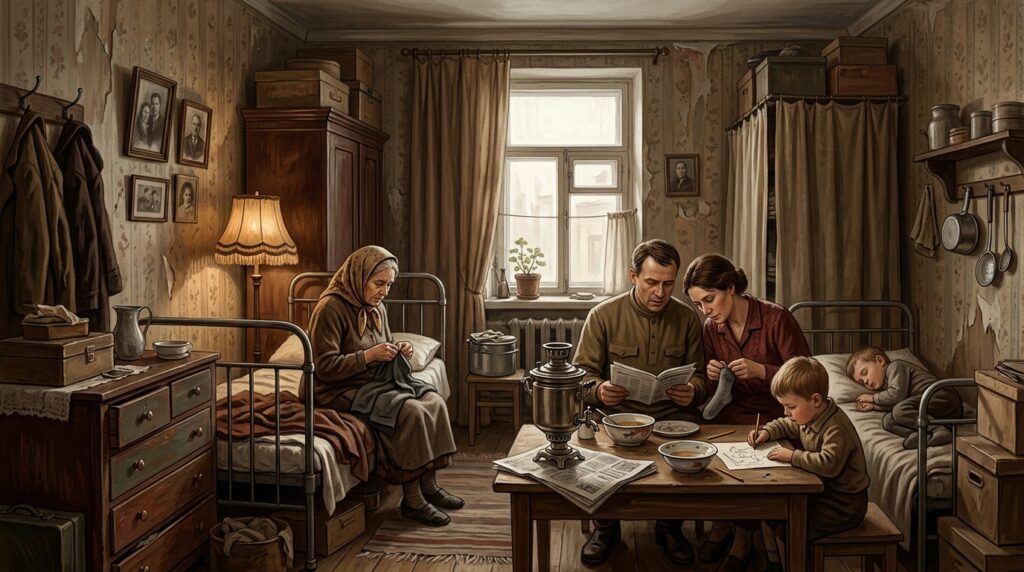
Daily life of a typical worker family in the early USSR
Clothing and footwear, by contrast, hit the wallet hard. A meter of plain cotton print was inexpensive, but finished goods cost serious money. A pair of good leather boots sold for 18–20 rubles, a third of an industrial worker’s monthly wage. Clothes were worn for years, constantly repaired and re-tailored.
Affordable transport and cinema, unattainable cars
Public transport was a cheap, everyday service for city dwellers. In autumn 1926 Leningrad launched regular bus routes with a 10-kopeck fare, and commuting cost less than 10% of a wage.
Entertainment was not considered a luxury either. A cinema ticket for the premiere of Battleship Potemkin cost 50 kopecks, so even a worker with a family could go to the movies regularly.
Household technology was a different matter. The main technical achievement in the home was the crystal (detector) radio receiver, a device that seemed to give its owner a sixth sense for catching invisible waves. The receiver itself cost around 6 rubles, but a complete kit with headphones, wiring and a mast came to 32 rubles, or 60% of the average wage.
A personal car was simply not on the agenda. In 1926 the USSR’s roughly 147 million inhabitants shared just 18,600 automobiles, most of them belonging to state institutions.
How the economy of the past differed from today’s
According to historical demographic research cited by the source, workers’ real wages had recovered to 1913 levels by 1926. It was a well-fed and relatively calm period, but the structure of spending was very different from a modern one:
- Basic food, city transport and entertainment tickets cost kopecks.
- Rent did not ruin a family, but obtaining a decent separate apartment was almost impossible.
- Clothing, footwear and technology required serious saving.
The source’s conclusion is that the main luxuries of 100 years ago and today have swapped places. Now it is relatively easy to buy fashionable clothes, a powerful smartphone or even a basic car, while acquiring spacious housing of one’s own is hard. In the NEP era, bread and a roof over one’s head came cheaply, but personal space and technological goods had to be paid for with months of heavy labor.