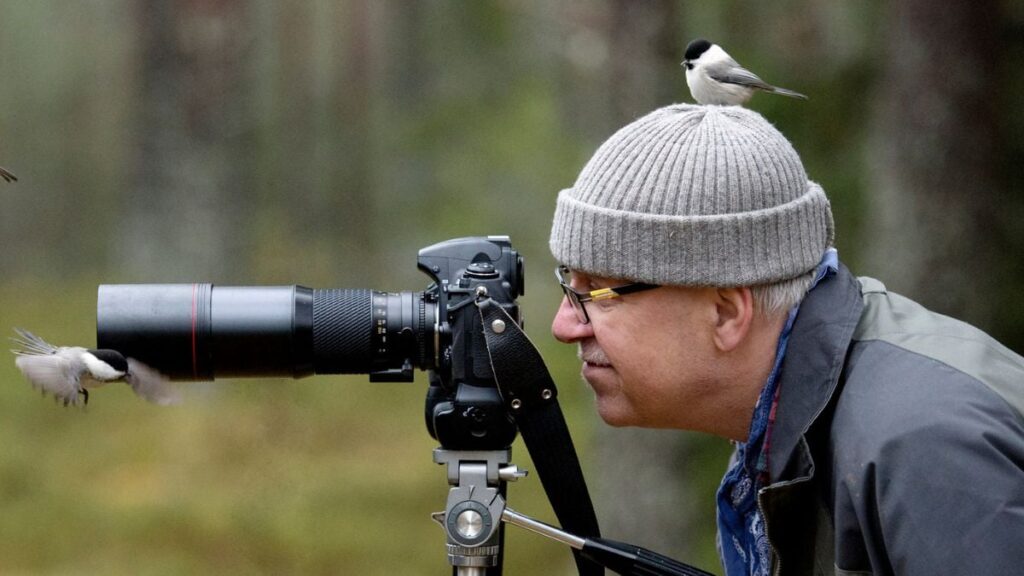
Urban birds fear women more than men — scientists have finally figured out why
If you’ve ever tried to sneak up on a pigeon or a thrush in a city park, the outcome may have depended not only on your stealth but also on your sex. A large-scale study across five European countries showed that urban birds — from crows to woodpeckers — systematically allow men to get about a meter closer than women. And the scientists honestly admit: they don’t yet have a definitive explanation.
How scientists tested birds’ reactions to people
Researchers from the Czech Republic, Italy, and the USA conducted more than 2,000 controlled approaches to wild birds in cities across France, Germany, Poland, Spain, and the Czech Republic. In each case, a pair of observers — a man and a woman of roughly the same height, wearing similarly colored clothing — took turns walking toward a bird at a constant speed, looking directly at it. The order of approach was alternated to eliminate the “first scary person” effect.
The scientists tried to eliminate as many variables as possible. Female observers did not participate in the experiment during menstruation, and long hair was tucked under clothing. Gait and gaze direction were strictly controlled — no sudden movements or wandering eyes.
A total of 37 bird species participated in the study: thrushes, robins, starlings, chaffinches, crows, sparrows, magpies, ducks, jays, woodpeckers, and many others. And the result was virtually the same for all of them.
Birds let men get a meter closer than women
The statistics were consistent: regardless of species, birds flew away or retreated sooner when a woman approached. They allowed men to get an average of one meter closer. The bird species didn’t matter — both small sparrows and large crows reacted the same way.
“As a woman working in the field, I was surprised that birds react to us differently,” says ecologist Janina Benedetti from the Czech University of Life Sciences in Prague. “Many behavioral studies assume that the human observer is neutral, but for urban birds in our study, that wasn’t the case.”
This observation matters not just for bird enthusiasts. If birds react differently depending on the observer’s sex, this could skew the results of dozens of field studies in which the experimenter’s sex was simply not accounted for.
How birds distinguish men from women
This is where things get most interesting — and most honest. Scientists don’t know why this happens.
“We identified the phenomenon, but we truly don’t know its cause,” says biologist Federico Morelli from the University of Turin.
The researchers aren’t even sure what exactly the birds recognize: biological sex or gender-related behavioral cues. Despite all attempts to equalize appearance and movement style, some subtle differences inevitably remained.
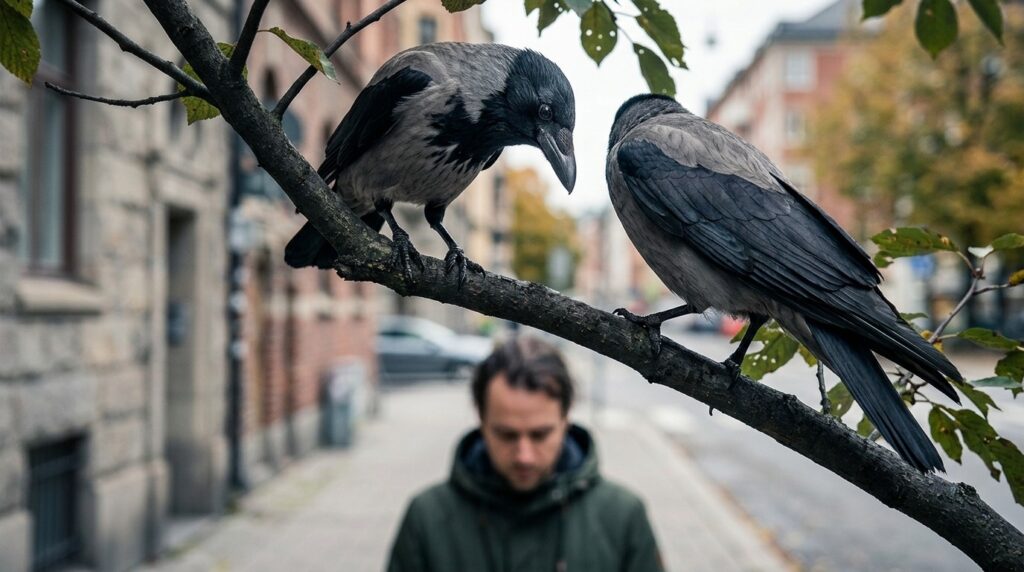
A crow watches a passerby from a tree branch
One hypothesis involves smell. For a long time, birds were thought to have a weak sense of smell, but recent research has debunked this myth — many bird species possess a powerful olfactory system. In pigeons, for example, scents can function almost like an internal navigator. It’s possible that birds literally “smell” hormonal differences between men and women.
This idea isn’t as exotic as it sounds. Back in 2014, scientists discovered that laboratory mice experience greater stress when handled by men rather than women. Similar stress responses have been observed in domestic animals such as horses, cows, and captive animals including monkeys. But in all these animals, it was men who caused more stress. In birds, it’s the opposite.
Connection to hunter-gatherer evolution
Another possible line of explanation reaches into the deep past. Humans and birds have lived side by side for tens of thousands of years. Traditional theory assumed that men were hunters and women were gatherers. If that were the case, one would logically expect birds to fear men more.
But the result is the opposite. This suggests a thought: perhaps ancient women hunted small game and birds more often than is commonly believed. However, the study’s authors emphasize that this is merely a hypothesis, not a conclusion. Modern anthropology indeed questions the rigid division into “male hunters” and “female gatherers”: archaeologists have already found evidence that women also hunted. But directly linking this to the behavior of urban birds is not yet possible.
“I fully trust our results — urban birds really do react differently depending on the sex of the approaching person. But I cannot explain it right now,” admits conservation biologist Daniel Blumstein from the University of California, Los Angeles.
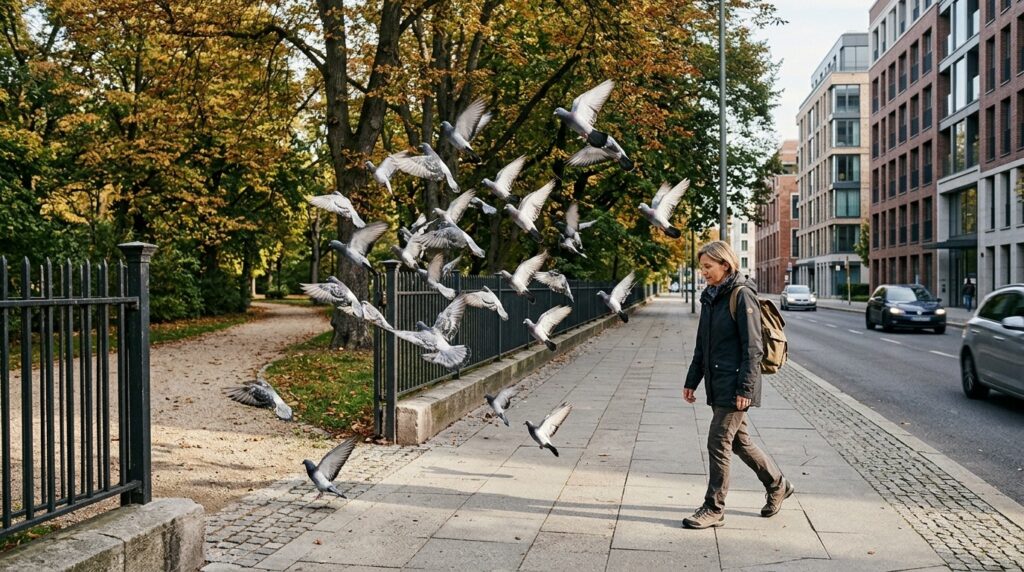
Birds take flight as a passerby approaches in the city
What birds’ fear of women means for ornithology
It seems birds study us no less carefully than we study them, and they see more differences than we expect. This study is one of the first convincing pieces of evidence that wild urban animals distinguish people by sex and adjust their behavior accordingly.
There are several practical takeaways from the research. For birdwatchers — men can indeed get slightly closer to a bird, although a one-meter difference doesn’t make much of a difference when photographing with a telephoto lens. What’s far more important is something else.
For field biology, this is a serious methodological signal. If the observer’s sex affects flight initiation distance, then this parameter needs to be accounted for and controlled when conducting experiments with wild animals. Many previous studies did not do this.