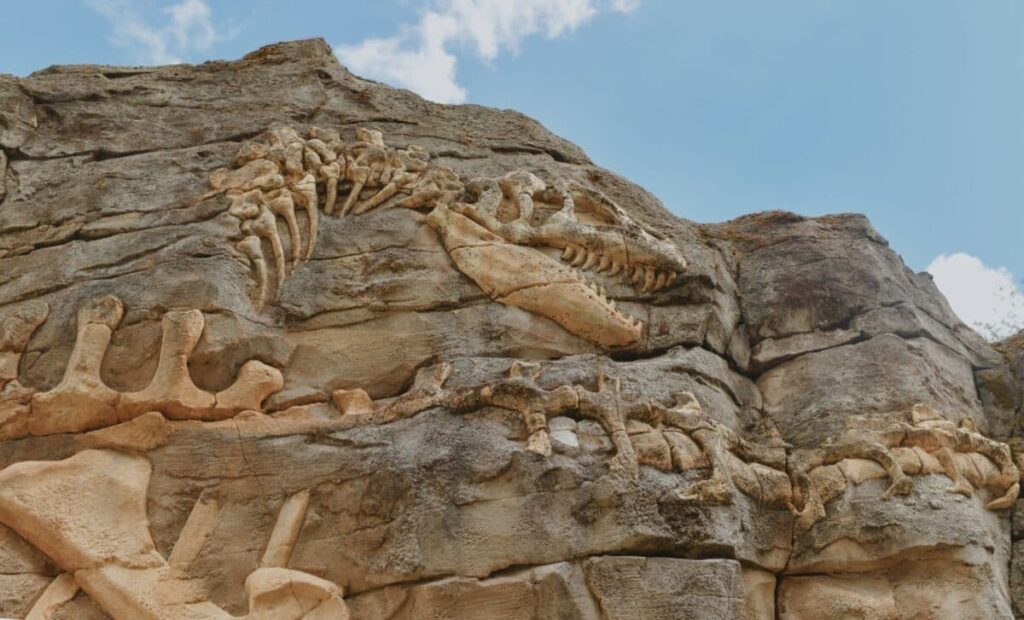
The new dinosaur may turn out to be one of the largest animals in the history of our planet
At a construction site in the Chinese city of Chongqing, workers stumbled upon the bones of a dinosaur that is approximately 147 million years old. Paleontologists determined that it is a previously unknown species of giant long-necked sauropod up to 28 meters long, one of the largest land-dwelling creatures on the planet. It may be smaller than the ancient giant weighing 180 tons, but it still boggles the imagination!
New Dinosaur Species in 2026
The discovery occurred in the Tongnan district of Chongqing, in southwestern China. The fossils were embedded in the Suining Formation, a geological layer from the Late Jurassic period, estimated to be approximately 147 million years old. The bones were first exposed during construction work, after which they were excavated by a team led by Xuefang Wei.
The skeleton is incomplete but includes key elements: vertebrae, parts of the shoulder girdle, and hind limb bones. This was enough for scientists to begin reconstructing the animal’s appearance. The new species was named Tongnanlong zhimingi. The genus name refers to the Tongnan district where the specimen was found, while the species name honors the renowned Chinese paleontologist Dong Zhiming.
Based on the scapula and fibula, scientists estimated the animal’s body length in the range of 23 to 28 meters. In sauropods, these bones correlate well with overall body length, so even without a complete skeleton, the estimate is fairly reliable. If the upper bound is confirmed, the new species would rank among the largest land animals ever to have lived on Earth.
Features of the New Dinosaur Species
The dinosaur Tongnanlong zhimingi belongs to the family Mamenchisauridae, a group of long-necked dinosaurs characterized by their relatively lightweight skeleton. To understand how an animal the length of a nine-story building could even move, it’s worth examining the structure of its bones.
Members of this family possessed cervical vertebrae with internal air cavities — meaning the bone tissue was permeated with voids that reduced weight without compromising strength. This allowed them to support a long neck without placing excessive strain on the body. The principle is similar to bird bones: hollow inside but strong on the outside.
The vertebrae of the new dinosaur species also show signs of additional reinforcement: complex bony crests and partitions that functioned like beams in an engineering structure. Based on its scapula size of 182 centimeters, the new species may be the largest mamenchisaurid known to science.
Where the Long-Necked Dinosaur Lived
The bones revealed not only information about the animal itself but also about the world in which it lived. The Suining Formation consists of reddish-brown mudstones and sandstones with characteristic ripple marks, indicating a lakeside environment. Such a setting would have offered dense concentrations of vegetation along the water’s edge — exactly what a giant herbivore would need.
In the same layers, fossils of freshwater bivalve mollusks, ostracod crustaceans, and turtles were found. This means the area was a rich wetland habitat capable of supporting several large herbivores simultaneously.
The preservation of the find deserves special mention. The fossil remained nearly in its original burial position, meaning the carcass was not carried far by currents. This strengthens the connection between the bones found and the local habitat: most likely, the dinosaur lived right here rather than just passing through.
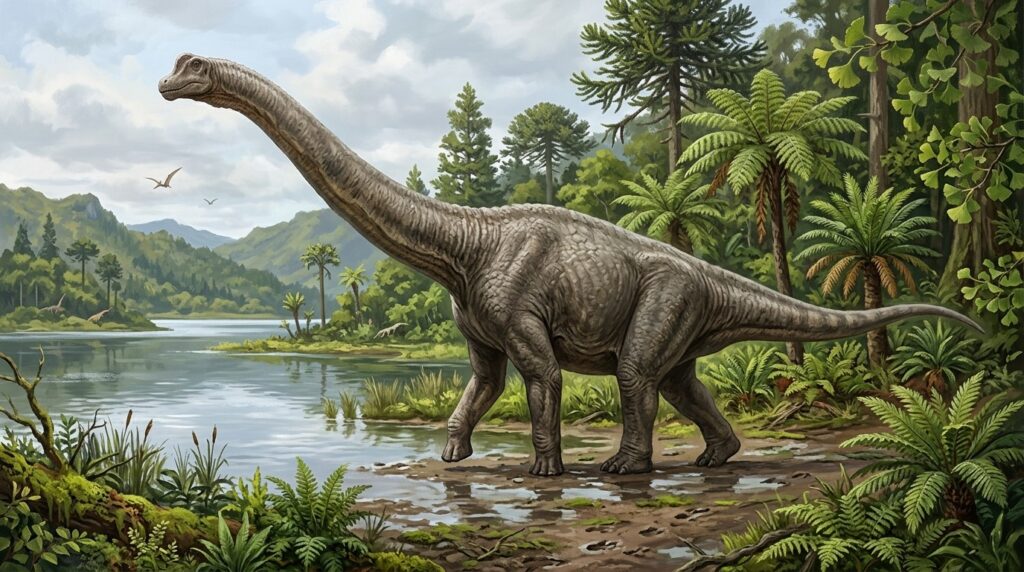
A giant sauropod on the shore of a Jurassic lake
The East Asian Isolation Hypothesis in Question
The discovery concerns not just a single dinosaur — it touches on a major debate in paleontology. For a long time, the so-called East Asian Isolation Hypothesis prevailed: it proposed that the dinosaur fauna of the region evolved in relative isolation due to geographical barriers. In short, East Asia was considered something of a “dinosaur island” where evolution followed its own unique path.
However, in Late Jurassic deposits in Tanzania, a sauropod called Wamweracaudia keranjei was found, also belonging to the Mamenchisauridae. This suggests that the family had a wide geographical distribution not limited to East Asia.
The new find from Chongqing adds further arguments. The study’s authors directly state that mamenchisaurids were globally distributed during the Late Jurassic, rather than being an endemic fauna previously thought to be restricted to East Asia. If similar species existed on different continents simultaneously, paleontologists will need to reconsider how freely dinosaurs moved between landmasses 150 million years ago.
What Has Changed in Understanding Sauropod Evolution
The dinosaur Tongnanlong zhimingi is not just another large sauropod. This find works in several directions at once.
First, it expands the known diversity of mamenchisaurids. The Sichuan Basin has long been considered one of the key regions for Jurassic sauropods, and mamenchisaurids dominated its Late Jurassic fauna. The new dinosaur adds another large species with unique anatomical features to this picture.
Second, the giant size of Tongnanlong — with the largest known mamenchisaurid scapula — suggests that body size increase could have been an evolutionary strategy: large reptiles reduced their risk of predation and gained a competitive advantage, which may have allowed mamenchisaurids to gradually achieve a dominant position in the Late Jurassic fauna.
Finally, further research should reveal whether Tongnanlong’s size reflects local conditions, global climate shifts, or a trend across the entire evolutionary lineage. Additional skull and neck bones would help clarify the picture.
The fact that the discovery happened by accident at an ordinary construction site is a reminder that we are far from knowing everything about the animals that inhabited Earth hundreds of millions of years ago. Each such find not only adds a name to the catalog but also forces a reassessment of previous models of dinosaur dispersal, evolution, and ecology.
The study was published in the journal Scientific Reports.