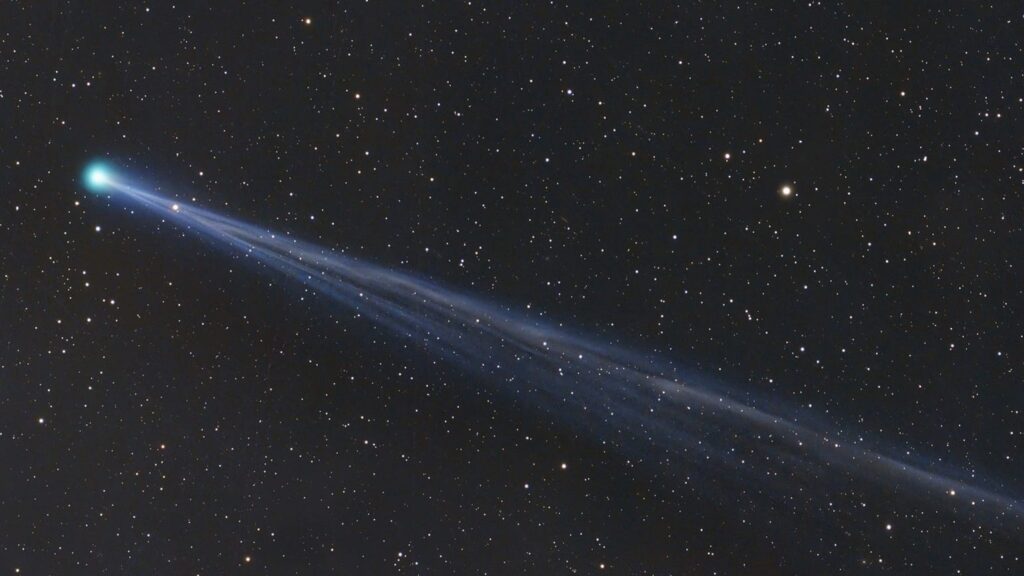
Comet C/2025 R3 (PanSTARRS) approaching peak brightness in April 2026. Image source: starwalk.space
Comet C/2025 R3 (PanSTARRS) is rapidly gaining brightness and is already visible through binoculars and small telescopes. By the end of April, it may become bright enough to spot with the naked eye under dark skies. But the observation window is narrow — the comet is rapidly approaching the Sun and will soon disappear in its glare.
Comet C/2025 R3 PanSTARRS: Origin and Orbit
The comet was discovered by the Pan-STARRS survey telescope in Hawaii on September 8, 2025. At the time of discovery, it was a faint speck at about magnitude 20 — so dim that only the most sensitive cameras at a professional observatory could detect it.
Pan-STARRS (Panoramic Survey Telescope & Rapid Response System) is an automated sky survey system that continuously scans the sky searching for asteroids, comets, and other objects. It has already discovered dozens of comets.
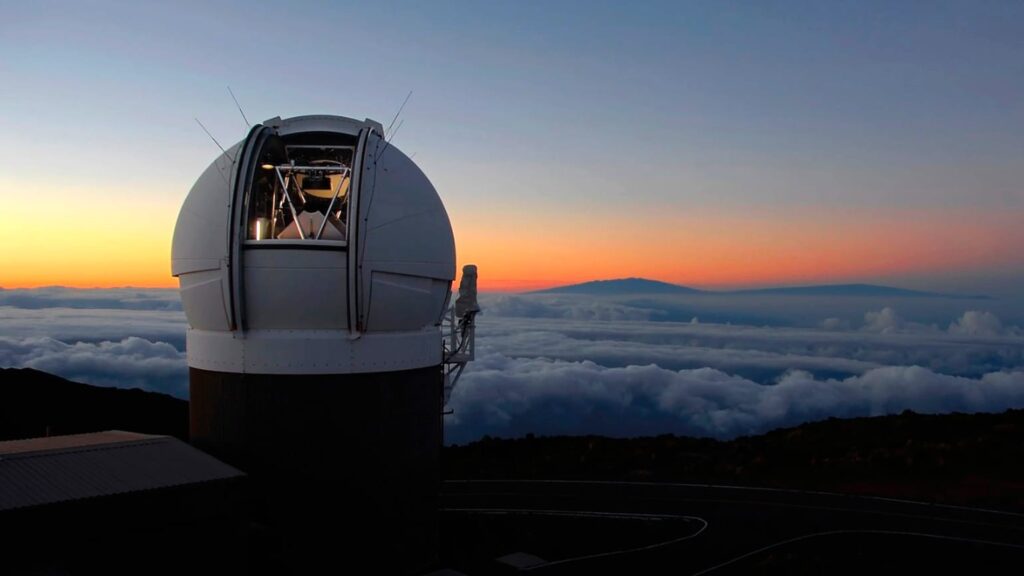
The Pan-STARRS observatory in Hawaii — a telescope system that has discovered numerous new comets and near-Earth objects. Image source: starwalk.space
C/2025 R3 is a hyperbolic comet from the Oort Cloud. The Oort Cloud is a hypothetical giant sphere of icy bodies at the very edge of the Solar System. Sometimes the gravitational influence of passing stars or galactic tidal forces “push” some of these icy chunks into the inner Solar System. This is how long-period comets are born, which we can observe in the night sky.
According to current data, C/2025 R3 is transitioning from a long-period to a hyperbolic comet: it once orbited the Sun with a period of about 170,000 years, but gravitational interaction with Jupiter altered its trajectory. Now the comet is leaving the Solar System forever. In simple terms, April 2026 is the only chance to see this object in all of human history.
Brightness of Comet C/2025 R3 PanSTARRS and Its Visibility
In the most likely scenario, the comet may reach a brightness of about magnitude 3.2 — roughly comparable to the stars of the Big Dipper. In the best case, it could become significantly brighter — up to magnitude −0.5, approaching the brightness of the most prominent planets, though it would still appear as a fuzzy patch rather than a bright point.
Why such a wide range of predictions? It all comes down to a phenomenon called forward scattering. When the Sun, comet, and Earth align at a certain angle, dust particles in the comet’s tail can scatter light directly toward the observer — making the comet appear significantly brighter. This effect can temporarily increase a comet’s brightness by up to 100 times.
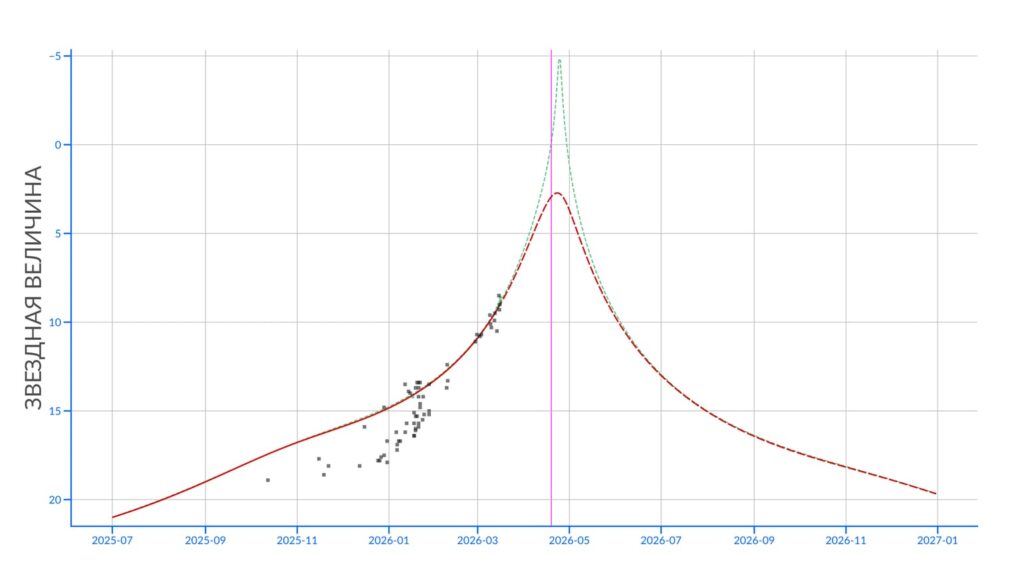
Predicted brightness of comet C/2025 R3. Red line — standard forecast, green dashed line — possible brightness increase due to forward scattering, gray dots — actual observations, pink line — perihelion date. Image source: starwalk.space
But counting on a maximum brightness outburst doesn’t seem warranted. Observations show that the comet’s ion tail is well developed, but it has little dust. And forward scattering works specifically on dust particles. So a more realistic scenario is a brightness of magnitude 3–4 — enough to see the comet without optics under dark rural skies.
When to Observe Comet C/2025 R3 in the Northern Hemisphere
Now, in mid-April, the best chance to see the comet from the Northern Hemisphere is approximately 45–60 minutes before dawn, low above the eastern horizon. The comet is located in the constellation Pegasus — inside the Great Square asterism.
Here’s what you need to know by dates:
- Before April 18–19 — the best time for observations from northern latitudes. The week around the new moon on April 17 is the ideal window: the sky is as dark as possible. Binoculars (10×50) or a small telescope will work for observations. If forecasts hold, after April 18 the comet may reach magnitude 4 and become visible to the naked eye.
- April 20–25 — the comet will become brighter, but also closer to the Sun in the sky. The key window is April 10–20: the comet is still gaining brightness but hasn’t yet drowned in sunlight.
- After April 25 — for observers in the Northern Hemisphere, the comet will essentially be lost in the Sun’s glare.
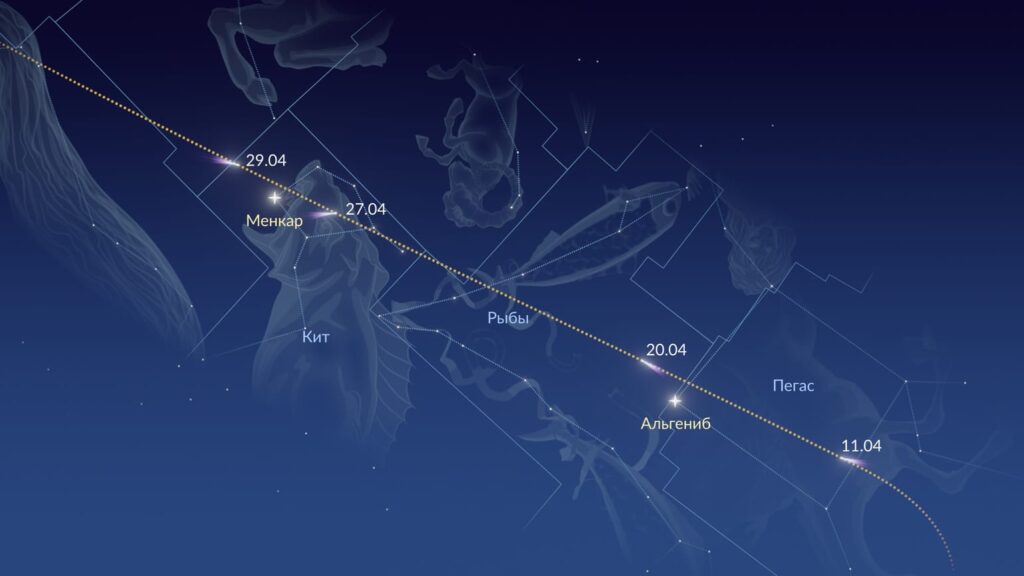
Path of comet PanSTARRS through the constellations in April 2026. Image source: starwalk.space
For residents of central Russia, this means waking up around 4–5 AM local time and finding a clear eastern horizon. Light pollution is the main enemy; even a rural house with lights on neighboring lots can interfere. The farther from the city and the lower the horizon — the better.
Comet C/2025 R3: Observing from the Southern Hemisphere
After perihelion, visibility rapidly deteriorates in the north but improves in the Southern Hemisphere, where the comet will become an evening object in late April and early May.
For southern latitudes, here’s the breakdown:
- Before April 20 — seeing the comet from the Southern Hemisphere is difficult; it’s too close to the Sun, and the pre-dawn window is very short.
- Late April — early May — the most favorable time. The comet appears in the evening sky and gradually rises higher above the horizon after sunset. Brightness in early May may hold at around magnitude 4 — sufficient for binoculars, and away from cities — even for the naked eye.
- By the end of May — the comet fades to magnitude 9–10 and becomes a telescope-only object.
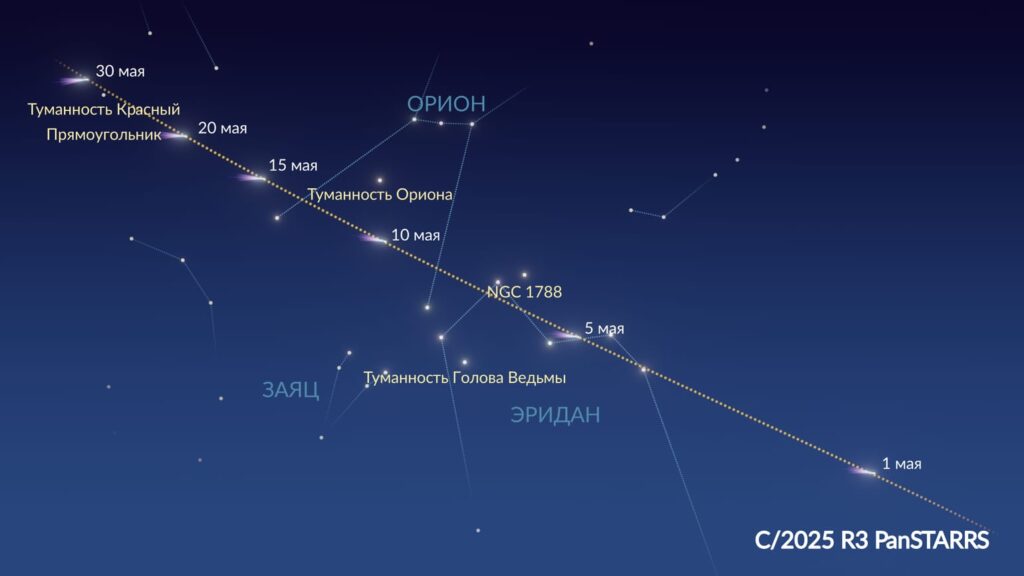
Path of comet PanSTARRS through the constellations in May 2026. Image source: starwalk.space
What Comet C/2025 R3 PanSTARRS Looks Like in April 2026
It’s important to understand: a comet is not a bright point like a star or planet. Rather, it looks like a small fuzzy patch, making it harder to spot than a star of the same brightness.
But photographers are already thrilled. The comet’s gas tail stretches more than 10 degrees across the sky — roughly the width of a fist at arm’s length. Recent images show that the ion tail has split into two distinct structures: one looks like a straight beam, where gas accelerates to hundreds of kilometers per second, and the other is more diffuse and irregular.