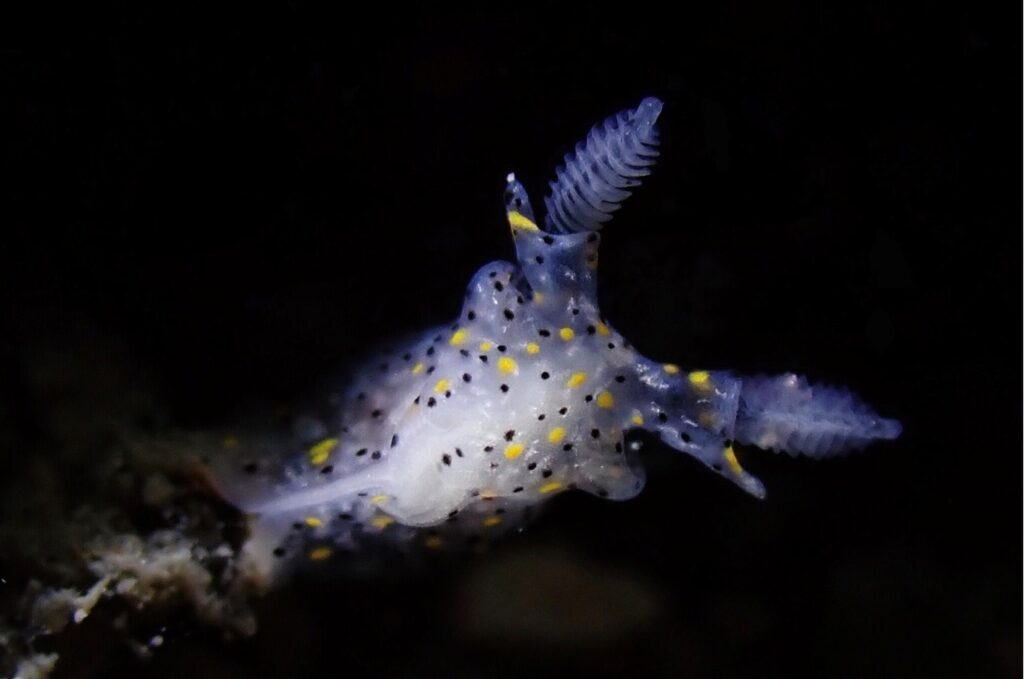
A new animal discovered off the coast of Taiwan: this tiny creature is the size of a sesame seed.
A new species of nudibranch — a sea slug (though that term hardly suits this cutie) — measuring less than 3 millimeters has been found off the coast of Taiwan. That’s smaller than a grain of rice, so even among the smallest animals, this little creature is practically invisible, and spotting it underwater is nearly impossible. What makes it even more remarkable is that it was actually noticed — not by scientists with expensive equipment, but by an ordinary diver during a recreational dive.
How a New Species of Sea Mollusk Was Found Off Taiwan’s Coast
The story began in 2019. Ho-Yung Chan, then still a student at the National Taiwan Ocean University, was diving near the port of Keelung not far from Taipei just for fun. And he noticed something tiny and unusual underwater. Sometimes discoveries like these begin almost by accident.
The location, by the way, isn’t the most convenient for diving. Due to summer typhoons and dangerous waves, diving is only possible for about four months a year. And finding a well-camouflaged mollusk just a couple of millimeters long is a task that few would seriously expect to accomplish.
Chan didn’t try to figure it out himself — he messaged a specialist in marine mollusks, researcher Hsini Lin, directly on social media. She immediately realized: this was something entirely new. Seven years passed from the first encounter to the official description of the species.
Why the New Sea Slug Species Was Named After Sesame and What It Looks Like
The newcomer was classified under the genus Thecacera. For nearly 200 years, biologists thought they knew this genus fairly well: six species scattered across the world’s oceans, roughly one and a half to two and a half centimeters in size. And suddenly — a seventh species that defies all expectations about size.
This slug was given the name Thecacera sesama — “sesame”. The reason is simple: both in shape and size, it resembles a sesame seed. Moreover, local divers had long been calling it “sesame” in Chinese, so the name was a perfect fit.
Here’s what it looks like: a semi-transparent whitish body covered with small black dots and occasional large yellow spots. Less than three millimeters — and yet a separate, scientifically recognized species.
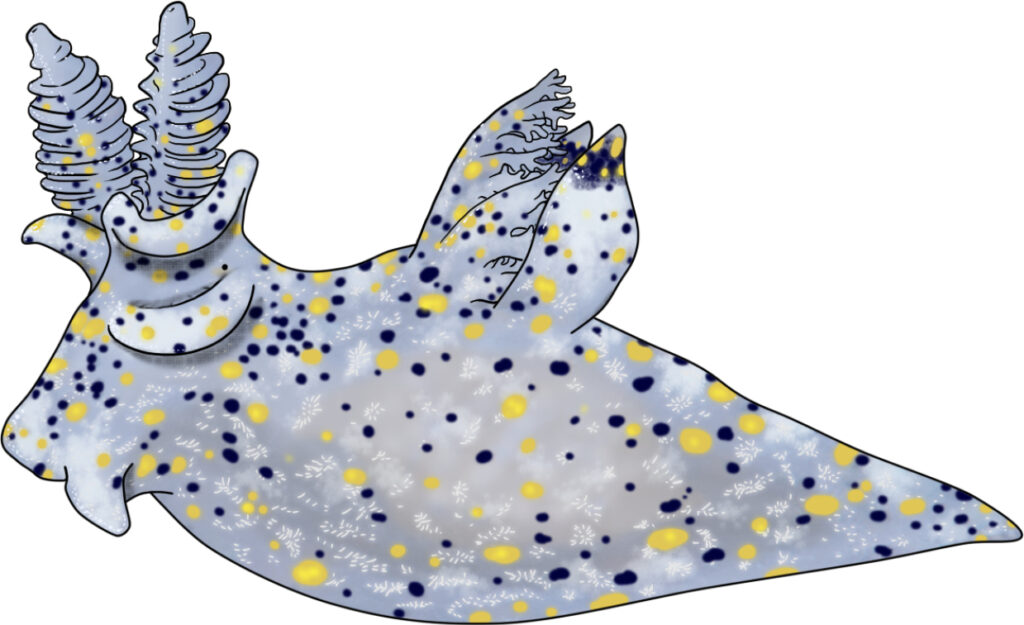
Illustration of the appearance and morphological features of Thecacera sesama.
How Scientists Proved That the Miniature Mollusk From Taiwan Is Truly a New Species
Appearance alone isn’t enough for science. To confirm they were dealing with a new species, researchers studied its DNA. They collected only six specimens, and three of them had to be used entirely for analysis — the creatures were so tiny that there simply wasn’t enough material otherwise.
The result was convincing: the genetic divergence from its closest relative was 14.17%. That’s more than sufficient to establish a separate species. The closest relative of the “sesame” slug is Thecacera picta.
A curious detail: the mollusk feeds, searches for a mate, mates, and lays eggs on bryozoans — small marine organisms that resemble moss. And the very bryozoan on which it lives may also be unknown to science: its sample matched known species by only 82%. So alongside the new slug, yet another discovery may be hiding.
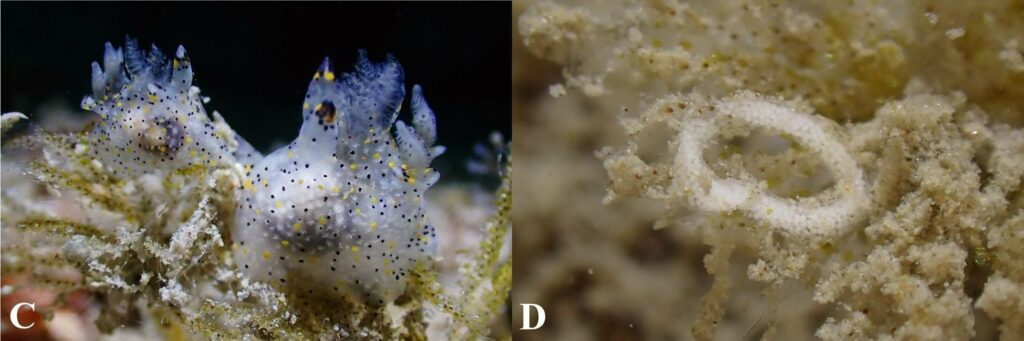
C. Two specimens of Thecacera sesama feeding on a bryozoan; D. Egg ribbon of a polycerid species.
Why Scientists Keep Discovering New Marine Animal Species
Nudibranchs are notable participants in marine food chains. They can be incredibly colorful and are often found on coral reefs. But many of them are so small that spotting them underwater with the naked eye is virtually impossible.
That’s precisely why scientists are confident: numerous species are hiding in plain sight. Thecacera sesama is most likely just the first of a whole series of marine mollusks yet to be found in the waters of the western Pacific around Taiwan.
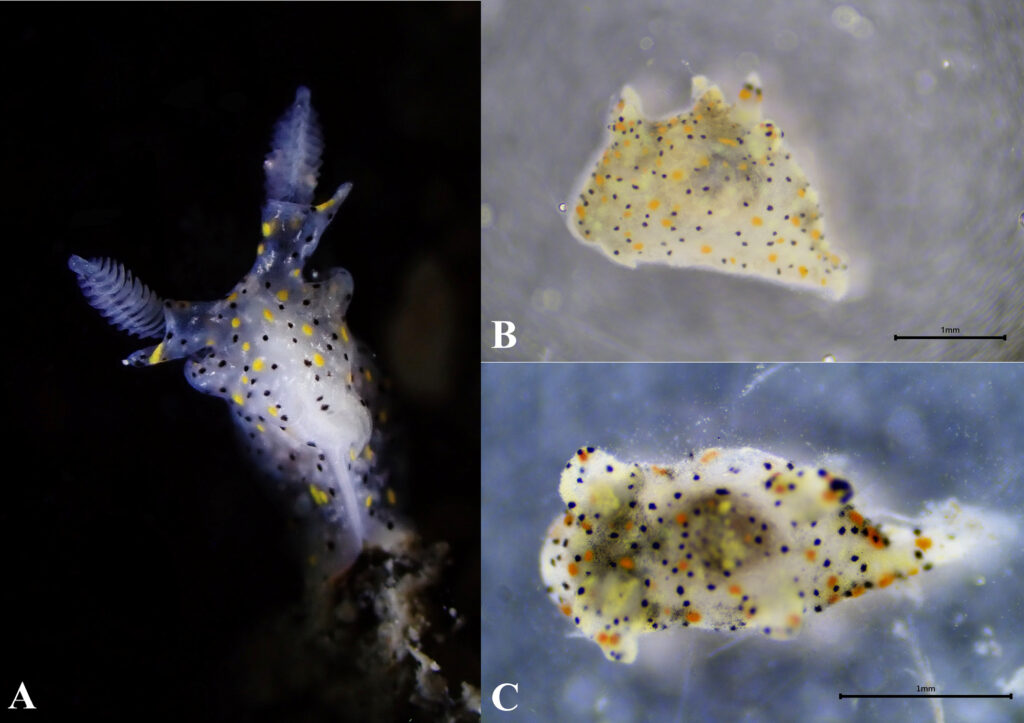
Live specimens of Thecacera sesama. A semi-transparent body with black and yellow speckles is the hallmark of the new species.
Amusingly, this tiny creature’s entire life repertoire fits into just four activities: eat, search, mate, and lay eggs. No fuss — just a little slug going about its business that still managed to make it into the textbooks.
The main takeaway here isn’t even about the slug itself, but about how little we still know about the life around us. An entirely new species was found a half-hour drive from the capital of a major country — not in the depths of the ocean, but near the shore where people regularly dive. The study was published in the journal ZooKeys, and it serves as yet another reminder: you don’t have to travel to the ends of the earth to make a discovery.