
This one emotion can radically change your psyche: scientists have revealed the secret
At least once in their life, everyone has experienced this, even if they didn’t know it had a name. Your skin gets goosebumps, words disappear somewhere, and you feel incredibly small yet simultaneously filled with something enormous. This is how awe works — one of the most complex and understudied human emotions, which, according to neuroscience, can change how the brain works and improve mental health. Though not always — this feeling has a dark side too.
What Is Awe and How Do People Experience It
Awe is an emotional state that arises when the scale of what is seen or experienced exceeds our ability to comprehend what is happening. Astronauts describe it when looking at Earth from space: a tiny blue marble in infinite emptiness. This experience even has its own name — the overview effect, and it can permanently change a person’s attitude toward life on the planet.
But to experience awe, you don’t necessarily need to fly to the Moon. A majestic mountain landscape, a painting in a museum, dancing in a crowd at a concert — all of this can trigger that very feeling when reality turns out to be bigger than your ability to contain it. Through a similar mechanism, people get goosebumps from music during particularly powerful moments.
Psychologists define awe as an experience on the boundary between pleasure and fear. Rapid heartbeat, goosebumps, chills — the body reacts the same way to both delight and horror. But how we interpret this emotion depends on the context.

Awe can make us feel small and insignificant in the face of something enormous
How Positive Awe Differs from Negative Awe
When we talk about awe, we most often imagine something beautiful — a sunset, a waterfall, a starry sky. This is positive awe, and it brings a sense of calm and admiration.
But imagine standing before an approaching tsunami. You feel powerless and filled with terror, but at the same time — struck by the power of nature. Negative awe occurs when we feel threatened or lose control — during an earthquake, a catastrophe, or a terrorist attack.
The difference is not only in the sensations but also in what happens in the body. Negative awe activates the sympathetic nervous system — that very “fight or flight” response. Positive awe, on the contrary, enhances the parasympathetic system (responsible for relaxation): it slows the heart rate and reduces arousal. That’s exactly why after a magnificent sunset you feel calmer.
How Awe Changes the Way the Human Brain Works
Our brain constantly makes predictions and integrates new experiences into existing “schemas” — mental models of how the world works. You know what a waterfall is: rocks, water, pretty. But when you find yourself before a massive waterfall — its roar, its scale, the way sunlight plays in the spray — your “waterfall schema” can’t cope.
It is precisely this combination — the sense of grandeur and the inability to fit what you see into familiar frameworks — that gives rise to awe. The brain is forced not merely to supplement an existing model but to rebuild it. In essence, awe forces the brain to update its “map” of reality.
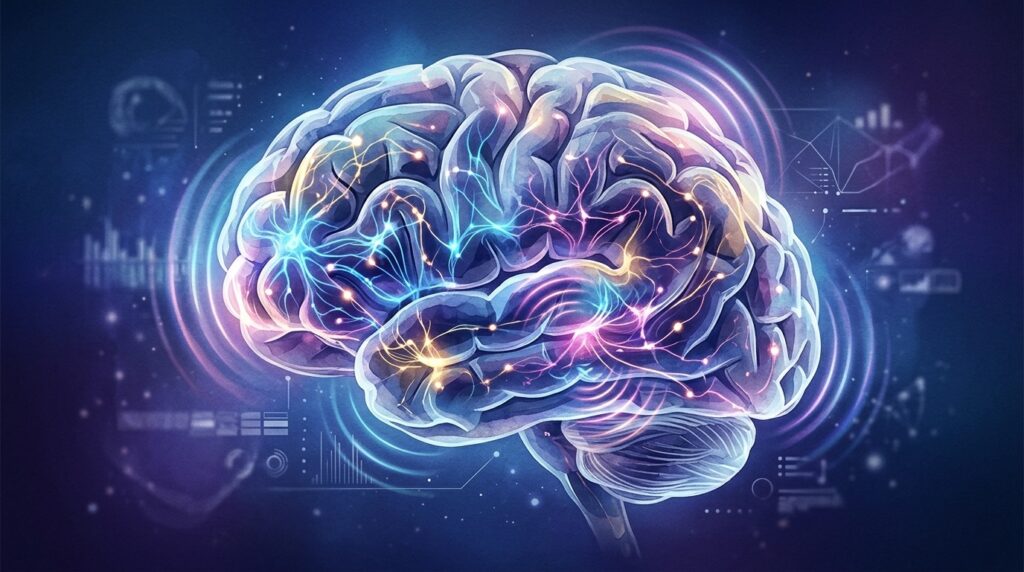
Schematic depiction of neural brain activity
At the same time, something curious happens in the brain: activity decreases in areas associated with self-referential processing — the network responsible for our sense of “self,” memories about ourselves, and our place in the world. When these areas quiet down, the focus of attention shifts from the self to the external world. That’s why in moments of awe we literally “forget about ourselves” and feel small.
How Awe Affects Mental Health
Researchers from UNSW Sydney gathered data on how positive awe affects mental state. Preliminary results point to five key mechanisms:
- Improved ability of the nervous system to relax — through parasympathetic activation
- Reduced excessive self-focus — which is important for anxiety and depression
- Increased tendency to help other people
- Strengthened sense of connection with others
- Enhanced sense of meaning in life
It’s important to note: research in this area is still at an early stage. Scientists emphasize that additional studies are needed before long-term effects of awe can be confirmed. But there are already reasons to believe that deliberately seeking such experiences helps you feel less stressed, more satisfied, and happier.
Interestingly, the “self-diminishment” mechanism — when attention shifts from internal experiences to the external world — echoes what happens to the brain after meditation and certain physical practices.

Collective experiences at concerts are one of the most powerful sources of awe
Where People Most Often Experience Awe and How to Seek It in Everyday Life
What triggers awe is different for everyone. But there are experiences that provoke it more often than anything else:
- Some people are overwhelmed by art, live music, or a powerful film that truly moves them;
- Others — by mountain landscapes, the ocean, or a starry sky;
- Some experience this feeling at concerts and sporting events, through a collective experience when many people simultaneously live through the same moment;
- Sometimes awe comes completely unexpectedly — for example, when you encounter an idea so powerful or unfamiliar that your worldview suddenly begins to crack at the seams.
One specific method is the so-called “awe walks.” The idea is simple: you go for a walk with the intention of noticing beauty, scale, and wonder around you. Not scrolling through your phone, but looking at trees, the sky, architecture — and allowing yourself to be amazed.
Even learning something new can become a source of awe. For instance, a story about Leonardo da Vinci’s DNA revealing the secret of his genius — that’s the kind of case where a complex idea triggers that very sensation: the world turns out to be bigger than you thought.
A connection with your own spirituality (even outside of religion) can also evoke awe. This isn’t about belief in a specific god, but about the ability to feel yourself as part of something greater.
Ultimately, awe begins with a simple action — stopping and noticing. Not every sunset will change your life, but the habit of paying attention to the grand within the ordinary is perhaps one of the most accessible tools for maintaining mental health. Science is still cautious in its conclusions, but the direction is set: the more often you allow yourself to be amazed, the better your brain feels.