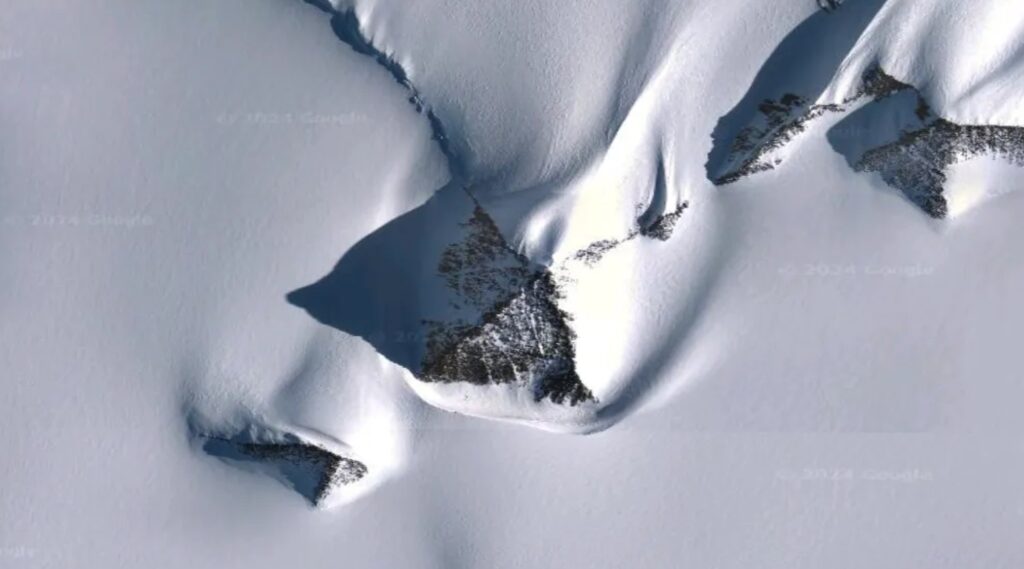
Satellite image of a mountain in Antarctica that resembles a pyramid. Image source: Live Science
Deep in Antarctica, among snow and ice, stands a mountain with perfectly even edges. On satellite images it looks man-made, which is why conspiracy theorists believe it is a trace of a highly advanced ancient civilization. There is also talk that this pyramid was built by aliens. However, geologists have a much more mundane yet more fascinating explanation. So what exactly is the pyramid in Antarctica?
The triangle-shaped mountain gained internet popularity in 2016, when its shape became linked to discussions about aliens, secret structures under the ice, and lost civilizations. The resemblance to a pyramid is indeed so striking that it makes you stop while scrolling through your feed. Details about this geological wonder were shared by the authors at Live Science.
Where Is the Pyramid in Antarctica Located
The mysterious mountain is not located in some unexplored corner of the planet but within a well-known mountain range. It is part of the Ellsworth Mountains, a documented mountain system in the interior of West Antarctica. The coordinates of the Antarctic pyramid are approximately −79.98 latitude and −81.96 longitude, deep in the continental interior.
The range was named after American polar explorer Lincoln Ellsworth, and the Ellsworth Mountains themselves are among the highest in Antarctica. So this is not a blank spot on the map but a place that has been photographed and studied for decades.
Why the Mountain in Antarctica Resembles an Egyptian Pyramid
The main reason for this peak’s fame is that its unusual shape is very easy to see from above. Many mountains on satellite images look jagged and sprawling in all directions. But this one looks compact, with sharp edges and enough symmetry to resemble a snow-covered Egyptian pyramid.
Scientists say the mountain’s shape most likely formed through frost weathering over hundreds of millions of years. Three sides of this peak apparently eroded at roughly the same rate. The fourth, eastern face, formed separately, and this is precisely what helps explain why the mountain looks symmetrical without any builders.
What Is Frost Weathering in Simple Terms
It sounds like a complex term, but the mechanism is frustratingly simple, and everyone has seen its effects. Frost weathering begins when water seeps into cracks in rock. When it freezes, it expands, pushes against the walls of the crack, and gradually tears the stone apart from within. In a similar way, asphalt on roads cracks in winter or bottles of water left out in the cold burst. In Antarctica, this cycle repeats again and again over an unimaginably long period of time.
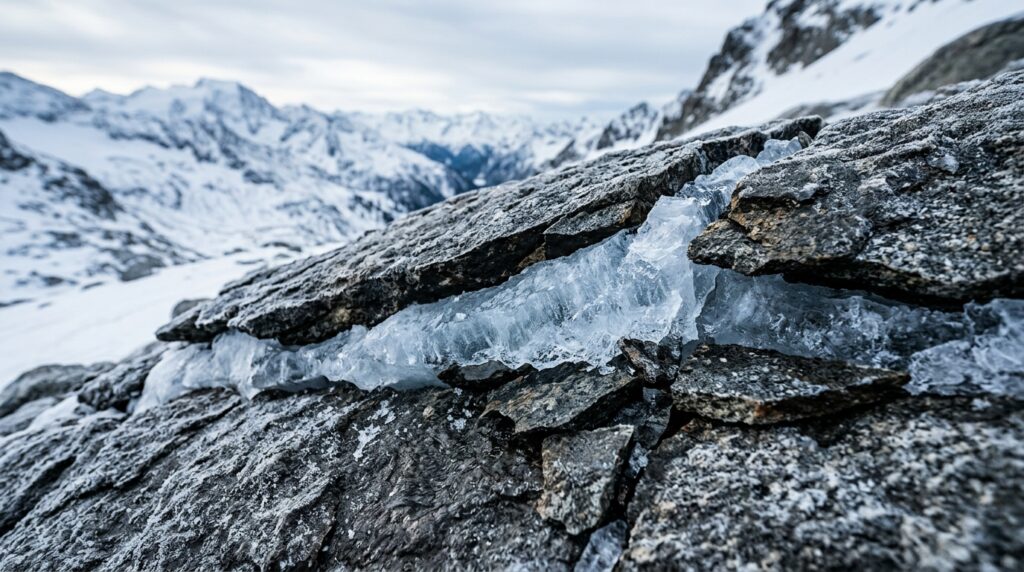
Ice in rock cracks slowly destroys the stone
The result accumulates step by step:
- water seeps into cracks and freezes, expanding;
- ice pushes against the walls and widens the fractures;
- chunks of rock break off and tumble down;
- slopes become increasingly steep and smooth.
If several faces of a mountain erode at roughly the same rate, it can eventually take on an almost geometrically perfect appearance. There is no design behind it — just ice, water, and time.
Why Scientists Don’t Consider the Antarctic Pyramid Artificial
Scientists are confident that what we see on satellite images is simply a mountain that resembles a pyramid. Pyramid-shaped mountains are quite common in nature, although peaks with four such faces are indeed rare. But that doesn’t mean the pyramid in Antarctica was built by an ancient civilization or aliens.
Researchers don’t deny that the peak looks unusual. But there is a clear physical explanation for its shape, which I already described above. Rock splits along weak points, ice carries away the debris, and slopes become steeper as the broken rock crumbles away.
What Is Actually Hidden Beneath Antarctica
If this region has a hidden ancient history, it is recorded in layers of rock and fossils, not in architecture. The surrounding area is known for fossils approximately 500 million years old, including trilobites and other Cambrian-period life.
A separate scientific paper by the United States Geological Survey describes trilobite finds in several regions of Antarctica. According to it, trilobite-bearing layers were first discovered in the Heritage Range during the 1963–1964 field season. This is the real treasure of the area. There is evidence of ancient marine life and a geological record that is older than any human civilization by hundreds of millions of years.
It turns out that while people search for traces of a lost civilization under the Antarctic ice, the continent’s real history is far more ancient and grand than any structures. The pyramid-shaped mountain helps us understand how ice and frost carve stone — and learn to tell the difference between a geological wonder and a conspiracy theory. Perhaps in the future we will learn something new about Antarctica, but for now it should be left in peace.