A golden-brown pie on a table in an old candlelit kitchen.
In the winter of 1692, when several girls in Salem, Massachusetts, began suffering fits, a neighbor proposed an unusual way to check whether witchcraft was to blame: bake a cake from flour mixed with the afflicted girls’ urine and feed it to someone else. The “witch cake” was given to the minister’s dog, which ate it and showed no ill effects. The test exposed no one, yet suspicion kept spreading, and the panic that followed became one of the darkest episodes of colonial America.
What you need to know
- Neighbor Mary Sibley suggested kneading flour with the sick girls’ urine and baking it into a cake to test for witchcraft.
- The cake was fed to the Parris family’s dog, which ate it and was unharmed, so the test produced no result.
- Reverend Samuel Parris condemned the cake from the pulpit, arguing that the blasphemous baking itself had brought witchcraft into the village.
- Over the following year, more than 100 people fell under suspicion and at least 24 died.
Moles, milk and cold water: how witches were hunted
In an era when people genuinely feared curses and evil spells, little held back those searching for witches. Suspects could be stripped and examined for “witch’s marks”: unusual birthmarks, moles or extra nipples. There was also the “touch test,” in which the accused was made to touch the afflicted person. The belief was that this would break the spell and give the witch away.
If someone suspected that a witch had cursed livestock, they would take milk from the sick animal, heat it over a fire and beat the pail. It was believed that every blow would leave welts on the witch’s back.
The cruelest method was the water ordeal. The accused was thrown into a river or pond, often with thumbs tied to toes. Those who floated were declared witches and sent to trial or execution. Those who drowned were considered innocent, which no longer helped them. Such tests harmed a great many innocent people, mostly women.
Three girls in Salem began having fits
Salem was a small village in Massachusetts. In 1689, the Puritan preacher Samuel Parris arrived there, and his harsh sermons quickly split the community into two camps.
In the winter of 1692, the pastor’s nine-year-old daughter Betty, his eleven-year-old niece Abigail and their twelve-year-old friend Ann Putnam began suffering fits and convulsions. The local physician, William Griggs, declared that witchcraft was to blame. Parris’s supporters began eyeing those who attended church less diligently.
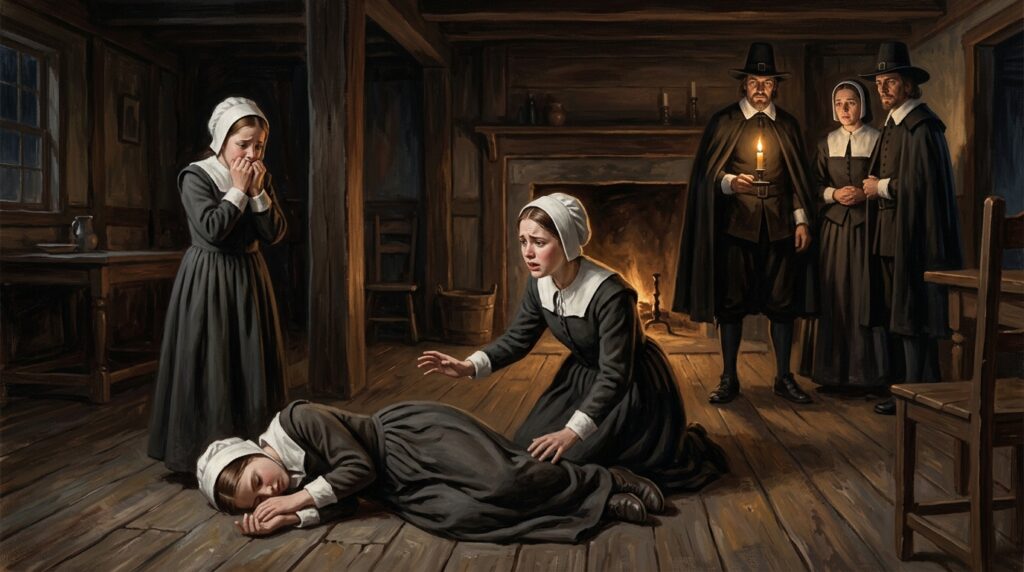
A girl lying unconscious on the floor of a dim room
Possible explanations remain unproven
Today, historians look for natural explanations of the girls’ behavior, ranging from epilepsy and even asthma to ergot poisoning. Ergot is a parasitic fungus that grows on grain; poisoning from it causes choking, hallucinations and a sensation of something crawling over the skin. However, there is no definitive diagnosis, and there never will be, so these remain hypotheses rather than established fact.
The witch cake recipe: flour and urine
Once the whole village believed in witchcraft, the Parrises’ neighbor Mary Sibley suggested a way to find the culprit: knead flour with the afflicted girls’ urine and bake the dough into a cake.
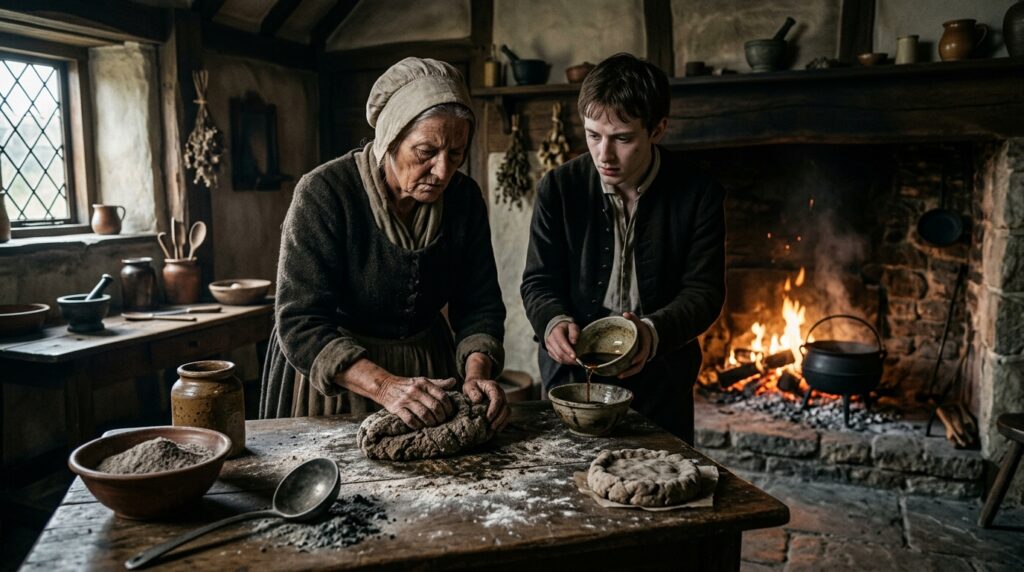
An elderly woman kneading dough by the hearth, with a young helper nearby
It sounds absurd, but by 17th-century standards there was a logic to it. The cake was seen as a kind of conduit for a witch’s power. In other accounts, such a cake served as a remedy: it was baked and then burned, buried or otherwise destroyed to lift the spell from the sufferer. In Salem, however, the cake was meant to establish whether witchcraft was present at all.
The pastor’s dog became the test subject
The reasoning went like this: if the girls’ bodies were bewitched, the curse would also pass into everything that came out of them. So if a third party ate the cake and fell ill too, witchcraft could be considered proven.
Fortunately, the cake went not to a person but to the Parris family’s dog. The dog ate it, and nothing happened. The test produced no result.
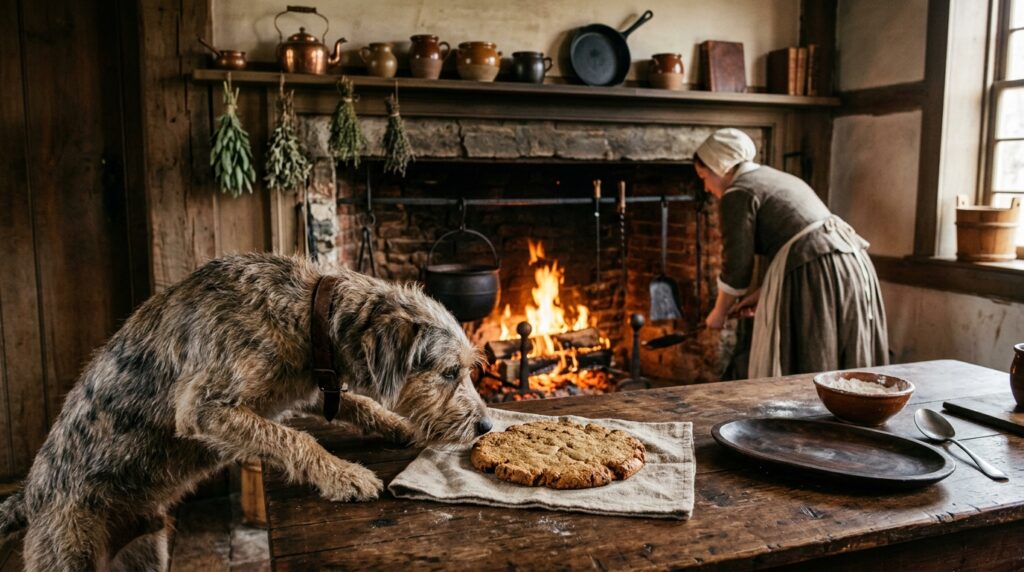
A dog sniffing a flatbread on a wooden table by the fireplace
When the pastor learned what had been going on in his house, he was horrified. In his view, it was the blasphemous cake itself that had brought witchcraft into the village, not any particular witch. In his Sunday sermon, he publicly called the baking the devil’s work.
Three women were the first to be accused
The cake exposed no one, but suspicion could no longer be contained. Soon Tituba, an enslaved woman in the Parris household, was arrested. Accused alongside her were Sarah Good, a destitute beggar, and the bedridden Sarah Osborne.
Salem then lived in panic for a full year. Accusations followed one after another: more than 100 people fell under suspicion, 19 of them were hanged, one was pressed to death with stones, and at least four more died in custody. In total, at least 24 people died.
The first three accused met different fates:
- Sarah Osborne died in prison before her case ever came to trial.
- Sarah Good was hanged in July 1692; she may not yet have been forty.
- Tituba was held for more than a year, but the case against her collapsed. What happened to her after 1693 remains unknown.
A rarely remembered starting point
Countless books have been written about the Salem trials, but the cake at the start of it all is seldom mentioned. Yet this repulsive baked good, eaten by an entirely blameless dog, helped set in motion one of the grimmest chapters of colonial American history.