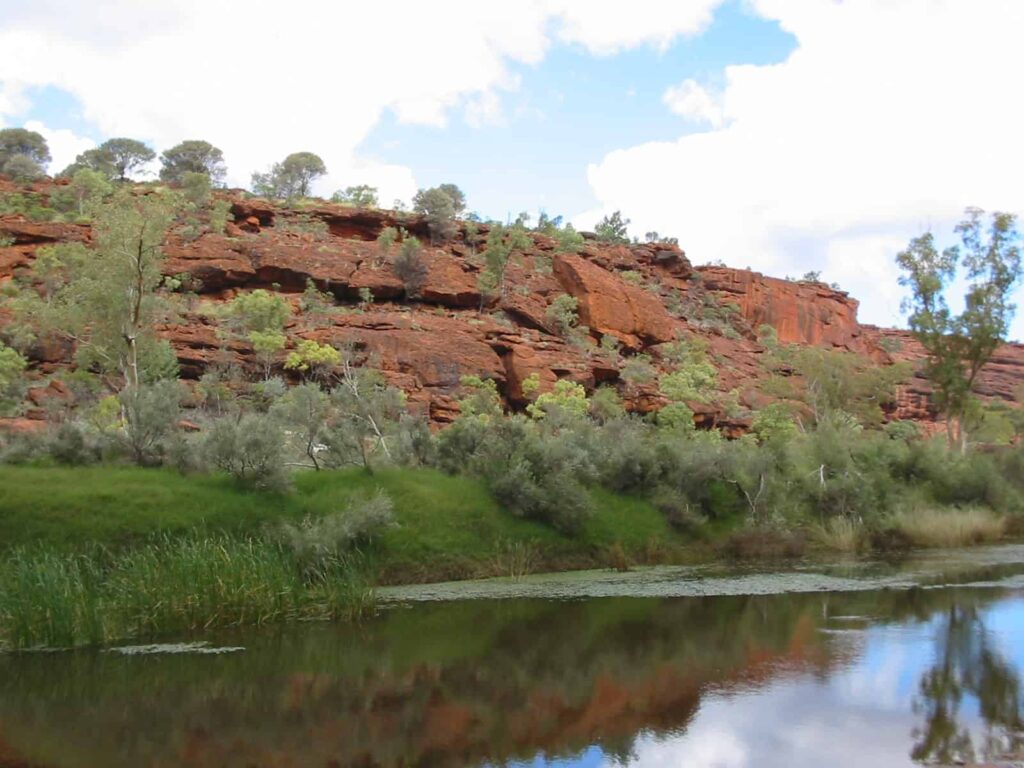
The most ancient river on Earth: it flowed even during Pangaea
The Finke River in central Australia was flowing even before dinosaurs appeared and probably even before all continents merged into the single supercontinent Pangaea. Back then, the Earth already had the most ancient forest, ancient fish, and giant insects, but the world as we know it did not yet exist. Geologists consider it the leading candidate for the title of the oldest river on Earth: by estimates, it is between 300 and 400 million years old. Yet for most of the year, the Finke doesn’t even look like a river.
The Finke River: Why It Is Considered the Most Ancient on Earth
The Finke River in central Australia, called Larapinta by the indigenous Arrernte people, is considered the leading candidate for the title of the oldest river on the planet — it is attributed an age of around 400 million years. That is more than 150 million years before the appearance of dinosaurs.
For most of the year, the Finke doesn’t look like a proper river. It flows only a few days a year, and its water usually disappears into the sands of the Simpson Desert, extremely rarely reaching Lake Eyre. In the dry season, instead of a river, only scattered pools and sandy channels are visible. But when tropical rains come, brown torrents of water rush through the gorges.
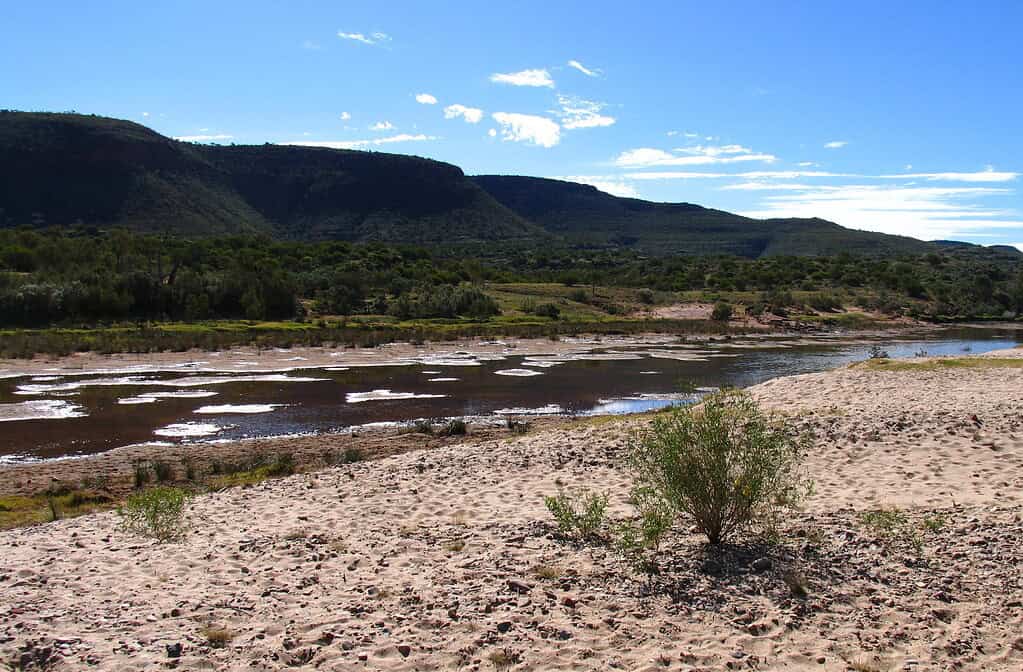
The Finke River in the dry season.
Why the Finke River Is Older Than the Mountains Around It
Normally, rivers flow along the path of least resistance — along valleys, faults, around mountain ranges. But the Finke cuts straight through mountain ranges as if they were no obstacle. It originates in the MacDonnell Ranges in central Australia and flows south toward the Lake Eyre basin.
How is this possible? Geologists call such rivers antecedent: the river existed before the mountains rose. While tectonic forces were pushing rocks upward, the river continued to saw its way downward, maintaining its channel through the growing range. Imagine a band saw cutting through a log while it is slowly being lifted from below — the saw stays in place while the cut deepens.
The history of the Finke is closely linked to the so-called Alice Springs Orogeny — a massive episode of mountain-building that began roughly 450 million years ago and ended about 300 million years ago. The MacDonnell Ranges formed during this very event. And since the river cuts straight through the range, it is at least as old as the mountains — and possibly older. Such processes clearly demonstrate how slowly yet powerfully tectonic plates move, reshaping the planet’s landscape.
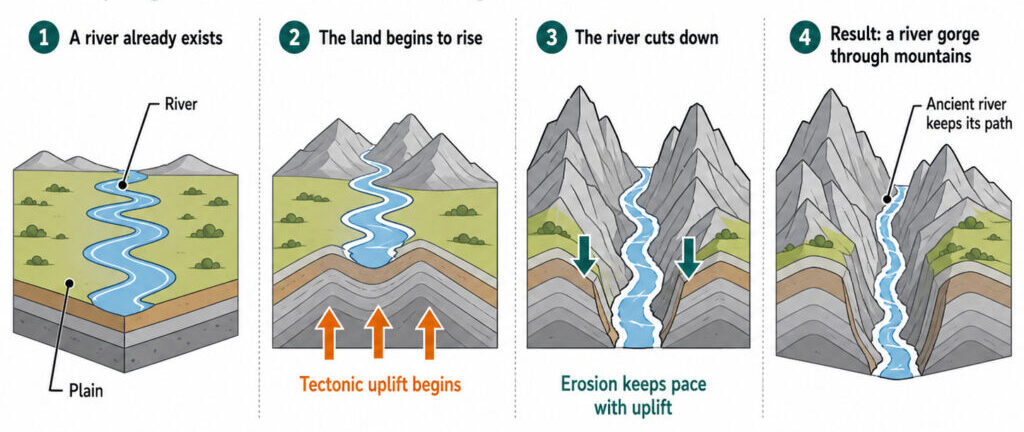
How an ancient river cuts through mountains
There is another clue as well. Near the modern course of the Finke, ancient river gravels are found that now sit high above the water. They once lay at the bottom of the river, but groundwater cemented them with iron and silica, turning them into rock harder than the surrounding formations. When the softer landscape around them eroded away, these deposits remained standing as hills — geologists call this inverted relief (when former low-lying areas become elevated features). Essentially, these are “fossilized casts” of former channels, layered one on top of another — living proof that the river carved into the same landscape for an unimaginably long time.
Incidentally, remains of an ancient fish that lived in this system millions of years ago have also been found in this area.
How the Finke Survived Pangaea and Five Mass Extinctions
If the age of the Finke drainage system is indeed 300–400 million years, then the ancestors of this river were already flowing when continents were just beginning to assemble into the single supercontinent Pangaea. Pangaea finally formed about 335 million years ago from earlier continental blocks — Gondwana, Euramerica, and Siberia. This means the Finke River is older than the most famous supercontinent in Earth’s history.
Over hundreds of millions of years, the climate changed, entire oceans disappeared and appeared, and the planet was shaken by five major mass extinctions (one of the most devastating was the Great Dying, after which a huge proportion of marine and terrestrial species vanished). But Australia proved to be an extraordinarily stable landscape: the continent sits in the middle of the Australian tectonic plate and has not experienced significant tectonic activity for the last several hundred million years. This allowed the Finke River system to develop and expand almost without interruption.
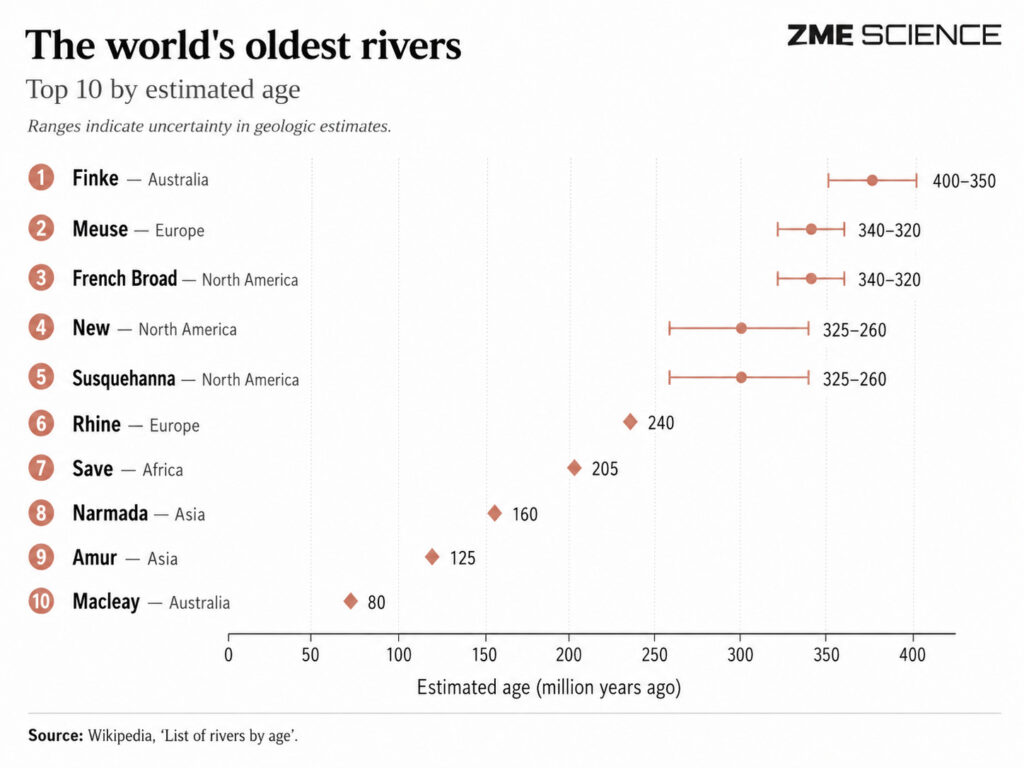
The oldest rivers in the world and their age
As geologists note, the river’s long life is ensured by tectonic stability and the absence of glaciation. Australia was bypassed by both the ice ages that reshaped river systems in North America and Europe, and by active mountain-building that could block or redirect a river.
Which Rivers Are Considered the Oldest in the World
The Finke is the leader, but not the only candidate.
- Meuse in Western Europe. The river flows 950 kilometers through France, Belgium, and the Netherlands and is estimated to be 320–340 million years old. It cuts through the Ardennes in a manner similar to how the Finke cuts through the MacDonnell Ranges — the mountains rose around an already flowing river.
- New River in the USA. Despite its “new” name, this river in the Appalachians may be one of the oldest in North America — age estimates range from 10 to 360 million years. The spread is enormous, and many geologists believe the current gorge is significantly younger.
- Rhine in Europe. Its possible age is around 240 million years, but the modern river system was assembled piece by piece, including Alpine tributaries, only over the last few million years.
- Nile. It is often called the most ancient river, but this status is more associated with human history than geological age. Civilizationally, the Nile is indeed ancient, but geomorphologically the modern Nile is significantly younger. One section of it dates to 65–75 million years ago, but most of the system is younger than 2 million years.
There are other candidates as well — the Save River in Zimbabwe and Mozambique, whose age is linked to the rifting of Gondwana, and the Narmada in India, associated with India’s separation from Gondwana and its drift northward. But the evidence base for them is weaker than for the Finke.
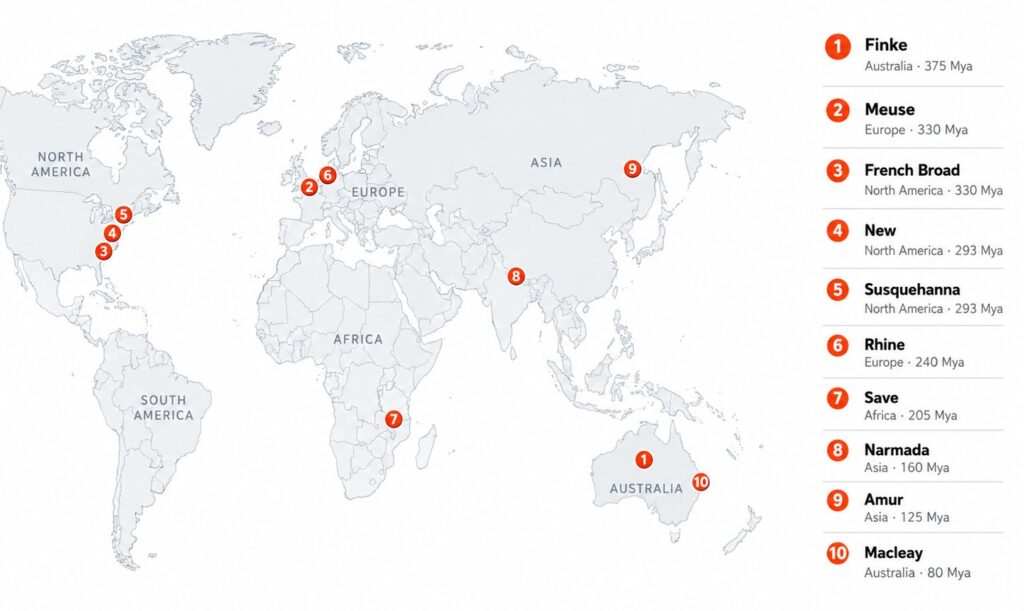
Where the oldest rivers in the world are located.
How Scientists Determine the Age of Ancient Rivers
Rivers are poor archivists of their own history. They meander across floodplains, capture neighboring streams, shift their channels, and in the process destroy the very rocks that could confirm their age. This is where the main problem arises: the age of a river itself cannot be determined directly.