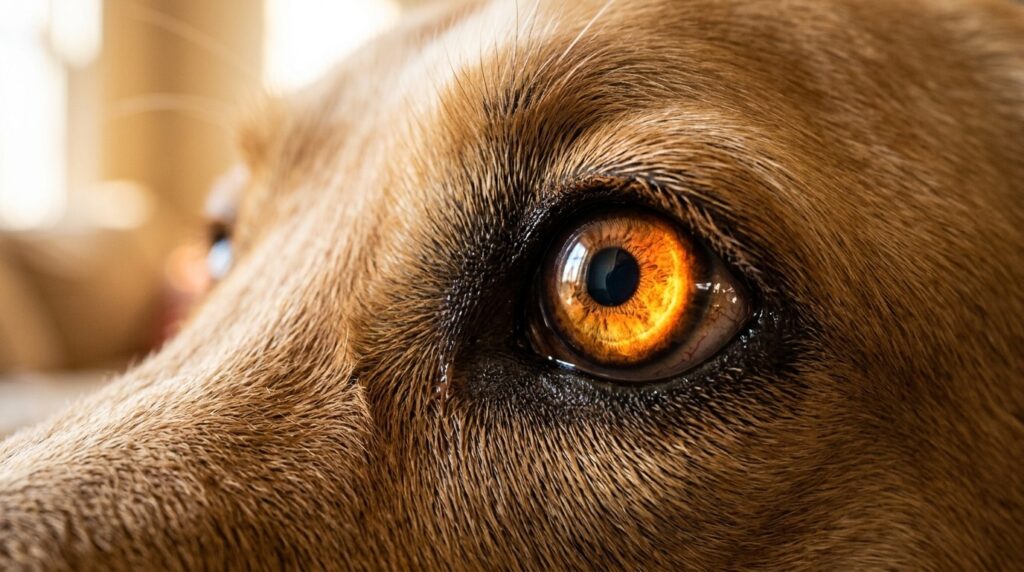
What colors dogs actually see and which they don’t.
Dogs see the world in color — just not in all colors at once. The popular myth about black-and-white vision in dogs was debunked by science long ago, but some people still believe it. In general, many animals see the world quite differently from what we tend to think. Let’s figure out which colors are available to your dog, why a red ball isn’t red to them, and how this knowledge can be useful in everyday life.
Why People Think Dogs See the World in Black and White
If you’ve ever heard that dogs see the world like an old movie — only in shades of gray — you can breathe easy. It’s not true. Dogs do distinguish colors; their palette is just noticeably more limited than ours.
It all comes down to special cells in the retina called cones. These are responsible for color perception. Humans have three types of cones, which is why we see far more shades — from red to violet. Dogs have only two types of cones — which is why their vision is called dichromatic. Imagine a person with red-green color blindness: that’s roughly how the world looks through your dog’s eyes.
What Colors Can Dogs See
The two types of cones in dogs are sensitive to different parts of the spectrum. One detects blue-violet wavelengths, and the other detects yellow-green ones. This means that dogs distinguish blue and yellow colors particularly well.
But red and green are a problem. A dog most likely sees these colors as something grayish-brown. Veterinary ophthalmologist Mary Lassaline from the University of Pennsylvania provides a vivid example: a red flower with a green stem in a blue vase would appear to a dog as a gray flower with yellowish leaves and a blue-violet vase.
An important caveat: we can’t get inside a dog’s head and know exactly how it “experiences” any given color. Scientists only know which wavelengths the cones respond to. But a dog’s subjective perception of color may differ from ours even within the yellow-blue range.
How Dog Vision Differs from Human Vision
It might seem like dogs are at a disadvantage compared to us when it comes to vision. But that’s only if you measure everything by our standards. A dog’s retina has an especially large number of other photoreceptors — rods. Dogs have about 3% cones, while humans have 5%. But they have far more rods.
Rods are responsible for two superpowers of the canine eye:
- Excellent night vision — dogs see in the dark significantly better than we do
- Superior motion detection — even the slightest movement at the edge of their field of vision won’t go unnoticed
Essentially, evolution made a choice: fewer colors, but razor-sharp reaction to movement and the ability to navigate in twilight. For a predator that hunts at dawn and in the evening dusk, this is far more valuable than the ability to admire shades of a sunset.
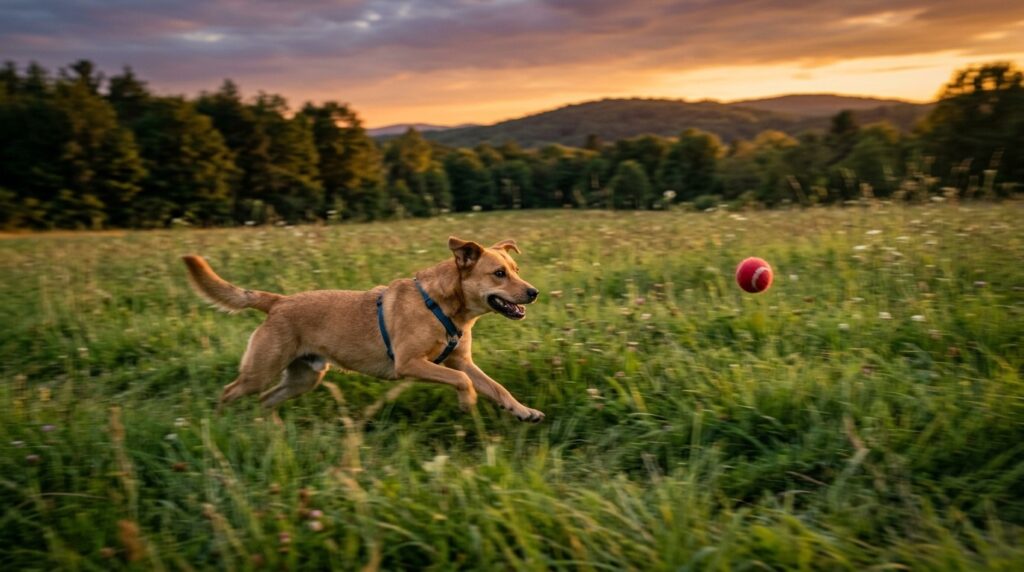
In twilight, dogs see much better than humans thanks to the rods in their retinas.
What Color Toys Are Best for Dogs
Now it’s clear why your dog sometimes loses a bright orange ball on green grass: to them, both the ball and the grass look roughly the same — in grayish-brown tones. But a blue or yellow ball is much easier for a dog to find, because they distinguish these colors very well.
However, there’s no need to worry too much.
As experts note, dogs navigate the world not only with their eyes: hearing and smell are more important to them than vision, and they find their favorite toy primarily by scent. So your pet doesn’t suffer from not seeing red roses — they compensate perfectly well with their nose.
Mary Lassaline jokes: “As far as I know, none of my four-legged patients has ever managed to get behind the wheel.” For a dog’s everyday life, limited color vision is not a problem.
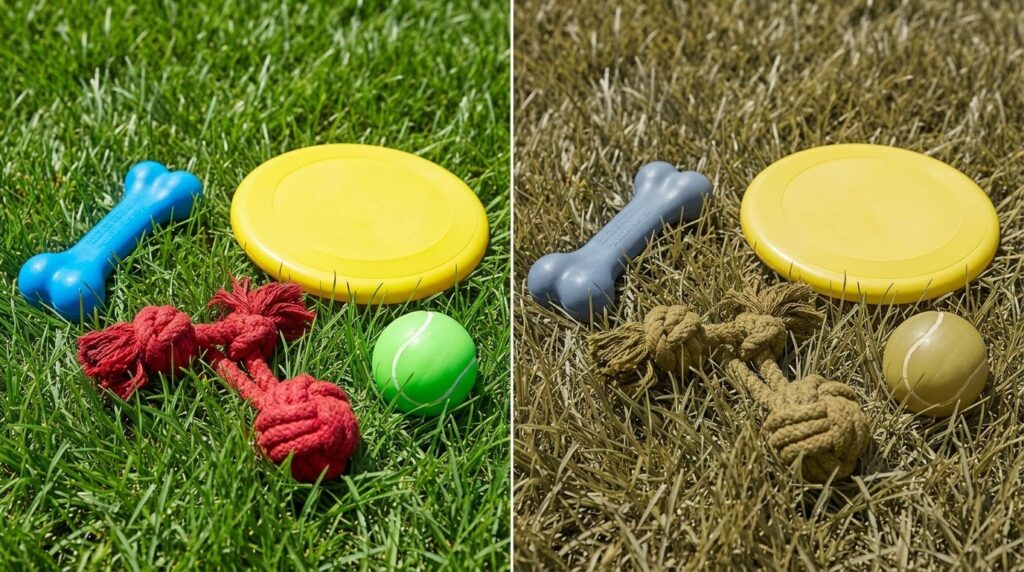
Blue and yellow toys are the best choice for dogs because they distinguish these colors best.
What You Need to Know About Dog Color Vision
To make it easier to imagine how dogs perceive colors, here’s a quick cheat sheet:
- Blue — the dog sees it as blue
- Yellow — seen as yellow
- Red — appears gray or dark brown
- Green — also turns into grayish-yellow
- Purple — perceived as blue
If you want a toy to be as visible as possible for your dog, choose blue and yellow colors — they will stand out against any background. Meanwhile, the red-green color range merges into one indistinct blob for a dog’s eyes.
A dog’s vision isn’t a deficient version of human vision — it’s simply a different system designed for different tasks. Where we need colors, a dog needs reaction speed, sensitivity to movement, and the ability to see in dim light. And their eyes handle these tasks brilliantly. As for colors? That’s what their nose is for — and it seems to work even better than our eyes.