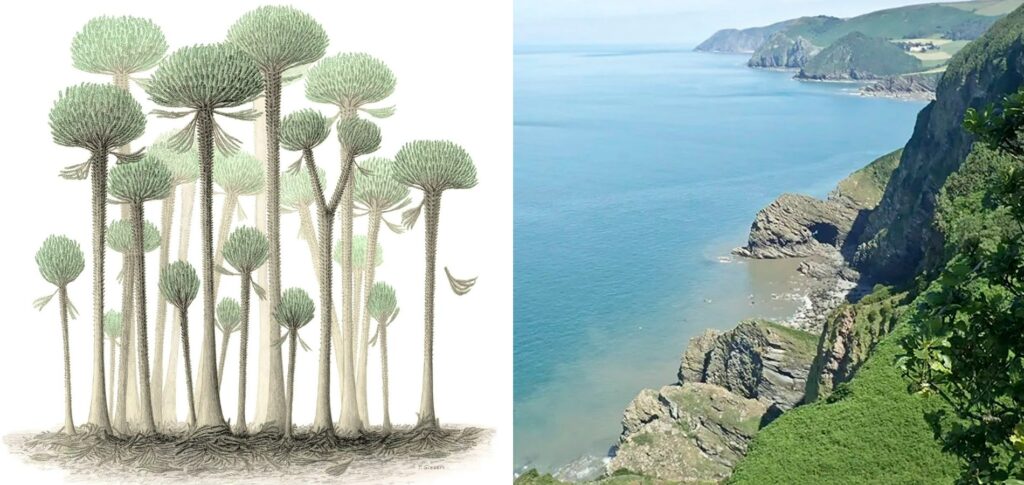
The most ancient forest on Earth is hidden in a small corner of England.
The most ancient forest on Earth turned out to be not in the Amazon or Australia, as many might have assumed, but on the coast of Somerset and Devon in southwest England. It is 390 million years old, making it 4 million years older than the previous record holder — the fossil forest in Cairo, New York State. Yes, scientists dig up not only mammoths but entire forests. The trees of that time bore little resemblance to modern ones, but they forever changed the landscape of our planet.
How the Most Ancient Forest on Earth Was Found in England
The oldest known fossil forest, aged 390 million years, was discovered in tall sandstone cliffs along the coast of Devon and Somerset in southwest England. The fossils were found and identified by researchers from the universities of Cambridge and Cardiff. The site is located near the town of Minehead, on the southern shore of the Bristol Channel, not far from the Butlin’s holiday park.
Fieldwork was conducted along the tallest sea cliffs in England, some of which are accessible only by boat. Scientists previously believed that this section of the English coast contained no significant plant fossils. But they were wrong — the sandstone turned out to be literally packed with fossil plant material from the Devonian period.
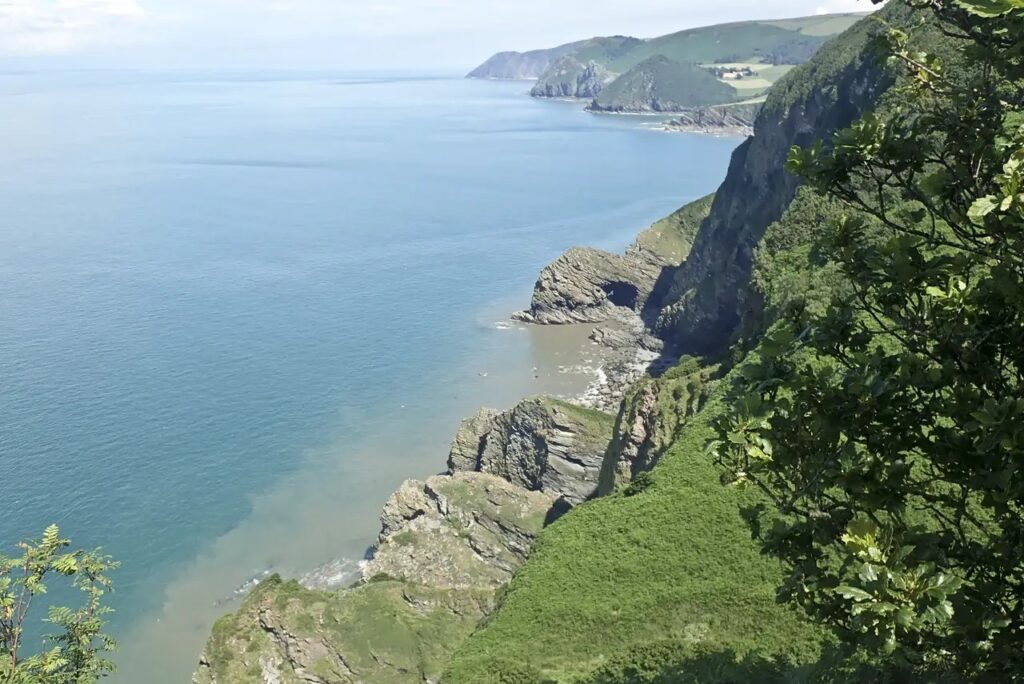
Tall sandstone cliffs on the coast of Devon and Somerset in southwest England, where the oldest known fossilized forest on Earth, aged 390 million years, was discovered.
Professor Neil Davies, the lead author of the study, admitted: this part of the world is quite well studied, and finding something like this was a complete surprise for the team. The fossil forest is approximately four million years older than the previous record holder — the forest from New York State.
What Are Calamophyton Trees and What Did the Ancient Forest Look Like
The fossil trees, known as Calamophyton, at first glance resemble palm trees but were merely a “prototype” of the plants we know today. Instead of solid wood, their trunks were hollow inside, with a ring of woody support strands on the outer side.
They had no true leaves — only branching structures resembling twigs that covered the upper part of the trunk. Calamophytons reached 2 to 4 meters in height and shed their branches as they grew.
Essentially, they were living tubes with bunches of photosynthesizing “twigs” on top. Over its lifetime, a single tree could shed 700 to 800 branches, creating a thick carpet of decomposing twigs on the ground. There was virtually no undergrowth — grasses did not yet exist.
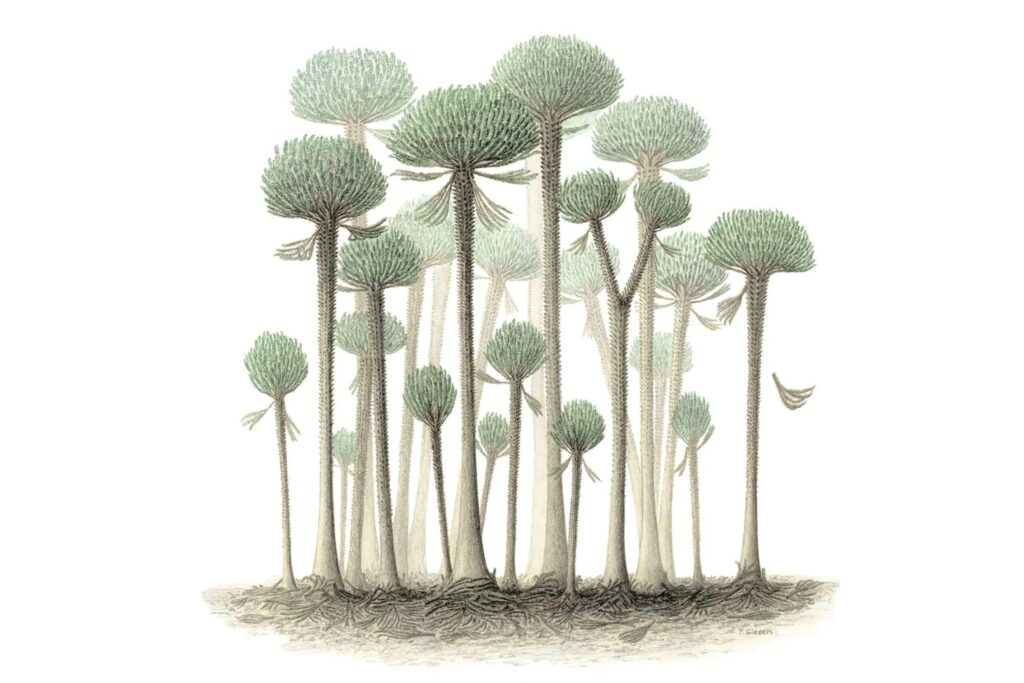
Reconstruction of a forest of Calamophyton trees — the most ancient on the planet.
Calamophytons belong to cladoxylopsids — an extinct group of plants related to ferns and horsetails. Cladoxylopsids dominated terrestrial ecosystems for about 5 million years before being replaced by more modern woody plants approximately 385 million years ago.
The Devonian Period — When Life Moved onto Land
The forest dates to the Devonian period, which lasted from 419 to 358 million years ago — an era of the first large-scale colonization of land by life. By the end of the period, the first seed plants had appeared and the first land animals, predominantly arthropods, had already established themselves.
In Devonian times, Earth looked nothing like it does today: this part of the landmass was not connected to the rest of England — it was located further south and adjoined the territories of modern Germany and Belgium, where similar fossils are found. Imagine an arid plain crossed by shallow river channels flowing from mountains to the northwest. Professor Davies described this forest as follows: it was quite strange and nothing like what we see today.
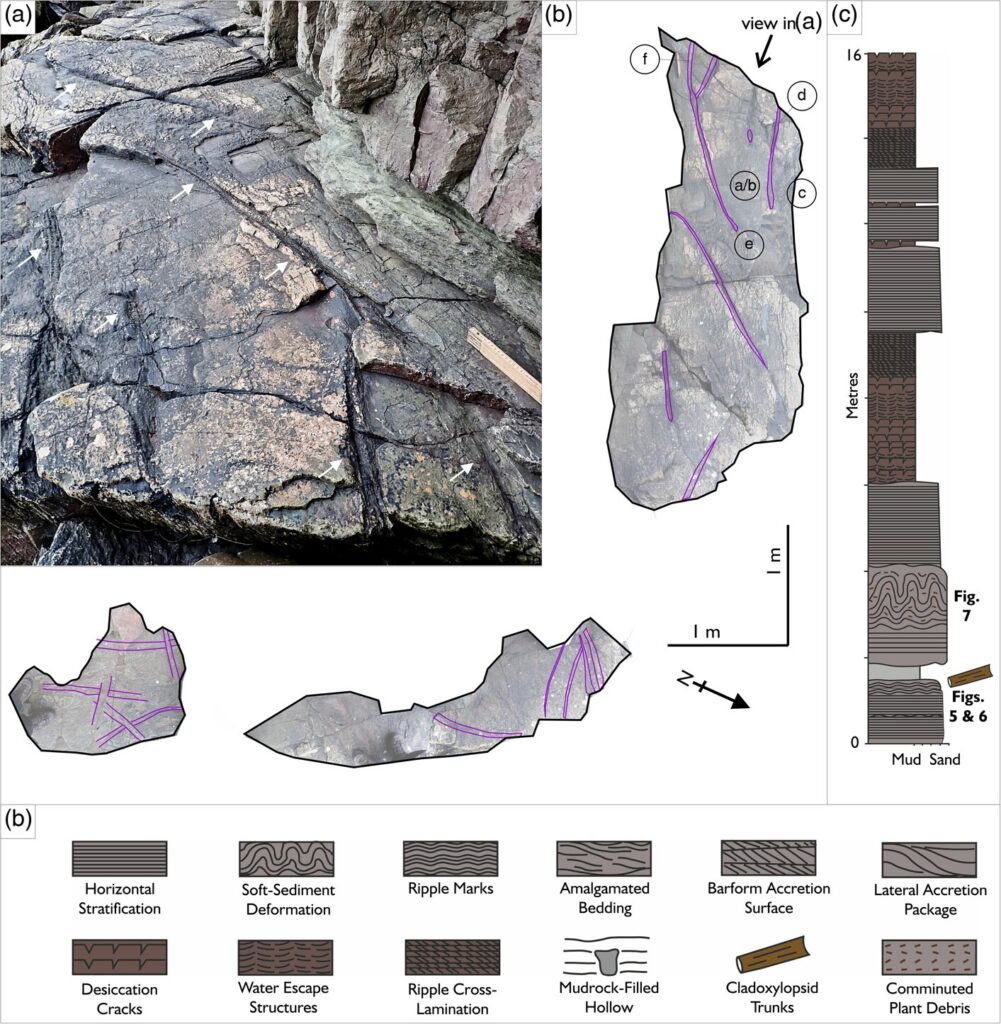
One of the sites with fossilized Calamophytons found. (a) Photo of the cliff showing at least 17 trunks. (b) Annotated photomontage of the bedding plane with plant fossils on the surface (circled letters indicate close-up images in the next figure). (c) Cross-section of the cliff. (d) Key for interpreting the cross-section data.
The discovery also shows the speed of early forest development. Although the Somerset forest was fairly sparse and consisted of only one tree species, the New York forest, just 4 million years younger, already exhibited greater species diversity. Comparing them, one can see how rapidly — by geological standards — vegetation was changing.
How the First Trees Changed Rivers and the Earth’s Landscape
The discovery is interesting not only for its record-breaking age. The most ancient forest shows how trees first began to reshape the Earth’s surface.
Professor Davies explained: the Devonian period fundamentally changed life on Earth, and trees and other plants, through their root systems, began to stabilize sedimentary rocks, changing how water and land interacted.
Densely growing Calamophytons shed enormous amounts of organic debris that accumulated in sediment layers. These deposits influenced river flow — for the first time in the planet’s history, plants were able to alter watercourse channels.
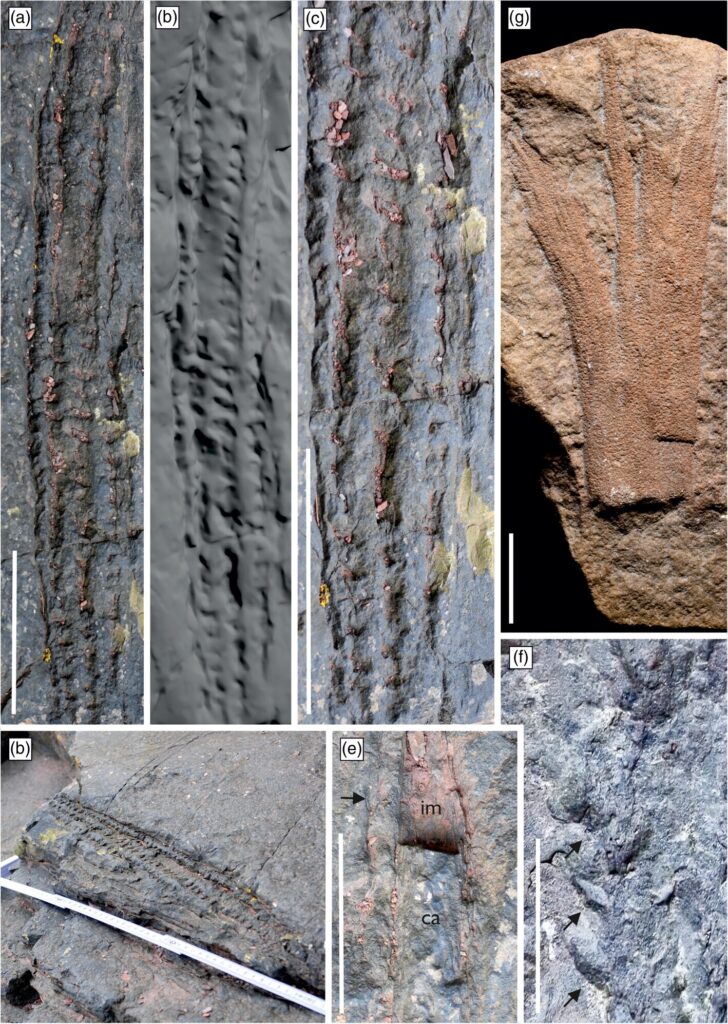
Details of the fossilized Calamophyton trunks found.
According to Davies, these fossils record a key stage in Earth’s development, when rivers first began to work in a fundamentally different way and became the powerful erosional force they remain to this day. In other words, before the first forests appeared, rivers simply spread across plains. And trees — initially clumsy and hollow — began to hold banks, alter channels, and shape a landscape similar to the one we know today.
Traces of Ancient Animals in the Most Ancient Forest on Earth
In addition to trees, scientists discovered something else interesting in the sedimentary rocks. The shed branches created a habitat for invertebrates living on the forest floor. Researchers found traces — footprints and tail drag marks of ancient arthropods. It is currently impossible to determine exactly what creatures these were due to the absence of physical remains, but the largest tracks were 5 to 10 centimeters wide (in those times insects were gigantic).
The team also found evidence that these arthropods burrowed into the sediment on the forest floor to escape desiccation in a very warm semi-arid climate. The forest, therefore, was not just a collection of trees but an already forming ecosystem with the first signs of plant-animal interactions.