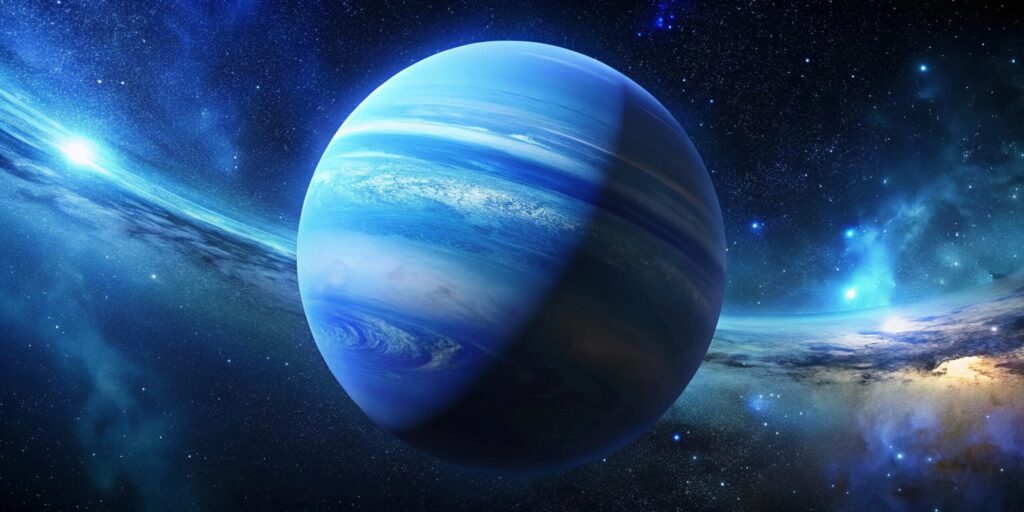
We visited Neptune and Uranus 40 years ago: why haven’t we returned?
Uranus and Neptune remain the most mysterious planets in our Solar System and the only ones we have visited just once. The Voyager 2 probe flew past Uranus and Neptune in 1986 and 1989, and since then no spacecraft has even come close to them. Technology has advanced enormously, so why haven’t we sent a new mission there yet?
How Voyager 2 Reached Uranus and Neptune
In the late 1970s, something rare happened: Jupiter, Saturn, Uranus, and Neptune aligned in space so favorably that a single spacecraft could fly past all four giants, using each planet’s gravity to accelerate toward the next. This “cosmic chain” occurs roughly once every 175 years, and NASA didn’t miss the chance.
Launched in 1977, Voyager 2 visited Jupiter and Saturn, then continued onward — to Uranus and Neptune. This Voyager space mission was essentially a series of high-speed flybys: the spacecraft spent only a few hours near each planet. Imagine trying to understand an entire city by racing through it on a high-speed train with just one glance out the window. That’s roughly what this sole “encounter” with these worlds looked like.
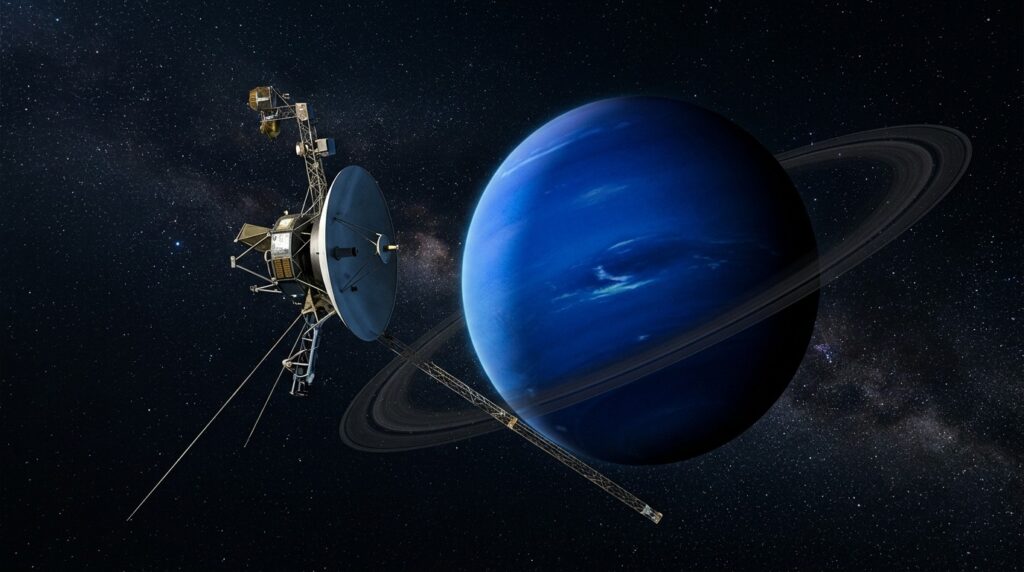
Voyager 2 approaches Neptune (AI-generated).
Uranus and Neptune: What We Know and What We Don’t
These planets are commonly called ice giants, but even this definition has recently been questioned — that’s how little we know. Uranus has an extremely unusual magnetic field and an axial tilt of nearly 90 degrees: the planet literally “rolls” along its orbit on its side. The likely cause is a giant collision billions of years ago.
Uranus also has a moon called Miranda with the tallest cliff in the entire Solar System — about 20 kilometers high. Neptune has its own surprises: mysterious changing storms and its largest moon Triton — a geologically active world with cryovolcanoes. Scientists have explained why Uranus and Neptune are colored in different shades of blue, but there are far more questions about these planets than answers.
Why You Can’t Just Fly to Neptune
The main problem is distance. Neptune is approximately 4.5 billion kilometers from Earth. Flying there on rocket thrust alone means either carrying an enormous amount of fuel (which means colossal launch costs) or traveling for an unbearably long time.
The ideal option is to use Jupiter’s gravity as an acceleration slingshot. The spacecraft flies past Jupiter and receives a powerful “kick” that allows it to reach Neptune significantly faster. But for this, Jupiter must be at the right point in its orbit, and the suitable “window” opens only once every 12–13 years.
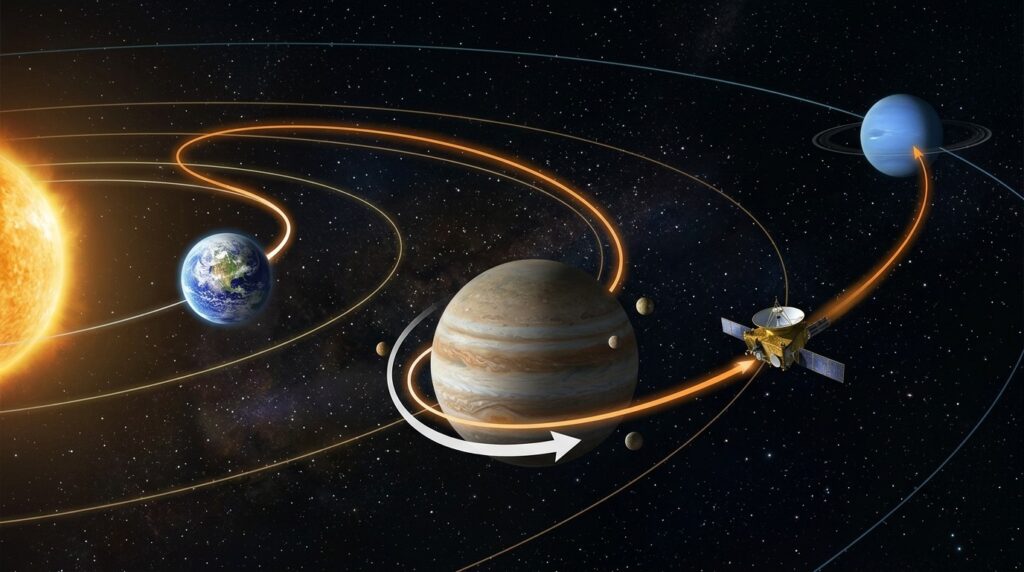
Gravity assist at Jupiter: without it, the journey to Neptune would take decades (AI-generated).
Moreover, the spacecraft must not only reach the planet but also slow down and enter orbit around it. Braking requires even more fuel. The more fuel — the heavier the spacecraft and the more expensive the launch. It’s a vicious circle that can only be broken with a favorable planetary configuration.
Mission to Uranus: NASA’s Plans for the 2030s
Currently, NASA has a specific priority — the Uranus Orbiter and Probe (UOP) mission. It was recognized as the top flagship mission of the decade in the Planetary Decadal Survey 2023–2032. The concept is simple: send a mission to Uranus, place a spacecraft into orbit around the planet, and drop a probe into its atmosphere.
The launch was originally planned for 2031 with a gravity assist at Jupiter and arrival at Uranus around 2044. However, due to a shortage of plutonium-238 (needed for the spacecraft’s nuclear batteries — solar panels are useless at such a distance from the Sun), the timeline has shifted to the second half of the 2030s. The journey will take 12 to 15 years.
There’s also a bolder idea: using SpaceX’s Starship, which could theoretically cut the travel time in half. But these capabilities have not yet been proven in practice.
Neptune Odyssey: Can We Reach Neptune Again After a 40-Year Gap
A mission concept has also been developed for Neptune — Neptune Odyssey. According to the plan, the spacecraft was supposed to launch in 2033 and arrive at Neptune in 2049 after a 16-year journey. It would enter orbit, drop a probe into the planet’s atmosphere, and study Triton in detail — a captured dwarf planet from the Kuiper Belt that may harbor an ocean beneath its surface.

Triton — Neptune’s moon with cryovolcanoes and a possible subsurface ocean (AI-generated).
But in practice, priority was given to the Uranus mission — for reasons of cost and logistics. And the nearest window for a flight to Neptune opens in the early 2030s and won’t wait forever. If the launch doesn’t happen during this window, the next favorable planetary alignment won’t come for another 12–13 years.
China is also considering its own mission to Neptune with an anticipated launch in 2033. So in the coming years, a real race to the distant ice worlds may unfold.
What Prevents Us from Returning to Uranus and Neptune: Money, Time, and Rare Launch Windows
Even if funding appeared tomorrow, preparing such a mission requires at least ten years. The spacecraft needs to be designed, built, tested, and launched precisely during the right window. And the budget for the Uranus mission alone is estimated at roughly $4.2 billion. And that’s without accounting for possible delays and cost overruns.
Add to that NASA’s unstable funding and competition with Mars and lunar programs — and it becomes clear why no one has flown to these planets since Voyager 2.
But the main limiting factor is physics itself. Planets don’t wait for us in convenient positions: the required alignment of Jupiter occurs only once every decade-plus. Miss the window — and the next chance to send a fast mission won’t come until the 2040s.
In the end, we face a remarkable situation: we live in an era of Mars rovers, space telescopes, and private rockets, yet two enormous worlds on the edge of our own system remain almost unexplored. The next ten years will show whether we can finally return there — or whether the ice giants will remain terra incognita for yet another generation.