When people ask me why pay for an expensive smartphone, I answer with one word: optical zoom. Not the processor, not the amount of memory, not the body materials, and certainly not the design. It’s the telephoto lens that became the reason I bought the vivo X300 and haven’t regretted it once. Let me explain why.
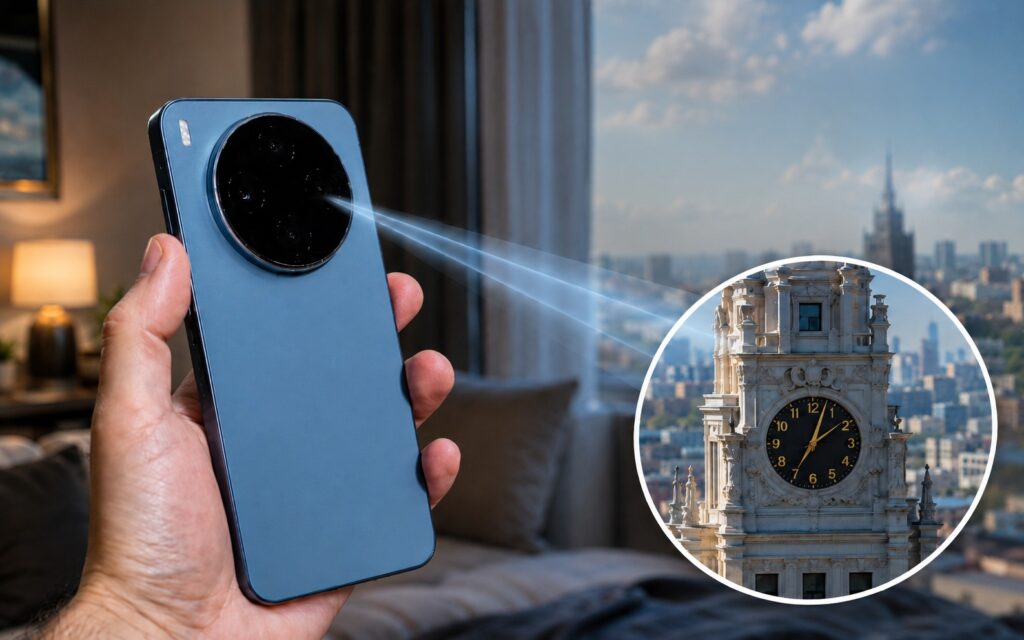
This is exactly the feature I splurged on a flagship for
What Is Optical Zoom in a Smartphone and Why Do You Need It
Most smartphones can “zoom in,” but it’s a trick. Digital zoom is simply cropping the frame: taking the central part of the image and stretching it to the desired size. Quality drops proportionally to the magnification. A smartphone camera without a telephoto lens at 10x produces an image like a point-and-shoot from the early 2000s. And that’s the best-case scenario.
A camera with optical zoom works differently. Inside the smartphone there’s a separate module (a periscope telephoto lens with its own sensor). It physically magnifies the subject through a system of prisms and lenses rather than cropping the image. The result is fundamentally different.

Photos at 3x and 10x zoom with a periscope camera
My vivo X300’s periscope camera delivers 3x true optical zoom, 10x without noticeable quality loss, and 100x digital. For comparison: a good smartphone with a powerful camera but no telephoto maxes out at 20x digital zoom, and the quality at those 20x is worse than mine at 100x. This isn’t an exaggeration—it’s the physics of optics.
Why I Bought the vivo X300 — Three Scenarios Where Zoom Changes Everything
The first scenario is portraits. When shooting at 3x magnification, you get a natural depth of field: the subject is sharp, the background is blurred. This happens on its own, without software processing. An ordinary shot turns into an artistic one simply because you stepped back a bit and tapped 3x.

Only a telephoto lens delivers portraits this good
The second scenario is concerts and events. If you’re not in the front row, without a telephoto lens the performer in the frame is the size of a fingernail. A smartphone telephoto lens solves this problem completely. I shoot from the back rows and get shots as if I were in the photo pit.

Examples of concert photos with up to 10x zoom
The third scenario is details at a distance. Architectural elements up high, signs, animals you can’t startle, nature. All of this can be captured calmly, from a comfortable distance, without quality loss. This is what makes it worth paying for an Android flagship.
Budget Smartphones with Telephoto Lenses — How They Compare to Flagships
Telephoto lenses have also appeared in mid-range smartphones. vivo V70, realme 16 Pro+, OPPO reno15 — all of these are affordable camera phones of 2026 with periscope lenses. So why pay more?
The problem is in the details. The vivo V70’s telephoto can’t focus at close range (macro shots and close-up portraits are out of the question immediately). The realme 16 Pro+ and OPPO reno15 have physically smaller telephoto sensors (less light, worse night shots, less detail). Plus, the less powerful processors in budget models handle processing worse (even if the sensor captures well, the algorithm can ruin everything). A telephoto lens in a budget smartphone is like a turbo in a budget car. Technically it’s there, but in practice it’s not the same thing.
Which Flagship with Good Zoom to Buy in 2026
If I’ve convinced you — here are three options for different needs:
- vivo X300 — my choice, a compact camera phone of 2026. A 3x periscope with a large sensor, excellent night shooting at zoom, small body. For those who care about smartphone size;
- POCO F8 Ultra — a balanced flagship of 2026. Snapdragon 8 Elite Gen 5, 5x periscope, triple 50+50+50 MP system. For its price, one of the best options in terms of value for money;
- OPPO Find X9 Ultra — a phone with a great camera at a level unattainable for competitors. The only smartphone with 10x optical zoom on the market, four 50 MP modules, Hasselblad optics. For those who need the maximum without compromises.
A smartphone with optical zoom completely changes the approach to photography, and I can say this from personal experience. Once you’ve tried shooting with a true periscope, you never want to go back to digital cropping.